Untitled

Yevhen Nahirnyi

  • Untitled 2
  • Untitled 3
Basic information
ID
ФНаг-Лев-Арх-2453
Author
Yevhen Nahirnyi
Name
Untitled
Technique
drawing
Material
tracing paper Indian ink
Dimensions (height x width, cm)
34.8 x 43
Additionally
Genre
architecture
Provenance
Nahirnyi-Lev Fund
Information about author
Author
Yevhen Nahirnyi
Artist's lifetime
1885–1951
Country
Austro-Hungarian Empire, the Ukrainian SSR, now Ukraine
Biography
Yevhen Nahirnyi was born on 5 August 1885 in the village of Rudno, near Lviv, as the son of Vasyl Nahirnyi and Mariia, the daughter of the parish priest and owner of Rudno, Father Yevhen Dutkevych. The artist's father was Vasyl Nahirnyi (1848–1921), a prominent Galician architect who contributed to creating the modern Galician school of sacred architecture through his many years of activity. He was one of the founders and an influential figure in Galicia's national and social revival.

Yevhen Nahirnyi first studied at a folk school, and in 1903, he graduated from a real school in Lviv (a gymnasium focused on mathematics and physics). The same year, he entered the Faculty of Architecture at the Lviv Polytechnic, where he studied under Professors I. Levynskyi and L. Daichak. During his studies, he was imprisoned for taking part in the fight for the Ukrainian University in Lviv. After graduating in 1912, he began to work as an architect in his father's design and construction office, designing mainly sacred buildings.

During the russian occupation of Lviv, Nahirnyi was deported to russia as a hostage. He then worked in quarries in the Donbas and Poltava regions and at the Vinnytsia Technical and Construction Cooperative in Proskuriv (now Khmelnytskyi). Here, he met his future wife, Olha Varenytsia, the daughter of a teacher from Kuzmin-Podilskyi. In 1920, after returning to Lviv, Yevhen Nahirnyi married, and the following year, the young family moved to Dolyna (near the town of Stanislaviv, now Ivano-Frankivsk), where Yevhen was appointed head of a construction office working on post-war reconstruction.

Soon after, Yevhen's wife died, and he and his young daughter Vira returned to Lviv. From 1922 to 1940, the artist worked in his own architectural office, where he created most of his projects: sacred buildings, public buildings, and private villas. During this period, Nahirnyi also taught perspective at the Oleksa Novakivskyi School. While working as an independent architect, he also worked for the Cooperative of Engineering Works.

In the 1930s, he met Yosyfa Flianch, whom he later married. In 1936-1937, he built his own house to his original design at 4 Smulikovskoho Street (now 83 Okruzhna Street). This building housed the archive of the Nahirnyi-Lev family, which was saved from destruction by Borys Voznytskyi in the late 1980s after the death of the last owners and is now kept in Borys Voznytskyi Lviv National Art Gallery.

From the 1940s, Yevhen Nahirnyi changed several positions and hardly worked as an architect. Only in 1942 did he win the competition for the best project to restore the Church of the Holy Spirit, which had been destroyed by a bomb in 1939.

From 1942 to 1943, he was the director of the Ukrainian-language State Art and Industrial School (47 Snopkivska Street) – now Ivan Trush Lviv College of Decorative and Applied Arts.

In 1945, Yevhen Nahirnyi was the head of the planning and urban sector of the Regional Department of Architecture, and later the head of the State Control Department and deputy head of the Regional Department of Architecture.

From August 1946 to September 1950, he worked as a senior inspector-architect for the protection of architectural monuments. At the same time, in February 1947, he began working as acting head of the Faculty of Artistic Woodwork department at the Lviv State Institute of Applied and Decorative Arts (now the Lviv National Academy of Arts). Subsequently, Yevhen Nahirnyi was appointed acting dean of the following faculties: Textile, Ceramics and Artistic Woodwork.

From 1948 to 1951, he headed the institute's furniture and interior design department. The Certification Commission of the Ministry of Education of the USSR rejected the proposal to award Yevhen Nahirnyi the academic title of associate professor of this faculty.

His scientific work on the architectural monuments of Lviv, which he had already prepared for publication, was never published.

Yevhen Nahirnyi died on 8 July 1951 in Lviv and was buried in the Lychakiv cemetery near his father, Vasyl Nahirnyi.

"In his architectural activity, Yevhen Nahirnyi was based on three principles: the European classical heritage, the search for the Galician school of Ukrainian modernism, and folk, especially wooden, architectural art. While designing various buildings – residential houses and villas, residential houses, reading rooms of the Prosvita, schools and public buildings – he paid great attention to sacred architecture, i.e. churches. His work, which we can only now collect and study, includes more than 190 projects of both new churches and reconstructions of old ones, often destroyed in the First World War or too small for the growing rural communities. The geography of his projects is also impressive, covering the whole of Galicia – from the outskirts of Krakow in the west to the Zbruch River in the east and from the Carpathian passes in the south to Volyn in the north." (Slobodian V. Architect Yevhen Nahirnyi and his sacred architecture. 100 Churches of the Nahirnyi family. Part Two: Churches of Yevhen Nahirnyi. Lviv, 2015. P. 7.)
Object description
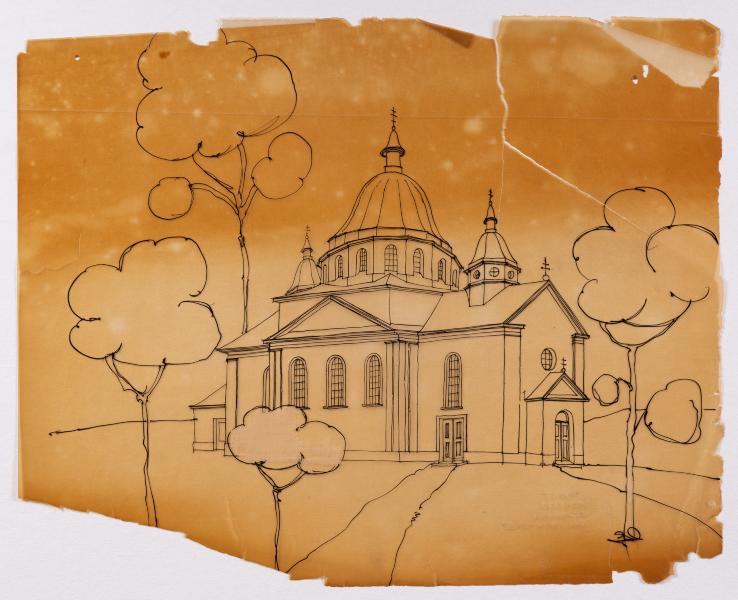
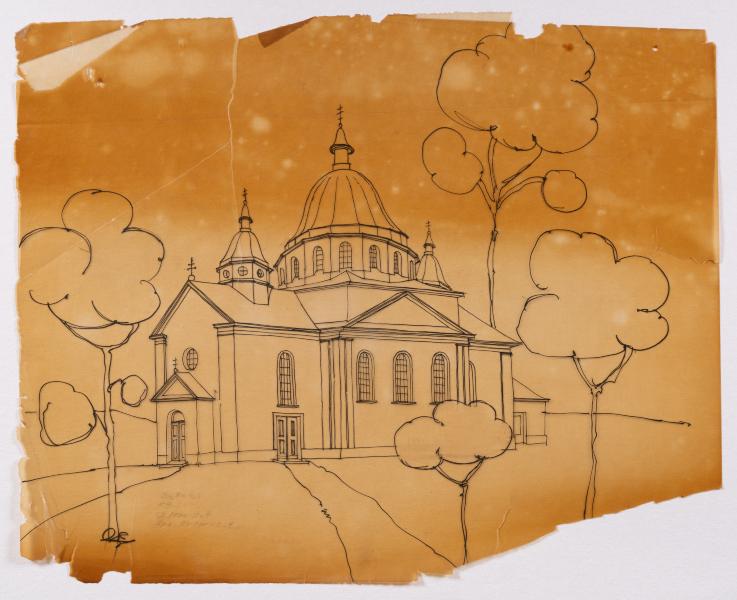
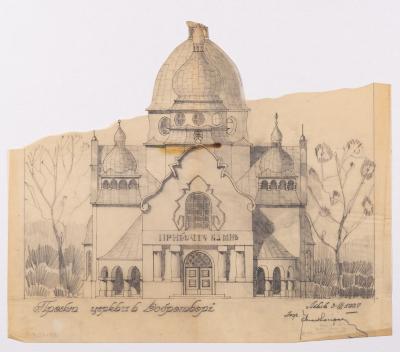
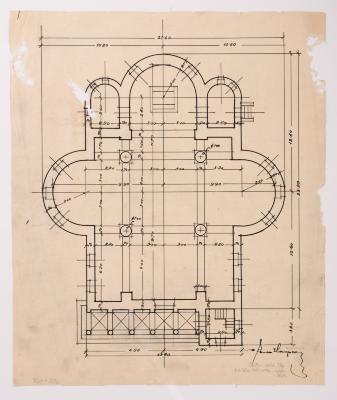
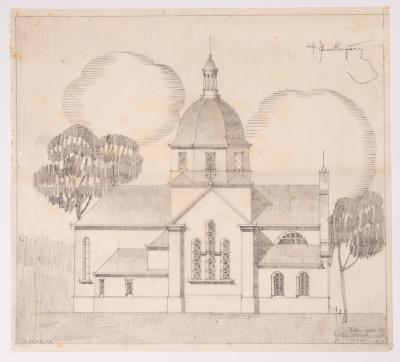
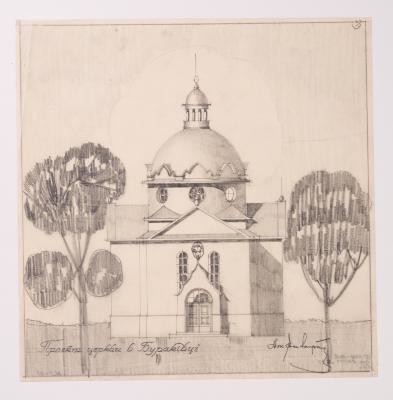
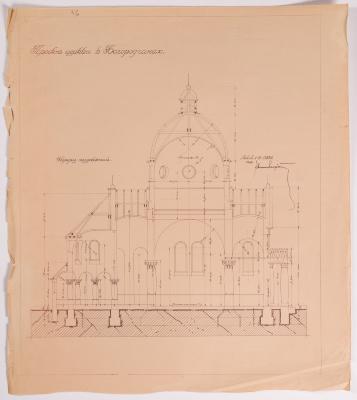
A drawing of a church and four trees.
Legal regulation
Borys Voznytskyi Lviv National Art Gallery