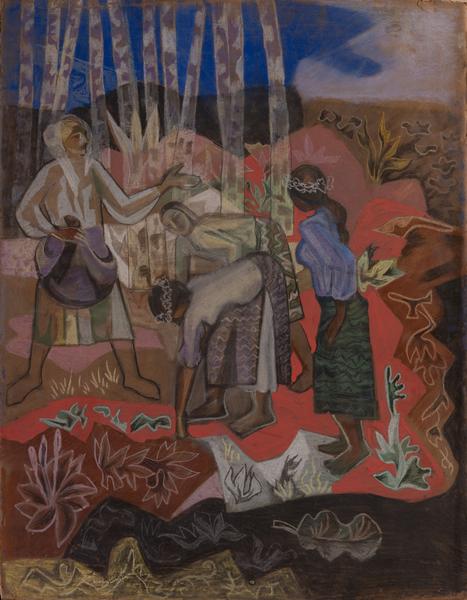
Sketch for the "Harvest Festival" Mural
Vasyl Poliovyi



Basic information
- ID
- Г-II-333
- Author
- Vasyl Poliovyi
- Name
- Sketch for the "Harvest Festival" Mural
- Date of creation
- 1970s (?)
- Country
- the USSR
- Culture
- Ukrainian art of the Soviet period
- Technique
- mixed technique
- Material
- cardboard pastel
- Dimensions (height x width, cm)
- 109.5 x 84
Additionally
- Type
- graphic art
- Genre
- symbolic art
- Provenance
- Handed over to the museum from Vasyl Poliovyi
Information about author
Object description
The artwork belongs to a series of thematic sketches executed in a mixed technique. The stylistic approach to composition combines characteristic modernist principles of interpreting individual elements and the overall imagery. The approach to form creation is decorative, and so are the colour combinations. The colour palette is diverse, with warm shades of earthy and ochre pigments predominating. There are individual splashes of ultramarine (the sky in the upper part) and whitened red (in the bottom). The viewer is presented with a scene where four women in traditional national attire (long linen shirts, zapaskas – rectangular aprons, and skirts) engage in an unspecified gathering activity in a forest area. It is difficult to visually determine what exactly they are gathering due to the stylisation. All the characters are depicted barefoot, indicating a warm season. There is a specific age gradation between the women: the woman on the far left is depicted wearing a headdress (namitka), which denotes marriage; the woman on the far right and one woman in the centre are wearing flower wreaths, which young girls wore. Two women in the centre are depicted bent over the ground, while the two figures flanking the composition stand at full length. Essentially, we are presented with a scene of dialogue with elements of morality (a characteristic hand gesture of the woman on the left). However, the approach to the stylisation of the trees against which the scene unfolds encourages a broader interpretation of this picture, as the "illusiveness" of the event's context may hint at its timelessness and the overall symbolism of what is happening here.
Legal regulation
Borys Voznytskyi Lviv National Art Gallery