Beach
Vasyl Poliovyi


Basic information
- ID
- Ж-7009
- Author
- Vasyl Poliovyi
- Name
- Beach
- Date of creation
- 1965
- Culture
- Ukrainian art of the Soviet period
- Technique
- original technique
- Material
- cardboard
- Dimensions (height x width, cm)
- 110 x 120
Additionally
- Type
- painting
- Genre
- symbolic art
- Provenance
- Handed over to the museum from Vasyl Poliovyi
Information about author
Object description
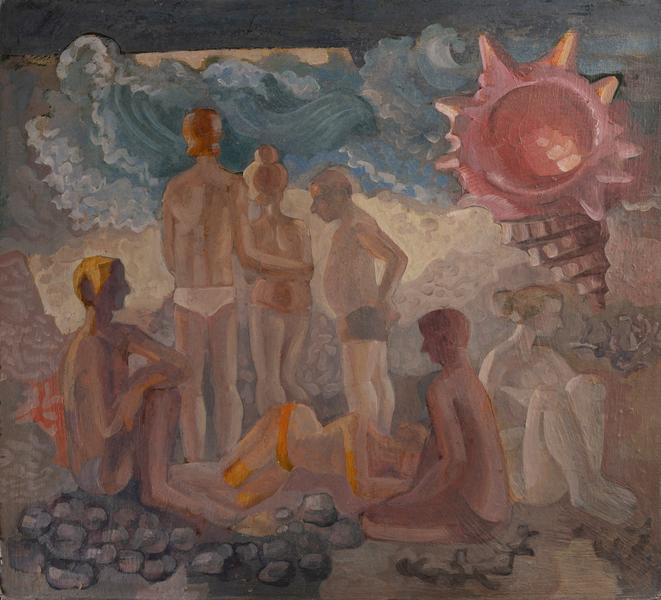
The artwork was created in the 1960s, one of the most productive periods of Vasyl Poliovyi's artistic career. During this time, he found a unique technique and narrative development approach. The piece combines everyday observations with symbolic, allegorical and partially surrealistic intonations in conveying its idea. The composition revolves around a group of people resting on a beach, presumably near a sea. In the foreground, on a somewhat rocky shore (likely Caucasian), two men are sitting. Next to them, one woman is lying on her side, while another is turned in three-quarters, with her head in profile. The man on the left has turned his head to the side, facing three standing people – a young man embracing a woman around her waist (they are facing the stylised sea waves, looking away from the viewer), and a middle-aged man standing at a distance. The distinctive approach to interpreting light on the figures and depicting the characters' positions creates an impression of artificiality; the distances between groups of people do not entirely correspond to the notions of acceptable social distances in public spaces of the 1960s. The design features of both male and female characters' swimwear, particularly the bikini, are not characteristic of the time. Combined with an absence of a clear horizon line and the depiction of space from two perspectives (normal and enormously exaggerated), a symbolic seashell form (possibly a murex) is notable. Located in the upper part of the artwork, it is many times larger than its actual size. This indicates that the artist is portraying a memory association evoked by the sound effect of holding a seashell to the ear, commonly referred to as the "sound of the sea". Due to the distance of events, the images fall into the category of vague and more associative rather than directly reflecting reality. This interpretation is facilitated by the soft and light colour scheme and the absence of vibrant colours typically found in a natural landscape under bright sunlight, which is partially present in the composition (the "sunlit patches" on the head of the man sitting on the left and the body of the woman sitting next to him).
Legal regulation
Borys Voznytskyi Lviv National Art Gallery