Still Life
Vasyl Poliovyi


Basic information
- ID
- Ж-7000
- Author
- Vasyl Poliovyi
- Name
- Still Life
- Country
- the USSR
- Culture
- Ukrainian art of the Soviet period
- Technique
- original technique
- Material
- fibreboard
- Dimensions (height x width, cm)
- 52.5 x 85.5
Additionally
- Type
- painting
- Genre
- still life
- Plot
- Allegory
- Provenance
- Handed over to the museum from Vasyl Poliovyi
Information about author
Object description
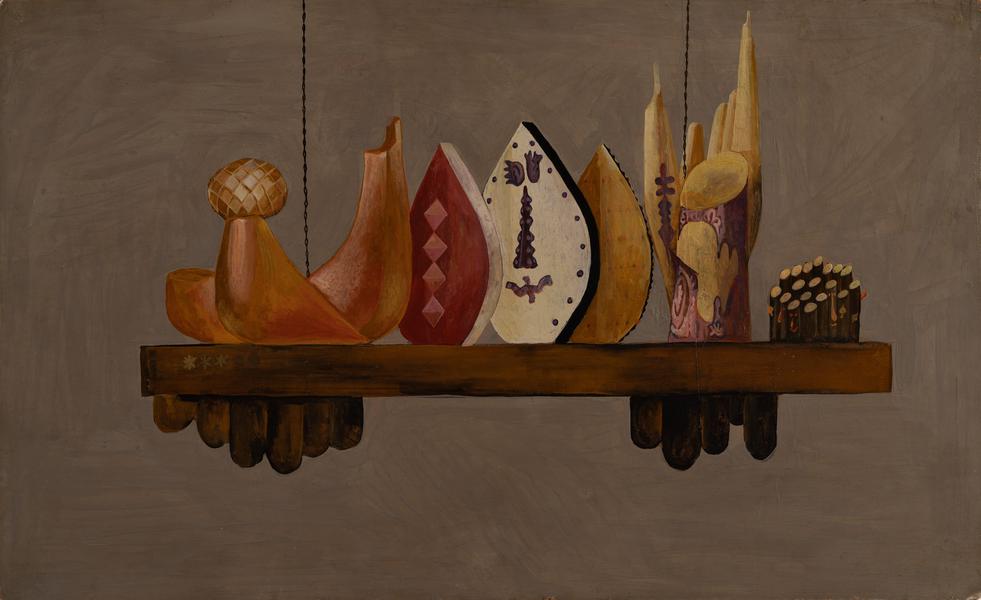
This still life work by Vasyl Poliovyi is significant in terms of how the author implemented the pursuit of artists who were engaged in the development of "metaphysical painting" in the 1960s-1970s. Since Vasyl Poliovyi interacted with those artists and had the opportunity to see their works during his time in Leningrad and Moscow, it is natural that specific ideas continued in his artistic practice. Later the artist Mykhailo Shemiakin, an acquaintance of Vasyl Poliovyi, would identify this concept as the "metaphysical synthetism", which refers to an attempt to grasp the underlying principles of harmony, equivalent to the notion of "seeing more and deeper". However, even more prominently in this artwork, we can see the results of creative and friendly communication with Dmytro Krasnopevtsev, a representative of the Moscow unofficial art. Like Mykhailo Shemiakin, Krasnopevtsev developed the idea of metaphysical painting closely aligned with the aesthetics of surrealism, with particular emphasis on the genre of still life. This work can be considered a dialogue with the "metaphysical still lifes" of Krasnopevtsev. Vasyl Poliovyi's irony is notable. Unlike the artist mentioned above, he does not create iconic forms partially devoid of substance. Instead, he arranges objects, sometimes challenging to identify, and imbues them with anthropomorphic qualities (as seen in the object on the shelf on the right side). The composition, developed by the author, directs the viewer to the distanced fixation of seven objects standing on a wooden hanging shelf, characteristic of the mentioned group of artists. The space is depicted as a bright achromatic environment without indications of the ceiling or walls. The shelf hangs on two thin dark chains resembling those used to secure weights on wall clocks. The interpretation of each object evokes associations with actual items. Still, at the same time, the combination of their visual characteristics does not allow us to determine what they are. This may allude to how a person perceives natural objects in dreams, particularly a clock. The central object has a white dial, a peculiar hand and an inconsistent number of markings that could indicate the time or simply serve as decoration. The colour scheme is subdued, with ochre and earthy shades predominating in depicting objects, and shades of light grey are brought together to outline space. The artwork is remarkable due to the specifics of the artistic process of that time and the author's original approach, where the intonations of seeking alternatives to both official and unofficial visual practices are vital.
Legal regulation
Borys Voznytskyi Lviv National Art Gallery