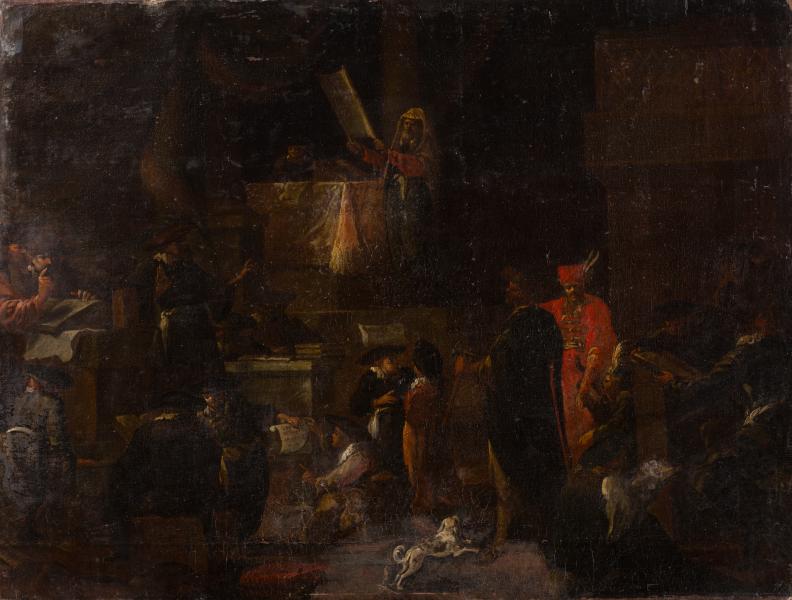
Disputation in the Synagogue
unknown


Basic information
- ID
- Ж-3426
- Author
- unknown
- Name
- Disputation in the Synagogue
- Date of creation
- 1st half of the 19th c.
- Technique
- oil painting
- Material
- canvas oil
- Dimensions (height x width, cm)
- 59 x 77
Additionally
- Type
- painting
- Genre
- history painting religious
- Provenance
- Lviv Historical Museum
Information about author
Object description
The work is a rectangular horizontal multi-figure composition. The depicted scene is a dimly lit interior of a religious building filled with people. In the centre, behind a tall pulpit, stands a rabbi holding a scroll. His gaze is directed at two men dressed in black and red attire, standing below to the right. A heated discussion is taking place among the people around, depicted with books at tables and pulpits. All of this conveys the tense atmosphere of the disputation. Even the small white dog, shown at the bottom of the canvas, seems to be participating in the argument. The artist portrays a real historical event, the subject of which is not common in painting and thus remains largely unknown to the wider public. According to art historian Y. Biriuliov (as detailed in the work "Jewish Painting in the Collection of the Lviv National Art Gallery", prepared for publication), the narrative of the painting is likely based on the historical event of the disputation in Lviv (1759) between orthodox rabbis and the followers of Jacob Frank (a successor of the ideas of Sabbatai Zevi) – the Frankists, who rejected the Talmud, recognized only the Kabbalistic book "Zohar", and preached a new form of messianism. After the Lviv disputation, which involved key figures such as the Vicar and High Canon Stefan Mikulski, the Chief Rabbi of Lviv Chaim HaKohen Rappaport, and the founder of Hasidism, Baal Shem Tov, many Frankists converted to Roman Catholicism. The painting depicts these men already in black Catholic attire (with "saturno" hats). In the centre of the composition, on an elevated platform, stands Chaim Rappaport holding the Torah high in his hands, while to the right are Canon S. Mikulski and Baal Shem Tov, who is wearing a shtreimel and holding a shepherd's axe (a Hutsul axe), which, according to legend, was gifted to him by Oleksa Dovbush.
Legal regulation
Borys Voznytskyi Lviv National Art Gallery