Untitled
Arnold Sharhorodskyi


Basic information
- ID
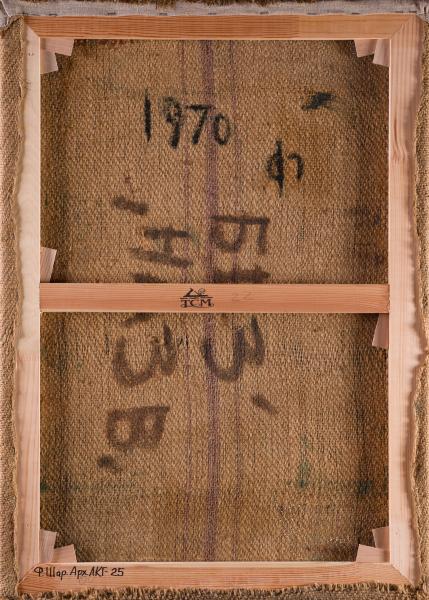
- Ф.Шар.Арх.ЛКГ-25
- Author
- Arnold Sharhorodskyi
- Name
- Untitled
- Date of creation
- 1970
- Country
- the USSR
- Culture
- Art of the Soviet period
- Technique
- mixed technique
- Material
- canvas oil
- Dimensions (height x width, cm)
- 84.5 x 60
Additionally
- Type
- painting
- Genre
- symbolic art
- Plot
- Abstract works
- Provenance
- Handed over to the museum from Arnold Sharhorodskyi
Information about author
Object description
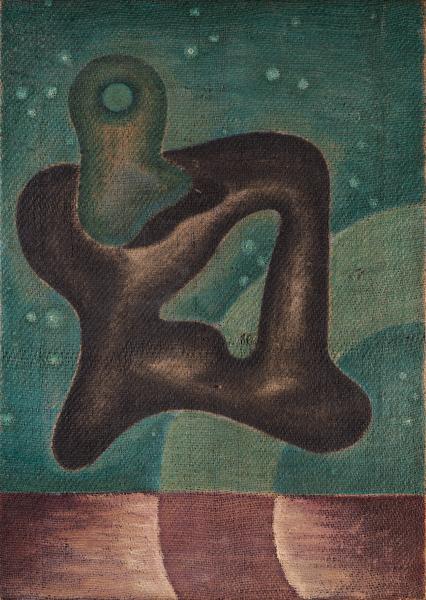
The work is one of the examples of how Arnold Sharhorodskyi worked with the understanding of modernist practices and the study of development in the two-dimensional plane of spatiality in his practice. The artist's approach is in line with Soviet modernists who worked with bionic motifs, such as Yevhen Ablin's monumental objects for public spaces (Relief Mosaic in the Zelenograd Shopping Centre, 1967). Undoubtedly, the practices of earlier artists, such as Hans Arp, were among the likely primary sources of the composition's solution. However, given the presence of objects related to Yevhen Ablin's work in public spaces in the USSR at the time, we can assume a double source of inspiration. As for the composition itself, the harmony of the tonal solution, in which the central biomorphic, probably anthropomorphic motif, is interpreted three-dimensionally, with light and shadow modelling. In contrast to the central object, the background is as flat as possible, rendered in a light, partly cold (greenish) and partly earthy colour scheme (the lower part is soil). In general, this approach to composition refers either to the Platonic-idealistic world of ideas or to the cosmic spatial context in which the transformation or development of living matter takes place. It is worth mentioning that a similar approach to experimenting with abstract imagery can be found in the work of an author of Ukrainian origin who worked in the United States during this period, namely Mykhailo Dzyndra. The latter shows that Arnold Sharhorodskyi's practice at that time was in line with the trends not only in the Soviet but also in the global unified cultural field.
Legal regulation
Borys Voznytskyi Lviv National Art Gallery