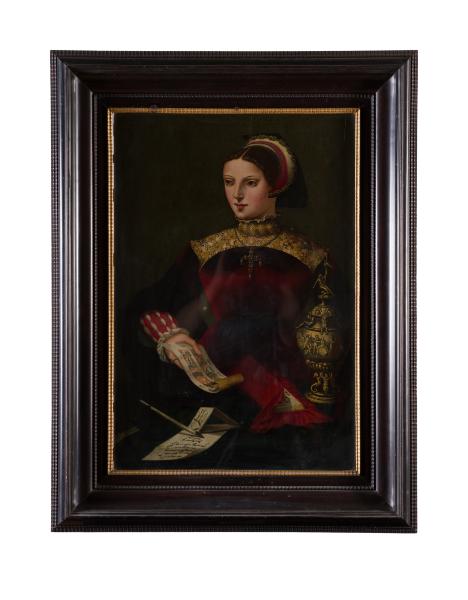
Portrait of a Young Woman With a Letter
"I.C."



Basic information
- ID
- Ж-508
- Author
- "I.C."
- Name
- Portrait of a Young Woman With a Letter
- Date of creation
- 16th c.
- Technique
- oil painting
- Material
- wood oil
- Dimensions (height x width, cm)
- 63.5 x 42.5
Additionally
- Type
- painting
- Genre
- portraiture
- Plot
- Portrait Mary Magdalene
- Provenance
- Collection of Lviv City Gallery
- Exposition
- Potocki Palace
Information about author
Object description
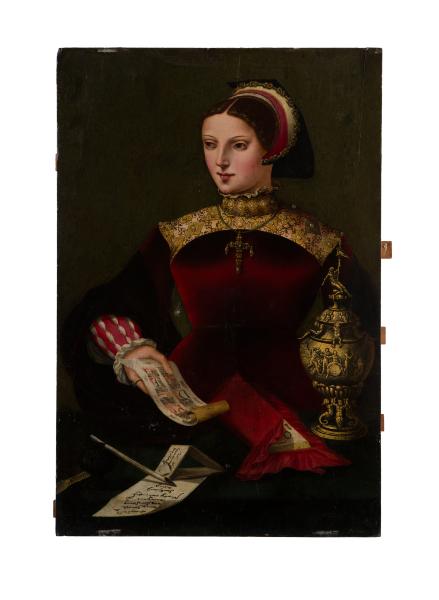
In the painting, against a green background, there is a bust-length portrait of a young woman in a ¾ turn to the left, holding a parchment in her right hand, dressed in a red gown. On the right is a golden vase. On the left is an inkwell with a quill. The iconographic theme of the work is Mary Magdalene writing an apocryphal gospel. The painting exhibits features of Mannerism. The artist can be classified among the so-called masters of female half-figures. This iconography was prevalent only in the Netherlands and Germany in the 16th and 17th centuries. The Bible reveals a few details about Mary Magdalene's life. Jesus freed her from "seven demons", which we understand to mean seven sins. She was also present at the cross and was the first to go to His tomb. All the earliest traditions about Mary Magdalene emphasise her role as a witness to the Resurrection of Jesus. According to Eastern Church legends, after the Resurrection of Jesus, Mary Magdalene, along with the other apostles, left Jerusalem to preach the Gospel throughout the world. She first travelled to Rome, was received by Emperor Tiberius, and preached across Italy. She then travelled to Ephesus and assisted John in writing the Gospel. In 2016, Pope Francis officially recognised Mary Magdalene as the "Apostle of the Apostles" ("Apostola Apostolorum"). This title was often used as far back as late antiquity.
Inscriptions
In the lower left is a signature – a monogram "I.C.".
Legal regulation
Borys Voznytskyi Lviv National Art Gallery