Drawing of a Man's Head
Yulian Zaiats


Basic information
- ID
- Ф-З-Арх-ЛГМ-5/32
- Author
- Yulian Zaiats
- Name
- Drawing of a Man's Head
- Date of creation
- 02.02.1919
- Country
- Austro-Hungarian Empire (?)
- Technique
- watercolour
- Material
- paper watercolour
- Dimensions (height x width, cm)
- 8 x 8.5
Additionally
- Type
- painting
- Genre
- portraiture
- Plot
- Portrait
- Provenance
- Received from Nina Zaiats
Information about author
Object description
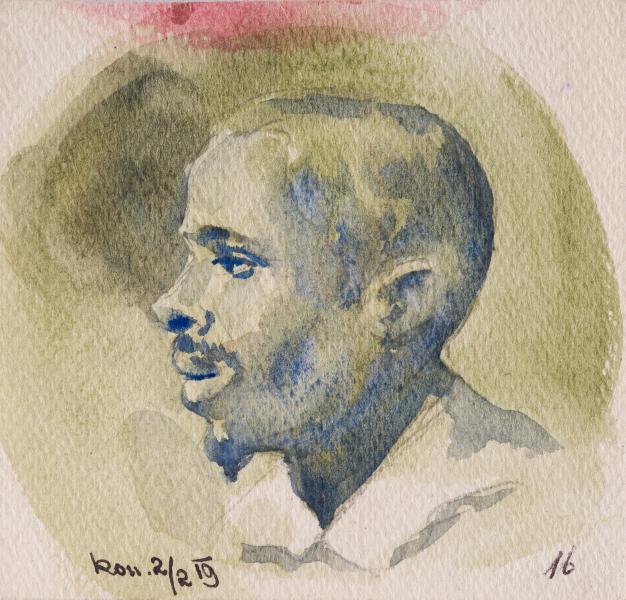
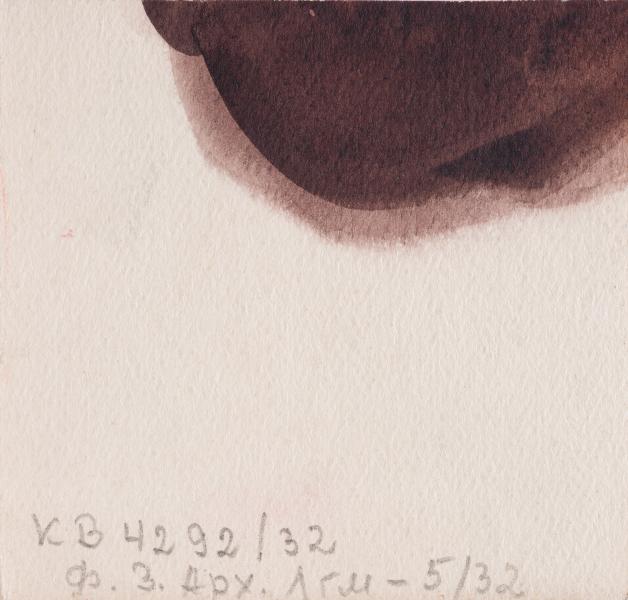
On the sheet, we see a small watercolour portrait of a young man, painted in profile with his head turned to the left. Only the upper part of the figure is depicted – the head and part of the shoulders – which creates a sense of intimacy and focus on the model's psychological state. The man's face is elongated, with a short beard and neat hairstyle, which gives the image a restrained expressiveness. The author focuses on the soft features of the face, delicately modelling them with transparent layers of watercolour paint. The colour scheme is based on a harmonious combination of greenish-yellow, blue, and almost greyish tones, which vary depending on the area of the image. This colour palette gives the image an inner balance and emotional restraint, while maintaining visual expressiveness. The interpretation of clothing deserves special attention: the light shirt with a collar is presented in a generalised way, without unnecessary detail, but with adherence to the main structural lines. This allows the viewer's attention to remain focused on the main accent, namely the face and the general silhouette of the head in profile. The technique is characterised by precision and moderation: the author does not overload the surface of the sheet, but instead works in the spirit of tonal painting, where semi-transparent layers lie freely, preserving the texture of the paper. Linear modelling is almost absent; the entire shape is created using colour and light-shadow transitions, which corresponds to the tradition of watercolour portraiture, where not only similarity but also the overall impression is important. On the reverse side of the sheet, there are remains of another watercolour work, which is fragmentary in nature and cannot be accurately identified. This could likely have been a trial exercise or part of an unfinished composition. Such layering is typical of student and studio sheets from the early 20th century, when paper was often reused on both sides and the work itself was a field for experimentation with technique or texture. This small watercolour work is an example of an attempt at studio portraiture, focusing on mastering the means of laconic yet subtle artistic expression. The choice of a profile angle, restrained colour scheme, and economical painterly gesture indicates academic discipline based on classical principles of composition, attention to proportion, colour harmony, and unity of light and shadow.
Inscriptions
Inscription: "Kon"; "2/2 19".
Legal regulation
Borys Voznytskyi Lviv National Art Gallery