Drawings of Genre Scenes
Yulian Zaiats


Basic information
- ID
- Ф-З-Арх-ЛГМ-7/9
- Author
- Yulian Zaiats
- Name
- Drawings of Genre Scenes
- Date of creation
- 12.05.1962–09.06.1962
- Country
- the Ukrainian SSR
- Technique
- drawing
- Material
- paper pencil Indian ink
- Dimensions (height x width, cm)
- 20.4 x 28.5
Additionally
- Type
- graphic art
- Genre
- symbolic art
- Provenance
- Received from Nina Zaiats
Information about author
Object description
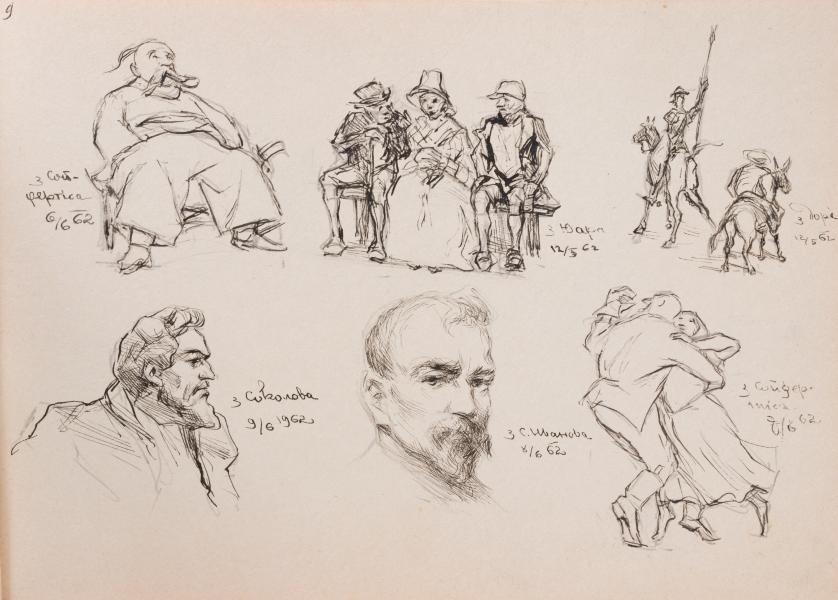
One sheet contains a series of genre and portrait sketches executed in ink and pencil, which are copies or interpretations of samples from the works of various 19th–and 20th–century artists. All compositions are accompanied by the author's signature, indicating the source and the exact date of execution (May–June 1962), which provides grounds to interpret this sheet as evidence of the artist's systematic copying and stylistic-analytical practice during the period of his mature, independent formation of his visual language. From Leonid Soifertis (June 6, 1962): depicts a caricatured Cossack sitting in a somewhat grotesque but distinctly plastic pose. The work is notable for its linear expression, characteristic of L. Soifertis, the wit of the image, and the generalised interpretation of form. The author emphasises the pose and gesture, conveying the character's personality with a slight caricature-like deformation. From Huart (May 12, 1962): a genre scene with three figures – two men sitting on a bench next to a woman in a hat. The composition is restrained, typical of French graphics from the late 19th to the early 20th centuries. The author reproduces not only the figurative structure, but also the atmosphere of an intimate interpersonal dialogue, where visual gestures fix characteristic social roles. From Gustave Doré (May 12, 1962): images of Don Quixote and Sancho Panza are presented – two figures in characteristic motion. The emotional contrast between the elongated, schematically heroised figure of the knight and the down-to-earth, dense posture of the squire is preserved. There is a noticeable attention to the rhythm of the line and the dynamics of the composition, which refers to the illustrative tradition. From Sokolov (9 June 1962): a full-length portrait of a bearded man in profile, with a lush hairstyle. The work emphasises the aesthetics of volume, especially in the area of the hair and beard. Soft hatching and thoughtful lighting testify to a careful study of facial plasticity and silhouette expressiveness. From Serhii Ivanov (8 June 1962): a three-quarter portrait of a man with a goatee. Here, the author employs a classic portrait composition, featuring a slightly turned face. There is a noticeable attempt to convey the psychological state of the model through the expression of the eyes, while maintaining academic accuracy of form. From Soifertis (8 June 1962): a scene of a couple dancing – a man and a woman in motion. Characterised by lightness and grace, this composition approaches theatrical plasticity. The author clearly conveys rhythm, gesture, and the interaction of bodies, emphasising the dynamics with linear refinement. All six groups of images demonstrate both a copying and an interpretative approach: the author not only carefully reproduces the main features of the sources but also undertakes a visual analysis of the manner and style of the selected artists. The thematic diversity – from satirical illustrations to academic portraits – testifies to the multifaceted nature of the artist's interests. The sheet can be viewed as a form of educational and methodological work by a mature author who uses reproductions or originals as a source of stylistic exercises for the development of his own imaginative thinking.
Inscriptions
In the centre, under the images, there are inscriptions: "From Soifertis"; "6/6 62"; "From Huart"; "12/5 62"; "From Doré"; "12/5 62"; "From Sokolov"; "9/6 1962"; "From S. Ivanov"; "8/6 62"; "From Soifertis"; "8/6 62".
Legal regulation
Borys Voznytskyi Lviv National Art Gallery