Drawings of Men's Heads
Yulian Zaiats


Basic information
- ID
- Ф-З-Арх-ЛГМ-8/2
- Author
- Yulian Zaiats
- Name
- Drawings of Men's Heads
- Date of creation
- 18.11.1962–19.11.1962
- Country
- the Ukrainian SSR
- Technique
- drawing
- Material
- paper pencil
- Dimensions (height x width, cm)
- 20.3 x 28.6
Additionally
- Type
- graphic art
- Genre
- portraiture
- Plot
- Portrait
- Provenance
- Received from Nina Zaiats
Information about author
Object description
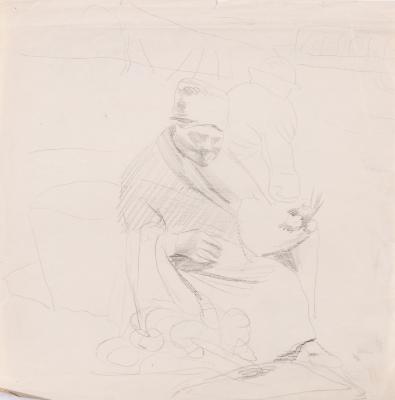
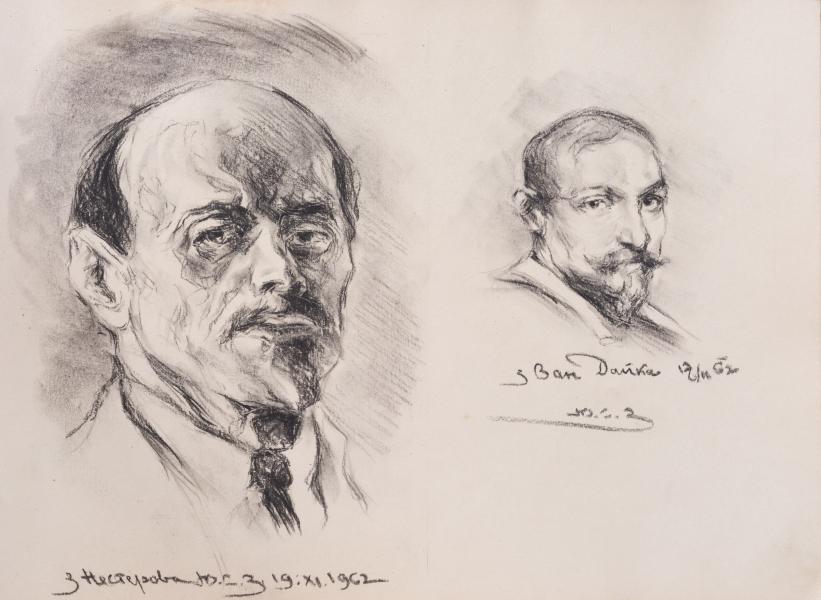
The drawing copy of Mykhailo Nesterov's self-portrait, made by Yulian Zaiats in 1962, is a deeply reflective work in which the artist turns to a complex, psychologically rich model. The image of a mature Nesterov, focused and closed in his own inner world, is presented with great restraint and respect for the original. His gaze is sad, yet slightly detached; his facial features are calm and focused. Zaiats reproduces not only the external resemblance, but also the psycho-emotional mood of the portrait, which speaks of spiritual depth, asceticism, and quiet dignity. Restrained pencil strokes form the face without decorativeness; everything is aimed at achieving the inner balance of the image. Therefore, this drawing is not just an exercise in copying, but a form of silent dialogue between the artist and an ideologically aligned author, a symbolic self-affirmation of Yulian Zaiats as an artist for whom creation is a means of searching for meaning, form, and truth. To the right of Nesterov's self-portrait in this same composition, Zaiats placed another portrait drawing of a man with short hair and a beard, based on a work by Anthony van Dyck. The portrait is also shoulder-length, three-quarter view, with the gaze directed straight at the viewer. The image is more dynamic and lively, yet no less focused. Unlike the asceticism of M. Nesterov's figure, this figure has a more secular, emotionally open character, although it is not devoid of inner depth. Placed side by side, the two images create an aesthetically and semantically balanced composition, serving as a counterpoint to two different yet equally valid ways of being present in the world through portraiture. Overall, this work by Y. Zaiats is evidence of his deep interest in interpreting the classical heritage, as well as his personal artistic search for what could be called a "quiet portrait of conscience", in which form always serves essence.
Inscriptions
In the centre, beneath the images: "From Nesterov"; Yulian Zaiats' signature; "19/XI 1962"; "From Van Dyck (?)"; "18/11 1962"; Yulian Zaiats' signature.
Portrayed person
- The name of the person portrayed
- Mykhailo Nesterov
- Lifetime of the person portrayed
- 19(31).05.1862–18.10.1942
Legal regulation
Borys Voznytskyi Lviv National Art Gallery