Two Drawings
Yulian Zaiats



Basic information
- ID
- Ф-З-Арх-ЛГМ-8/11
- Author
- Yulian Zaiats
- Name
- Two Drawings
- Date of creation
- 17.12.1962–21.12.1962
- Country
- the Ukrainian SSR
- Technique
- drawing
- Material
- paper pencil
- Dimensions (height x width, cm)
- 20.3 x 28.6
Additionally
- Type
- graphic art
- Genre
- portraiture
- Plot
- Portrait
- Provenance
- Received from Nina Zaiats
Information about author
Object description
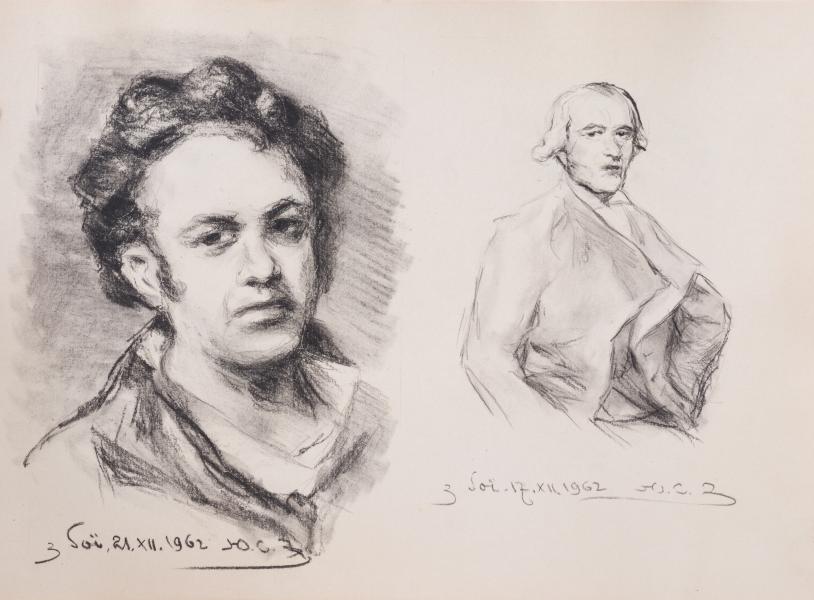
Two drawings by Yulian Zaiats, based on works by Francisco Goya, are a self-portrait of the artist at the age of 69 and a portrait of Francisco Bayeu y Subías (1795). Both works exemplify Y. Zaiats' attentive and investigative approach to interpreting classical models of painting, in which he strives not only to preserve the compositional and plastic features of the originals but also to recreate the psychological depth of the images. The perspective of both images is three-quarter, with a distinct chiaroscuro and clear modelling of form. The self-portrait of Francisco Goya (1815), created in his later years, embodies the image of an artist who has navigated life's trials and tribulations, retaining his sharp mind and inner strength. His gaze, directed at the viewer, combines attentiveness and weary concentration, revealing experience and a hint of melancholy. The headdress and dark clothing frame the white shirt, contrasting with the open face and emphasising its expressiveness. In his copy, Y. Zaiats preserved the tonal drama of the original, carefully recreating the chiaroscuro model and Goya's characteristic softness of transitions, while emphasising the psychological insightfulness of the image. The portrait of Francisco Bayeu y Subías, a colleague and relative of F. Goya, has a different emotional nature. Here, there is a palpable warmth and a certain intimacy characteristic of friendly portraits. Bayeu is depicted in a double-page spread, but his focused gaze is directed at the viewer. Light-coloured clothing creates a balanced tonal range. In Zaiats' copy, special attention is paid to the clarity of the contours, which emphasises the balanced character of the subject. It is clear that the artist worked not only as a copyist but also as a researcher, carefully analysing Goya's manner, which was probably part of his creative search.
Inscriptions
In the centre, beneath the images: "From Goya"; "21.XII 1962"; Yulian Zaiats' signature; "From Goya"; "17.XII 1962"; Yulian Zaiats' signature.
Portrayed person
- The name of the person portrayed
- Francisco Jose de Goya (30.03.1746–16.04.1828), Francisco Bayeu y Subias (09.03.1734–04.08.1795)
Legal regulation
Borys Voznytskyi Lviv National Art Gallery