Back

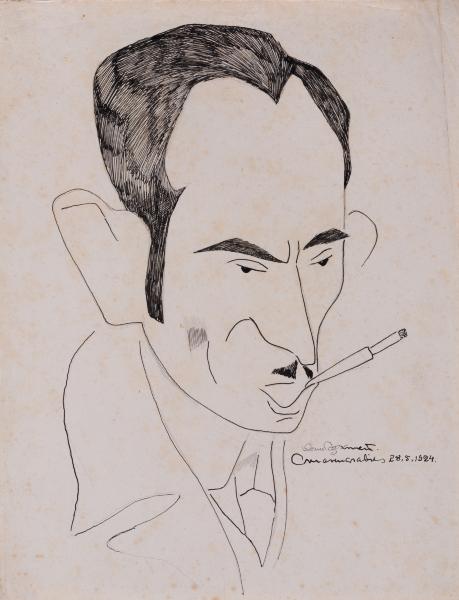
Caricature of an Unknown Person

Osyp Sorokhtei

  • Caricature of an Unknown Person 2
  • Caricature of an Unknown Person 3
Basic information
ID
Г-V-2090
Author
Osyp Sorokhtei
Name
Caricature of an Unknown Person
Date of creation
1924
Technique
drawing
Material
paper pen Indian ink
Dimensions (height x width, cm)
29 x 22.7
Additionally
Information about author
Author
Osyp Sorokhtei
Artist's lifetime
1890–1941
Country
Ukraine
Biography
Roman-Osyp Sorokhtei (28.02.1890, Baranivtsi (Baranchychi) village, Sambir district, Lviv region – 28.11.1941, Stanislaviv, now Ivano-Frankivsk) was a renowned Ukrainian artist, graphic artist, caricaturist, and teacher. From 1987 to 1905, he studied at a boys' boarding school in Stanislaviv, then ran away from school and worked for an al fresco painter. Between 1906 and 1910, he attended the Stanislaviv Teachers' Seminary. Later, he studied at the Department of Graphics at the Kraków Academy of Arts in the class of Professor Józef Pankiewicz (1911–1914). During the First World War, he was mobilised to the Austrian army and served at the Press Apartment "Striletska Kadra" of the Legion of Ukrainian Sich Riflemen. In 1918–1920, he resumed his studies at the Kraków Academy under the tutelage of Professors Wojciech Weiss and Stanisław Dębicki. He passed the exam to become a certified drawing teacher in schools. In 1920, the artist returned to Stanislaviv, where he taught drawing at the Ukrainian Gymnasium (1921–1926). During this period, he collaborated with the ГУДМ (Group of Ukrainian Art Activists) and participated in exhibitions. In 1926, following the publication of a caricature of the gymnasium principal in the magazine ZYZ, Osyp Sorokhtei was transferred to the position of a teacher at the Sniatyn gymnasium. In Sniatyn, he met his future wife, Mariia Karpiuk, a student of Oleksa Novakivskyi's school, whom he married in 1928. The artist worked here until 1929, then returned to Stanislaviv, where he taught drawing at the state Ukrainian gymnasium until 1940. In 1931, the artist was an exhibitor at the II International Exhibition of Woodcuts in Warsaw (1931). During 1934–1937, he participated in the exhibitions of the Association of Independent Ukrainian Artists in Lviv, АНУМ (Association of Independent Ukrainian Artists): VI (1934–1935); VII (1935–1936); VIII (1936–1937). In 1940–1941, he participated in the First Exhibition of Fine Arts of the Stanislaviv region. The main body of Osyp Sorokhtei's work consists of drawings that are characterised by strict, almost Gothic lines. Often, the interval between the creation of a work was only one day. The artist's caricatures are extremely accurate and sharply satirical, which corresponds to the artist's character. For the first time, the artist turned to this type of art during his service in the ranks of the Ukrainian Sich Riflemen: during this period, caricatures of the riflemen and the sergeant major appeared, which were presented at the exhibition of Riflemen's memorabilia in 1934–1935 in Lviv. The illustrations of the book A. Toto-Doloto (Antin Lototskyi's) book "Life and Adventures of Tsiapko Skoropad" (1926) was created during this period. The artist also created graphic, grotesque, and expressive portraits of Taras Shevchenko, Ivan Kotliarevskyi, Ivan Franko, Yevhen Hrebinka, Modest Mencynskyi, Mark Cheremshyna, Solomiia Krushelnytska, and Stanislav Liudkevych. Osyp Sorokhtei first turned to works on biblical themes in the 1920s, but one of his earliest sketches dates back to 1919. During this period, a miniature cycle devoted to parables and biblical stories from the New and Old Testaments appeared. Already in the early 1930s, the artist created the cycle "The Way of the Cross", portraying the Passion of Christ. And in 1935, Osyp Sorokhtei created the painting "Descent from the Cross" for the Cathedral of the Holy Resurrection in Ivano-Frankivsk. In a series of paintings on biblical themes, including "The Way of the Cross", the artist's inner feelings are most evident. In some Gospel scenes, we see characters from the streets of Stanislaviv who appear from the artist's everyday scenes, empathise, share the suffering of Christ, or join in his scourging. The artist develops this theme in two conceptual planes: black on white and white on black. In the first version, Osyp Sorokhtei uses black paper and white pastels. These scenes can be read as a kind of prayer-reflection, because the emotions of the characters are rather restrained, especially Christ, who accepts all trials with humility. In the Way of the Cross "on white" we observe an emphasised emotionality, the artist especially emphasises the extremely strong torment of Christ, expressive grimaces of pain. Subsequently, he created a large series of drawings on everyday subjects, depicting everyday urban characters who are constantly immersed in work, routine affairs, and their own experiences and reflections. According to the artist himself, he was primarily interested in everyday life because "nowadays there is more national character in everyday life, because people live primarily in it". Outlining the artist's stylistic explorations of the 1930s, it is worth mentioning his artistic notes, among which the notes on "Expressionism" and "New Objectivity" are worthy of special attention. It is with the style of the "new materiality" and the works of its individual representatives, in particular Otto Dix and Emil Nolde, that we can draw a parallel in the artistic search of Osyp Sorokhtei at that time. In the artist's work, colour most often appears in watercolour landscapes and everyday scenes. Oil painting is represented by portraits, still lifes, and the monumental work "Descent from the Cross", a repetition of the watercolour work of the same name in 1931. It was this work that became the best embodiment of the artist's artistic search between medieval drama, fiery Spanish Baroque, "New Objectivity", and the artist's own worldview. In total, Osyp Sorokhtei's oeuvre includes more than a thousand works. Most of them are kept in the collections of the Borys Voznytskyi Lviv National Art Gallery, the Art Museum of Prykarpattia, as well as in the Andrei Sheptytskyi National Museum in Lviv and private collections.
Object description
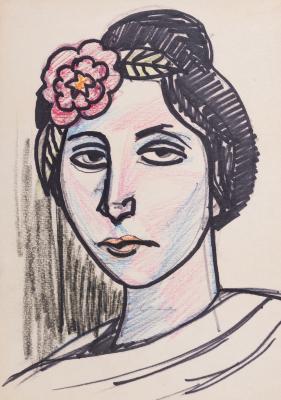
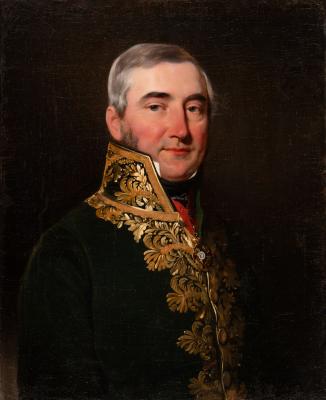
A grotesque portrait of a man's head with a cigarette in his teeth. The artist emphasises the stern face, sharp nose, high forehead, and large ears of the subject.
Inscriptions
Under the man's face, on the right, is the author's signature: "Osyp Sorokhtei / Stanislaviv / 28.5.1924".
Legal regulation
Borys Voznytskyi Lviv National Art Gallery