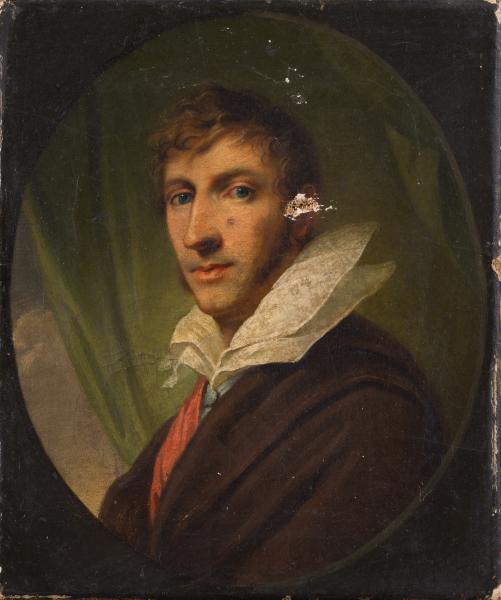
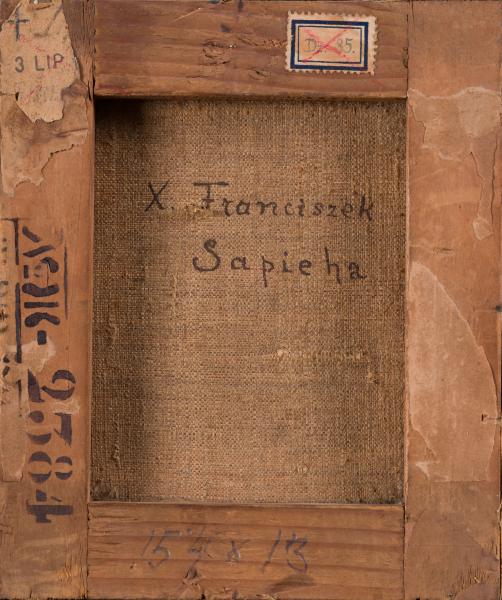
Portrait of Franciszek Sapieha
unknown


Basic information
- ID
- Ж-2384
- Author
- unknown
- Name
- Portrait of Franciszek Sapieha
- Country
- Polish-Lithuanian Commonwealth
- Culture
- Modern times
- Technique
- oil painting
- Material
- canvas oil
- Dimensions (height x width, cm)
- 15.4 x 13
Additionally
- Type
- painting
- Genre
- portraiture
- Plot
- Portrait
- Provenance
- the Dzieduszycki collection
Information about author
Object description
Franciszek Stefan Sapieha (August 28, 1772 – May 20, 1829) was a statesman of the Polish–Lithuanian Commonwealth, general of the Lithuanian artillery (1793–1795), and representative of the Lithuanian magnate family Sapieha. He was the younger son of Lithuanian Field Hetman and Grand Chancellor of Lithuania Aleksander Michał Sapieha (1730–1793) from his marriage to Magdalena Agnieszka Lubomirska (1739–1780). From 1782, he was raised on the Pulawy estate near Warsaw, the primary residence of the Czartoryski princes, together with his brothers Konstanty Adam (1773–1860) and Adam Jerzy Czartoryski (1770–1861). He later studied at Vilnius University. In 1792, he joined the Targowica Confederation in the Grand Duchy of Lithuania and became its advisor. In 1793, he was promoted to general of the Lithuanian artillery and headed the engineering and artillery corps. In the same year, he was awarded the Order of the White Eagle and the Order of St. Stanislaus. In 1793, he married Pelagia Roza Potocka (1775–1846), daughter of Count Stanisław Szczęsny Potocki (1751–1805). He had two children: a son, Eustachy Kajetan Sapieha (1797–1860), who participated in the November Uprising of 1830–1831 and became a prominent figure in Polish political emigration, and a daughter, Aniela Sapieha (1801–1855), married name Zamoyska. In 1794, he took an active part in preparing the uprising led by Tadeusz Kościuszko. He was promoted to lieutenant general and became commander of a separate division. He later withdrew from politics and military affairs, travelled throughout Europe, and often visited Vilnius. He led a luxurious lifestyle and was constantly in debt. He was one of the most significant landowners in Lithuania and Belarus. He maintained theatres on his estates in Ružany and Dzyarechyn. He died on May 30, 1829, in Franciszek Stefan Sapieha (August 28, 1772–May 20, 1829) was a statesman of the Polish–Lithuanian Commonwealth, general of the Lithuanian artillery (1793–1795), and representative of the Lithuanian magnate family Sapieha. He was the younger son of Lithuanian Field Hetman and Grand Chancellor of Lithuania Aleksander Michał Sapieha (1730–1793) from his marriage to Magdalena Agnieszka Lubomirska (1739–1780). From 1782, he was raised on the Pulawy estate near Warsaw, the primary residence of the Czartoryski princes, together with his brothers Konstanty Adam (1773–1860) and Adam Jerzy Czartoryski (1770–1861). He later studied at Vilnius University. In 1792, he joined the Targowica Confederation in the Grand Duchy of Lithuania and became its advisor. In 1793, he was promoted to the rank of general of the Lithuanian artillery and headed the engineering and artillery corps. In the same year, he was awarded the Order of the White Eagle and the Order of St. Stanislaus. In 1793, he married Pelagia Roza Potocka (1775–1846), daughter of Count Stanisław Szczęsny Potocki (1751–1805). He had two children: a son, Eustachy Kajetan Sapieha (1797–1860), who participated in the November Uprising of 1830–1831 and became a prominent figure in Polish political emigration, and a daughter, Aniela Sapieha (1801–1855), married name Zamoyska. In 1794, he took an active part in preparing the uprising led by Tadeusz Kościuszko. He was promoted to lieutenant general and became commander of a separate division. He later withdrew from politics and military affairs, travelled throughout Europe, and often visited Vilnius. He led a luxurious lifestyle and was constantly in debt. He was one of the most significant landowners in Lithuania and Belarus. He maintained theatres on his estates in Ružany and Dzyarechyn. He died on May 30, 1829, in Dzyarechyn.
Portrayed person
- The name of the person portrayed
- Franciszek Sapieha
- Lifetime of the person portrayed
- 28.08.1772–20.05.1829
Legal regulation
Borys Voznytskyi Lviv National Art Gallery