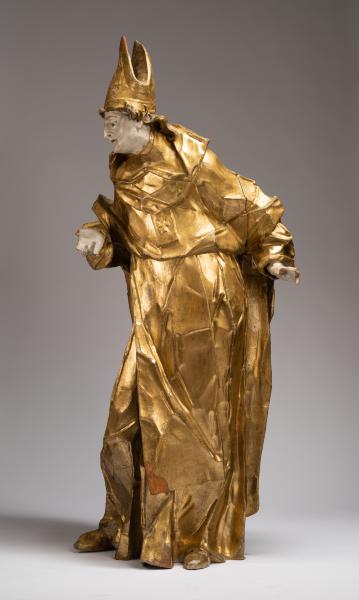
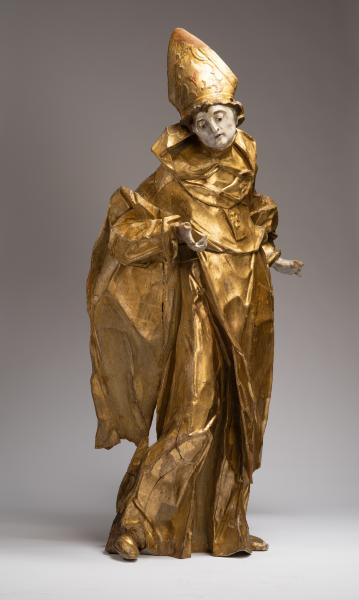
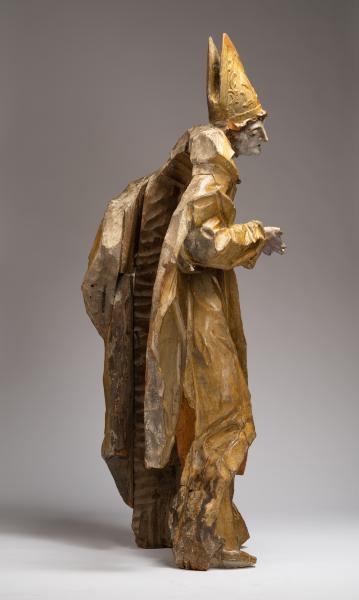
Figure of a Bishop
Antoni Osinski


Basic information
- ID
- С-I-1589
- Author
- Antoni Osinski
- Name
- Figure of a Bishop
- Date of creation
- 1750–1760s
- Country
- Ukraine
- Technique
- carving polychromy
- Material
- wood gilt
- Dimensions (height x width x depth, cm)
- 165 x 77 x 56
Additionally
- Type
- sculpture
- Genre
- religious
- Provenance
- Susidovychi village, Staryi Sambir district, Lviv region, St. Anne Cathedral
Information about author
Object description
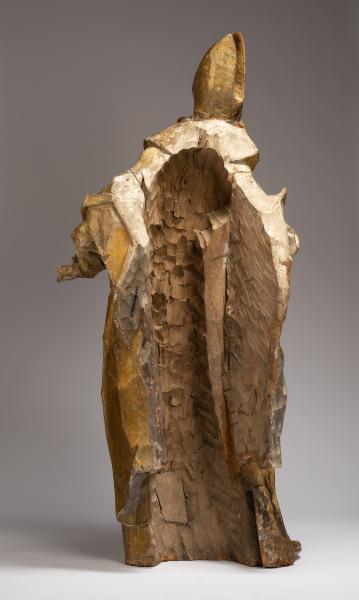
The figure of the bishop is polychrome. It is represented in an S-shaped silhouette and a theatrical pose. The man is depicted with a mitre on his head, from under which one can see his hair falling in waves on his shoulders. The figure is performed in the Baroque-Rocaille style. The most important for the sculptor was not to reliably reproduce the anatomical similarity but to convey the form, mood, and emotions. The bishop seemed to freeze, leaning to the right. The author focused on a face with a small sharp chin, protruding cheekbones with sunken cheeks, a straight, well-defined nose, and small, thin lips. The author modelled the face, accurately reproducing the facial expressions of the bishop. Dynamic folds of clothing add expression to the image. Draperies form a kind of abstract, curved at different angles planes, which are not always bound to the figure and do not repeat its movements. Antoni Osinski's works are characterised by a tendency to stylise poses and clothes, slight asymmetry, and not always correct anatomical performance of the human body.
Legal regulation
Borys Voznytskyi Lviv National Art Gallery