Sketch for a Mural
Vasyl Poliovyi




Basic information
- ID
- Ж-8196
- Author
- Vasyl Poliovyi
- Name
- Sketch for a Mural
- Date of creation
- 1970s (?)
- Culture
- Ukrainian art of the Soviet period
- Technique
- original technique
- Material
- fibreboard mixed media
- Dimensions (height x width, cm)
- 14.5 x 100
Additionally
- Type
- painting
- Genre
- symbolic art
- Plot
- Allegory
- Provenance
- Handed over to the museum from Vasyl Poliovyi
Information about author
Object description
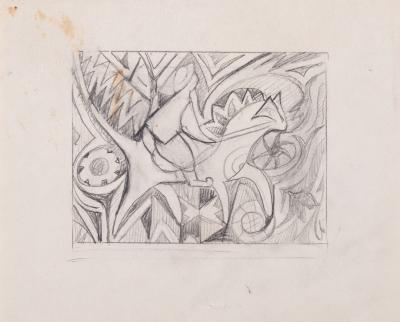
The sketch is likely part of a series of murals for a recreational complex. As in most of Vasyl Poliovyi's works, a series of thematically and visually related motifs are placed on a generalised and stylised background, seamlessly transitioning from one to another. The approach to decorative interpretation prevails here, resulting in most biomorphic forms being more elusive than recognisable (as was the case, for example, in Yevhenii Ablin's mosaics on Zelenograd's Yunost Square in 1969–1970). However, the fish in the lower left corner and the highly stylised ammonite (or nautilus) in the right part of the composition direct the viewer's imagination to perceive the entire space of images as the bottom of the sea, where one can see unimaginable shapes and creatures. Recognising specific features is not as crucial here. Whether they are sea anemones, gorgonians or some marine invertebrates unknown to science, the artist's goal is to create a unique environment where the extraordinary becomes real. The choice of colours, the harmonisation of tones and the horizontal structure of the composition as a contemplative environment align with the functional purpose of the building. The character of the artist's visual language corresponds to the trends of Soviet monumental and decorative art of the early 1970s.
Legal regulation
Borys Voznytskyi Lviv National Art Gallery