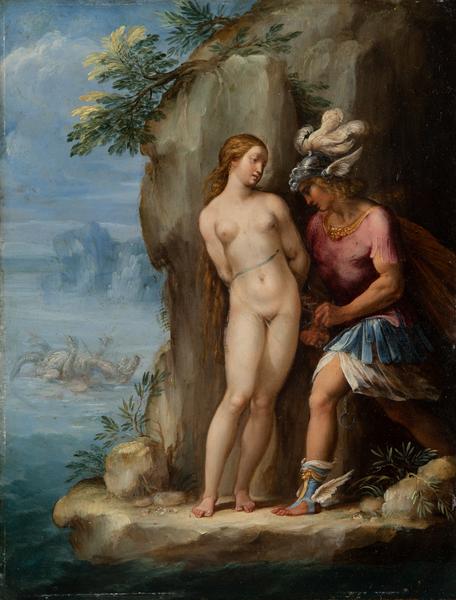
Perseus and Andromeda
Giuseppe Cesari


Basic information
- ID
- Ж-787
- Author
- Giuseppe Cesari
- Name
- Perseus and Andromeda
- Date of creation
- late 16th – early 17th c.
- Technique
- oil painting
- Material
- copper oil
- Dimensions (height x width, cm)
- 35 x 26.5
Additionally
- Type
- painting
- Genre
- mythological painting
- Plot
- Perseus and Andromeda
- Provenance
- Collection of Wladyslaw Lozinski in Lviv
- Exposition
- Potocki Palace
Information about author
Object description
The feat of liberating Andromeda glorified the hero of ancient Greek mythology. After defeating Medusa Gorgon, Perseus got on the horse Pegasus, born from the dead Medusa's body, and flew over the sea. Approaching the shore, he saw the charming Andromeda, the daughter of the Aethiopian king Cepheus, chained to a rock. A dragon was approaching her from the depths of the sea. The monster was sent to Aethiopia by Poseidon to take revenge on Queen Cassiopeia, who boasted that she was more beautiful than all the Nereids. Andromeda was sacrificed to atone for her mother's guilt. Impressed by the girl's beauty, Perseus killed the dragon and freed Andromeda. This plot was reproduced in several versions between 1593 and 1612. In most works, Perseus was depicted flying on Pegasus with a sword in his hand, ready to fight the dragon. Only in the Lviv painting is he represented alongside Andromeda after slaying the monster. The Gallery's work can be dated to ca. 1610, given the stylistic comparison. However, it is difficult to determine the degree of participation of Giuseppe Cesari himself in the painting process because, in addition to other representatives of the workshop, who imitated the artist's manner, his brother Bernardino Cesari worked with him.
Legal regulation
Borys Voznytskyi Lviv National Art Gallery