Portrait
Arnold Sharhorodskyi


Basic information
- ID
- Ф.Шар.Арх.ЛКГ-6
- Author
- Arnold Sharhorodskyi
- Name
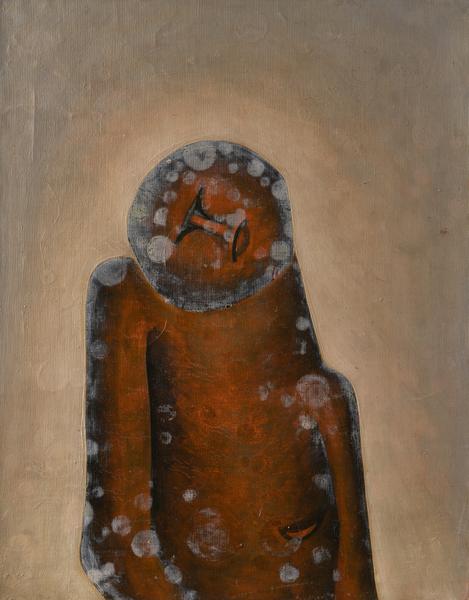
- Portrait
- Date of creation
- 1974
- Country
- the USSR
- Culture
- Art of the Soviet period
- Technique
- oil painting
- Material
- canvas oil
- Dimensions (height x width, cm)
- 69 x 54
Additionally
- Type
- painting
- Genre
- abstract painting
- Plot
- Abstract works
- Provenance
- Handed over to the museum from Arnold Sharhorodskyi
Information about author
Object description
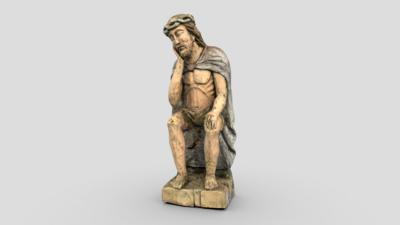
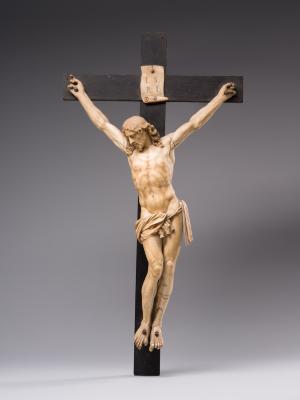
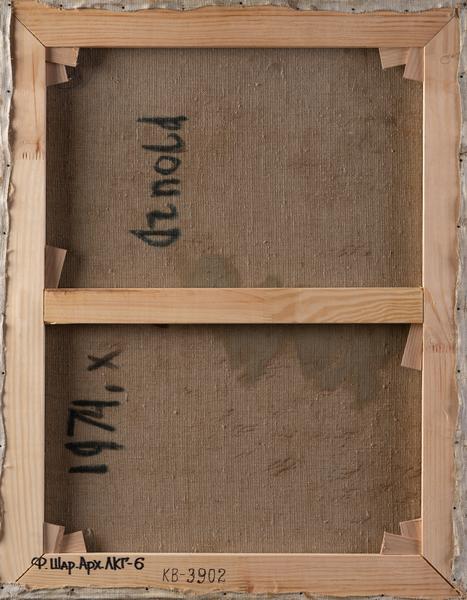
The painting is the work's first version, which the author recreated in the 1980s in the United States. Thanks to the video (early 1990s) by Emma Kuzminska – the wife of the poet, artist, and performer Kostiantyn Kuzminskyi (1940–2015) – it was possible to establish that the slightly modified artwork was kept in the artist's New York studio and, despite the horizontal signature on the back, is vertical. In the centre, slightly shifted downwards, there is a male half-figure with his head leaning on the right shoulder (eyes shut, mouth closed, no hair). The shoulders are positioned at different levels, and the arms are along the body, tightly pressed to the torso. A pocket-like incision is at the lower rib pair's level. Such a composition, considering the tilted head and the incision, can be interpreted as an allusion to Catholic wooden sculptural depictions of Christ's body after crucifixion, which the artist could see in Lviv museums and churches (in his interview with Vasyl Ahafonov on June 3, 1988, Arnold Sharrad mentioned visits to such cultural buildings). In this work, the stylisation of the body is associated with the perception of archaic fine art. This is emphasised by natural cadmium-ochre and earthy shades. The background is rendered in a light grey palette with added ochre hues. The lighting characteristic does not imply a defined source; instead, there is an impression of a mandorla-like "radiance" surrounding the body along its entire contour. The shadows on the face align with iconographic practices (although the image has certain portrait features of the author himself). Unlike its second version, the painting preserved in the Gallery contains spherical transparent whitish spots.
Legal regulation
Borys Voznytskyi Lviv National Art Gallery