Judgement of Paris
unknown


Basic information
- ID
- Ж-2328
- Author
- unknown
- Name
- Judgement of Paris
- Technique
- oil painting
- Material
- wood oil
- Dimensions (height x width, cm)
- 27.7 x 21
Additionally
- Type
- painting
- Genre
- mythological painting
- Plot
- Judgement of Paris
- Provenance
- Collection of Lviv City Gallery
- Exposition
- Potocki Palace
Information about author
Object description
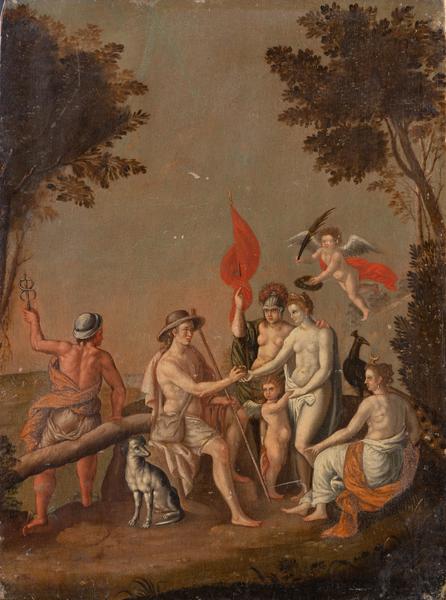
The composition is based on an ancient Greek myth of the Trojan Cycle. According to the legend, Zeus instructed Prince Paris to judge three goddesses – Hera, Athena, and Aphrodite – arguing over who should own the apple inscribed with the words "to the fairest one". This scene was popular in the works of many European artists. A group of partially nude figures is depicted against a landscape with trees. In the centre, seated on a fallen tree trunk, is a young Paris turned to the right, wearing a hat and a bag over his shoulder. In his left hand, Paris holds a shepherd's staff, while with his right hand, he presents the apple to Aphrodite. She takes the hand of Cupid, who accompanies her. To the left of Aphrodite is Athena, wearing a feathered helmet and holding a red flag in her right hand. To the right of Aphrodite sits Hera, with a golden crescent moon on her hair, draped in a white and yellow veil below her waist. Behind her, in the distant background, stands a peacock, her symbol. A putto (winged child) is flying in the air above the goddesses, holding a palm branch in his right hand and a wreath above Aphrodite's head in his left hand. To the left of Paris sits a dog, and Hermes sits on the left, on a tree trunk. It was he who brought the three goddesses to the prince for judgement. Facing away from the viewer, Hermes raises his left hand upward with the caduceus (a staff entwined with snakes). The painting's colouring is cool and muted, predominating olive, grey, green, white, yellow, and red tones.
Legal regulation
Borys Voznytskyi Lviv National Art Gallery