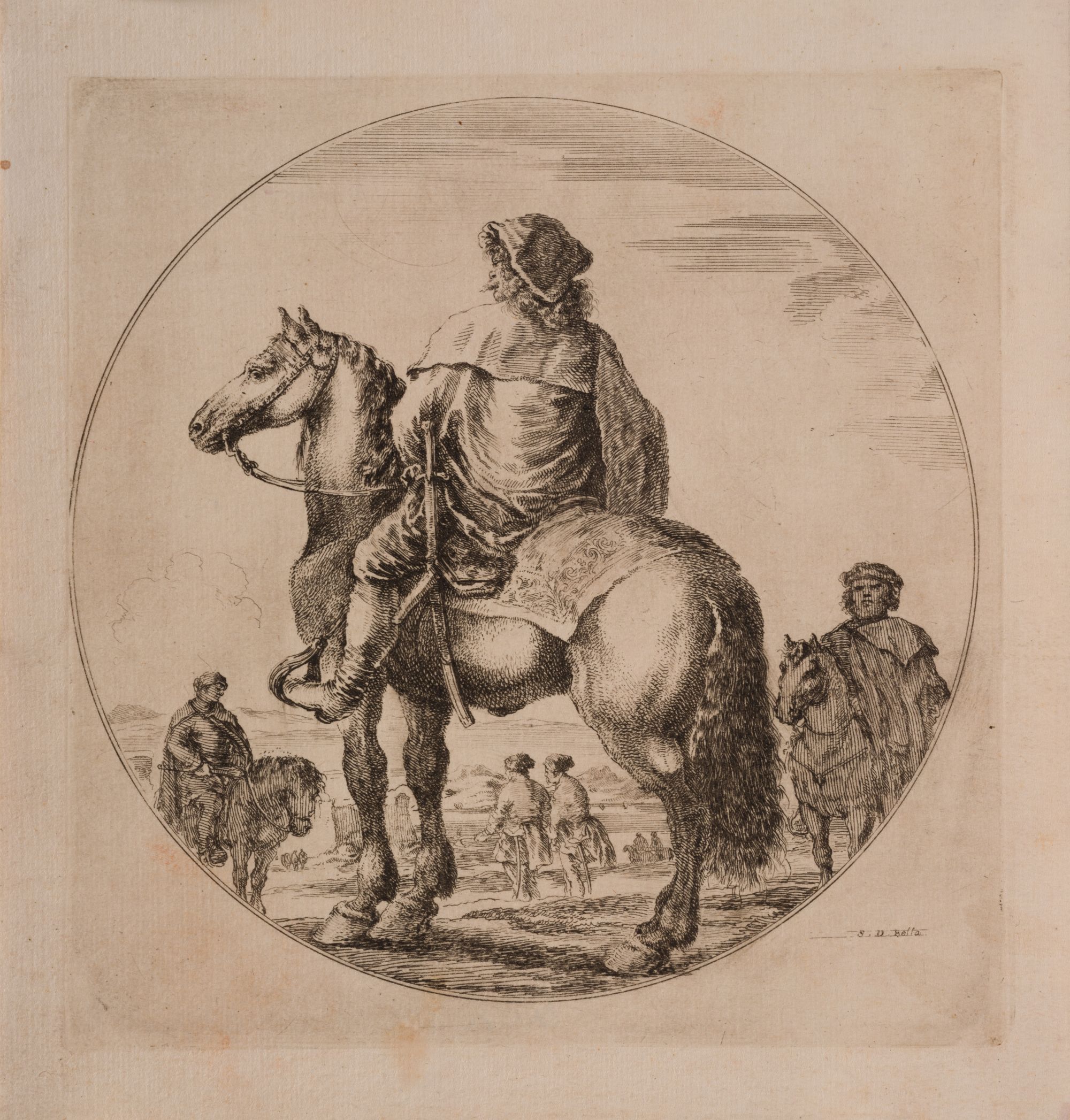
Hungarian Cavalier. From the "Moorish, Polish, and Hungarian Riders" Series
Stefano della Bella
Basic information
- ID
- Г-IV-2945
- Author
- Stefano della Bella
- Name
- Hungarian Cavalier. From the "Moorish, Polish, and Hungarian Riders" Series
- Date of creation
- 1648–1651
- Country
- France
- Technique
- etching
- Material
- paper
- Dimensions
- 19 x 18 cm (height x width)
Additionally
- Type
- graphic art
- Genre
- battle painting
Information about author
Object description
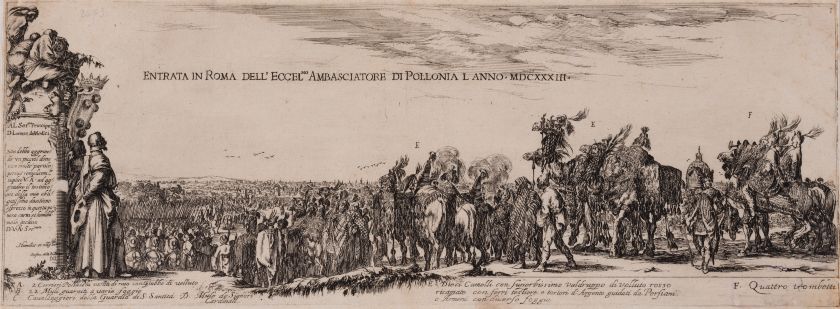
The artist's interest in depicting exotic warriors arose as early as 1633, when he witnessed and recorded the magnificent procession of the Polish ambassador. Later, while in France, the master recreated these cavalrymen across eleven tondi of a military series. These prints are highly valued by historians for their extraordinary precision in rendering the details of military attire, harness, equine anatomy, and weaponry – including karabela sabres, bows, and shields.
The work has the form of a tondo inscribed into a rectangular sheet. In the foreground, with his back to the viewer and turned slightly to the left, sits a rider in a traditional 17th-century Hungarian costume and a fur cap. A grey moustache is visible on the rider's face. His powerful horse is turned to the left and depicted in profile. In the background, a deserted flat landscape with a mountain range in the distance is outlined with fine lines. In the middle ground and background, the figures of other riders and foot soldiers are visible, creating a sense of depth of space.
The artwork is characterised by its virtuosic fine lines, excellent knowledge of animal anatomy, and masterful rendering of textures. The fur, the fabric of the caparison, and the horse's mane are rendered using complex cross-hatching.
The print is analogous to the artwork under No. Г-IV-977.
Inscriptions
On the bottom right of the sheet, the artist's signature is engraved: "S. D. Bella.".
Legal regulation
Borys Voznytskyi Lviv National Art Gallery