Sleeping Bacchus
unknown (School of Anton Raphael Mengs)


Basic information
- ID
- Ж-1089
- Author
- unknown (School of Anton Raphael Mengs)
- Name
- Sleeping Bacchus
- Technique
- oil painting
- Material
- canvas oil
- Dimensions (height x width, cm)
- 58.5 x 42.5
Additionally
- Type
- painting
- Genre
- mythological painting
- Exposition
- Potocki Palace
Information about author
Object description
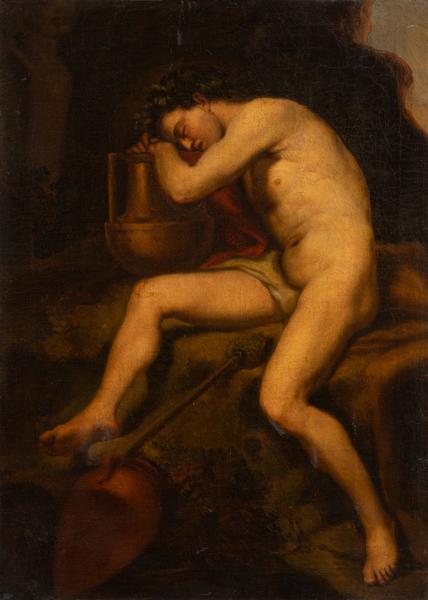
Against a dimly lit rocky backdrop, a nude young man with curly hair adorned with leaves is depicted. He sits on a stone, turned in profile to the left, his head and hands resting on a golden amphora. The artist skillfully emphasises his athletic body with warm, light colours against the overall dark background of the canvas. At the bottom, under his right foot, lies an overturned Greek terracotta amphora and a thyrsus. Bacchus, also known as Dionysus or Bromios, was one of the most popular gods in Ancient Greece. He was the god of vegetation and fertility and the patron of viticulture and winemaking. Bacchus is also one of the most widespread themes in ancient art. He was depicted in two main ways: either dressed in opulent drapery resembling Eastern royal attire, portrayed as a majestic figure with long hair and a thick beard (Indian Dionysus), or as a handsome nude youth with soft, almost feminine features, wearing a wreath of grape leaves on his head. In numerous statues, reliefs, and paintings, Dionysus is presented as a young, beautiful figure with exquisitely delicate features, wearing a wreath of ivy or grape leaves, holding a thyrsus in his hands, and carrying a bunch of grapes or a wine glass. He is usually portrayed resting in the shade of grapevines or riding a chariot pulled by lions or tigers. Typically, he is accompanied by a panther, leopard, or tiger. Many artists have turned to the myths of Dionysus, particularly Maarten van Heemskerck, Titian, Giulio Romano, Annibale Carracci, Peter Paul Rubens, and Nicolas Poussin.
Legal regulation
Borys Voznytskyi Lviv National Art Gallery