Bonze Beggar
Pu-Qua, Dadley
Basic information
- ID
- Г-IV-5531/9
- Author
- Pu-Qua Dadley
- Name
- Bonze Beggar
- Date of creation
- late 17th – early 18th c.
- Country
- China Italy
- Culture
- Far East
- Technique
- etching watercolour embossing
- Material
- Indian ink paper
- Dimensions
- 29.3 x 24.4 cm (height x width)
Additionally
- Type
- album sheet
- Genre
- genre art
- Provenance
- Purchased from a private individual
- Exposition
- Zolochiv Castle (Chinese Palace)
Information about author
Information about author
Object description
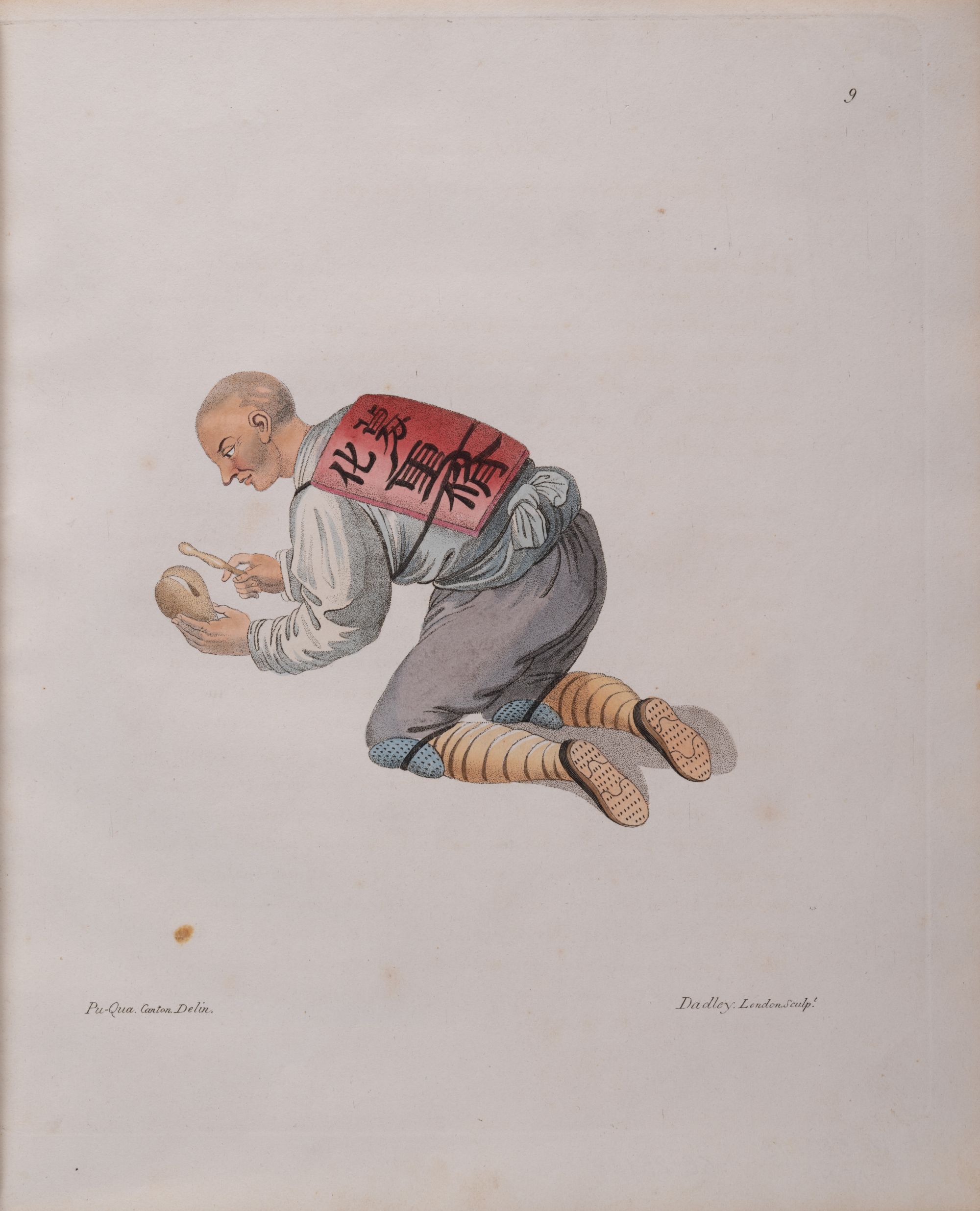
A bonze, the abbot of a Buddhist temple, is depicted in profile, on his knees with a turn to the left. His head is shaved. He is wearing a long-sleeved shirt with its hem tied at the back and short pants getting narrow to the knees. He is wearing woollen knee pads on his knees. A red board with straps is tied to the man's back. On the board are four hieroglyphs written in black paint – the name of the monastery he belongs to. The man is holding a pear-shaped wooden vessel with a lengthwise opening in his left hand. He strikes the vessel with a wooden stick, attracting the attention of passers-by. The etching comes from the album "Chinese Customs and National Costumes", which includes 60 images of Chinese people engaged in various activities. An explanation in German accompanies each image; some are written in French. In the eighteenth century, artists in Canton (Guangzhou) in southern China created such paintings for Europeans seeking to learn more about China and its people.
Inscriptions
In the lower left corner is a calligraphic inscription in Indian ink, "Pu-Qua. Canton. Delin.". In the lower right corner is an inscription, "Dadley. London. Sculpt". In the upper right corner is the number "9".
Legal regulation
Borys Voznytskyi Lviv National Art Gallery