"The Passion of Christ" Iconostasis: Christ Before Caiaphas, The Crowning with Thorns
unknown


Basic information
- ID
- Ж-4129
- Author
- unknown
- Name
- "The Passion of Christ" Iconostasis: Christ Before Caiaphas, The Crowning with Thorns
- Date of creation
- early 18th c.
- Country
- Ukraine
- Culture
- Rybotytska School
- Technique
- tempera painting
- Material
- wood tempera
- Dimensions (height x width, cm)
- 116 x 81
Additionally
- Type
- icon
- Genre
- religious
- Plot
- The Passion of Christ
- Provenance
- Semenivka village, Lviv region
Information about author
Object description
The Passion of Christ is an iconostasis of the 17th – early 18th century consisting of a series of monumental multi-plot icons that should be viewed from top to bottom, in rows from left to right. The work's composition is distinguished by a large number of iconographic images with multi-figure scenes: 25 horizontally elongated Gospel scenes that tell us about the last days of Christ's earthly life. This theme became especially popular in monumental art in the seventeenth and eighteenth centuries. The composition was placed on the southern or northern wall of the temple. Scenes were grouped around the main image, the Crucifixion, which was usually larger. The images depicting the Saviour's torment were often separated from each other and placed sequentially on the monumental plane.
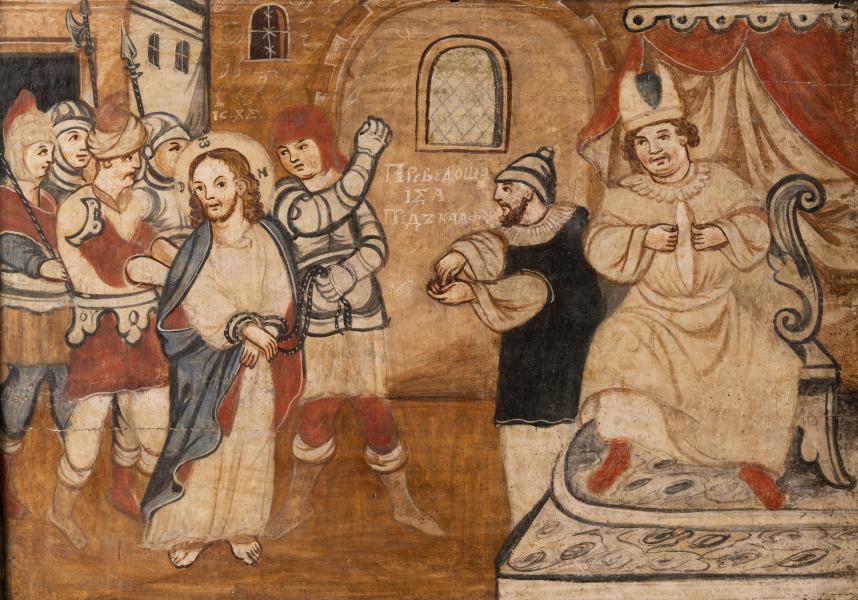
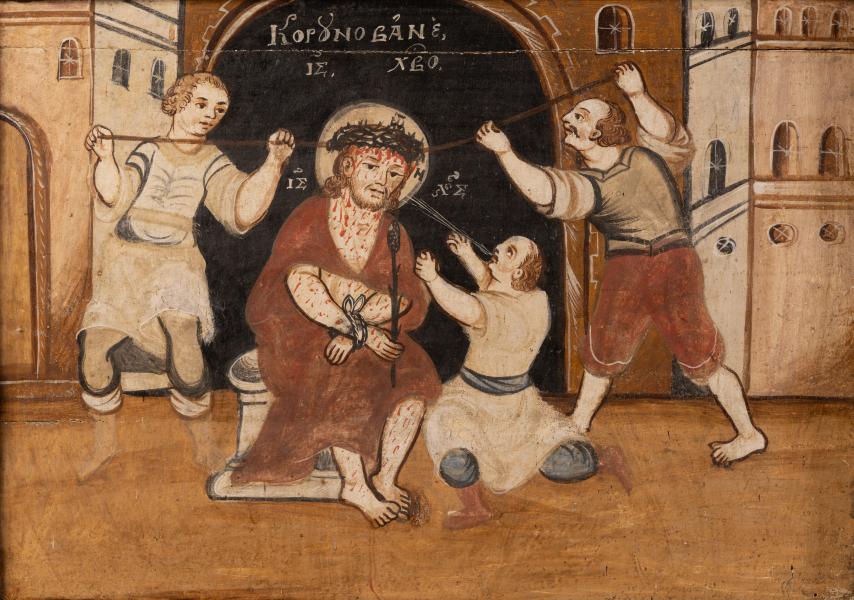
This work is a part of the multi-figure composition of the "Passion of Christ": two horizontally elongated images with the "Christ before Caiaphas" and "Crowning with Thorns" scenes. One of the scenes depicts the interior of a palace room, where Christ meets with the high priest Caiaphas, who sits on a throne with a canopy. The work depicts how he tore his clothes in anger and one of his servants took a swing at Christ – attention to detail is what characterises the works of the Rybotytska School. A planar interpretation of the form distinguishes the work. The graphic line that outlines the figures does not stand alone but is introduced with a great sense of proportion. The use of three colours in interpreting the faces of saints was characteristic of the Rybotytska School painters. The carnation of the faces was marked with white; the lines of the nose, eyebrows, and eyes with expressive pupils were outlined with black; red was applied to the cheeks and lips. The "Crowning with Thorns" scene demonstrates the event mentioned in the Gospel of Mark: Roman soldiers, having dressed the Saviour in purple and woven a crown of thorns, mocked Him. In the centre of the composition is the exhausted yet calm and noble figure of Christ, whose body is covered with abundant drops of blood. The scene attracts attention with its simplicity, immediacy, and expressiveness.
This work is a part of the multi-figure composition of the "Passion of Christ": two horizontally elongated images with the "Christ before Caiaphas" and "Crowning with Thorns" scenes. One of the scenes depicts the interior of a palace room, where Christ meets with the high priest Caiaphas, who sits on a throne with a canopy. The work depicts how he tore his clothes in anger and one of his servants took a swing at Christ – attention to detail is what characterises the works of the Rybotytska School. A planar interpretation of the form distinguishes the work. The graphic line that outlines the figures does not stand alone but is introduced with a great sense of proportion. The use of three colours in interpreting the faces of saints was characteristic of the Rybotytska School painters. The carnation of the faces was marked with white; the lines of the nose, eyebrows, and eyes with expressive pupils were outlined with black; red was applied to the cheeks and lips. The "Crowning with Thorns" scene demonstrates the event mentioned in the Gospel of Mark: Roman soldiers, having dressed the Saviour in purple and woven a crown of thorns, mocked Him. In the centre of the composition is the exhausted yet calm and noble figure of Christ, whose body is covered with abundant drops of blood. The scene attracts attention with its simplicity, immediacy, and expressiveness.
Legal regulation
Borys Voznytskyi Lviv National Art Gallery