Bust of a Knight

Marceli Harasimowicz
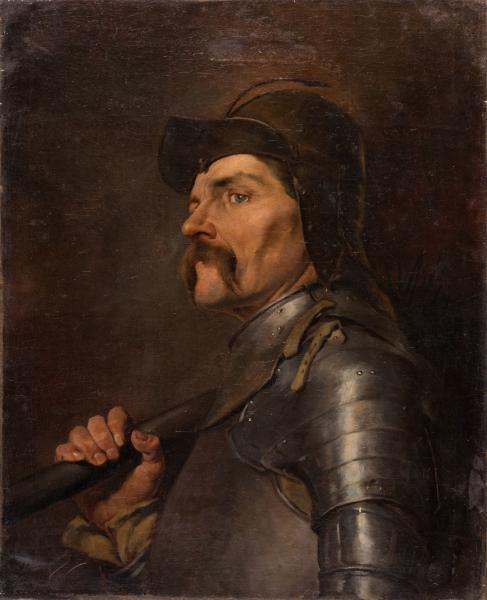
  • Bust of a Knight 2
  • Bust of a Knight 3
Basic information
ID
Ж-2539
Author
Marceli Harasimowicz
Name
Bust of a Knight
Date of creation
1880
Country
Austro-Hungarian Empire
Technique
oil painting
Material
canvas oil
Dimensions (height x width, cm)
68 x 55
Additionally
Type
painting
Genre
portraiture
Plot
Portrait
Provenance
Unknown origin
Information about author
Author
Marceli Harasimowicz
Artist's lifetime
1859–1935
Country
russian empire,
Biography
Marceli Harasimowicz (January 16, 1859, Warsaw – May 22, 1935, Lviv) was a Polish painter and educator. He was the brother of the sculptor Piotr-Witalis Harasimowicz. In 1873, he graduated from the Higher Real School in Krakow. From 1873 to 1879, he studied at the Krakow School of Fine Arts, and from 1880 to 1885, he attended the Vienna Academy of Fine Arts (in the studio of Carl Wurzinger) and the Munich Academy of Fine Arts (in the studio of Wilhelm Lindenschmit the Younger). After obtaining his artistic education, he settled in Lviv, where he worked under the guidance of Andrzej Grabowski. In 1888, he opened his own women's art school (which became a general school of painting and sculpture in 1891). In 1891, M. Harasimowicz became a scholarship holder of the Society of Friends of Fine Arts in Lviv. In 1907, he became the first chief curator of the Lviv City Gallery (now Borys Voznytskyi Lviv National Art Gallery) and co-author of the first catalogue of the gallery's Polish painting collections. He held this position until 1931. The artist regularly participated in exhibitions organised by the Society of Friends of Fine Arts in Lviv (TPSP) and Krakow. He presented his works at exhibitions of the Society for the Encouragement of Fine Arts in Warsaw (TZSP), as well as in Munich and Vienna. He was the author of landscapes, portraits, and genre scenes on Ukrainian themes created in a realistic style. He illustrated Lviv's periodicals and books. He also worked on the decorative painting of the City Theatre (now the Maria Zankovetska Lviv Academic Theatre of Opera and Ballet) in Lviv. He was involved in the restoration of paintings. Additionally, he was a member of the Literary and Artistic Club and the Association of Polish Artists in Lviv.
Object description
Nearly the entire height of the vertical rectangular composition is taken up by a bust of a middle-aged man with a long moustache dressed in knightly armour. The man is turned in profile to the left. With his right hand, he holds a spear resting on his shoulder. The knight's face radiates seriousness, focus, and readiness for battle. Calmly and confidently, he gazes into the distance. The background is neutral, in a dark olive colour. The painting is done in a realistic style and is characterised by the artist's attention to historical details and attributes. The helmet on the man's head, known as a "Lobster-tailed pot helmet" (pappenheimer), is a type of open helmet, specifically a zischägge, which was particularly popular among Polish cavalry units in the late 17th to the first half of the 18th century. It was named after the Field Marshal of the Holy Roman Empire, Gottfried Pappenheim (1594–1632). Marceli Harasimowicz's work echoes Jan Matejko's painting "Portrait of a Man in a Helmet" (1859).
Inscriptions
In the bottom left, there is the author's signature and the date: "Wiedeń 18/II-1880 M. Harasimowicz".
Legal regulation
Borys Voznytskyi Lviv National Art Gallery