Sketch for the "Ruthenian Architects" Mural
Vasyl Poliovyi, Yuliia Podohova


Basic information
- ID
- Ж-8190
- Author
- Vasyl Poliovyi Yuliia Podohova
- Name
- Sketch for the "Ruthenian Architects" Mural
- Date of creation
- 1972–1973
- Country
- the USSR
- Culture
- Ukrainian art of the Soviet period
- Technique
- original technique
- Material
- canvas particleboard tempera
- Dimensions (height x width, cm)
- 32.2 x 47.7
Additionally
- Type
- painting
- Genre
- symbolic art
- Plot
- Allegory
- Provenance
- Handed over to the museum from Vasyl Poliovyi
Information about author
Information about author
Object description
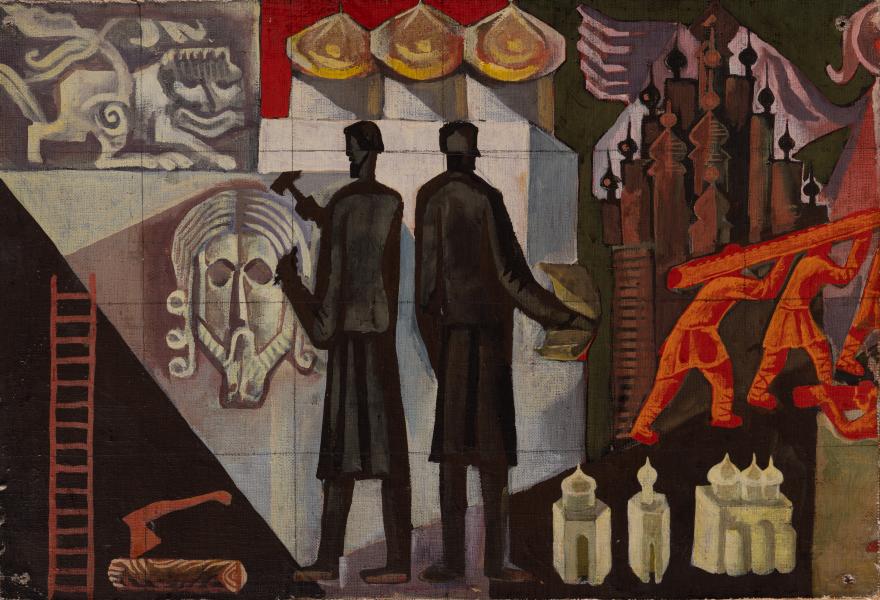
One of the sketches for the monumental paintings of the series "Ruthenian Architects" was made in collaboration with Yuliia Podohova. The composition, with elements of collage and stylisation, depicts a series of images significant for the art of the Ancient Rus, including samples of white stone carvings (according to I. Zhyshkovych, the authorship belonged to masters from the Kingdom of Galicia–Volhynia). Among them, there is a stylised grotesque smiling lion. It is similar to the carvings in the Cathedral of St. Demetrius in Thessaloniki, for example, the relief in the fifth arch of the vault (Volodymyr city, c. 1194–1197). However, given the peculiarities of the interpretation of the tail of the beast and the addition of floral motifs, the prototype could be the relief of St. George's Cathedral (Yuryiv-Polskyi town, Vladimir region, russian federation). The head of Jesus Christ, which resembles the iconography of the Image of Edessa, shows stylistic affinities with the works of the masters of Volodymyr-Suzdal, in particular the Bakun artel and the master Sviatoslav (1224 ?). On the right side of the composition, there is a stylised image, probably related to the image of the Church of the Transfiguration of the Lord (Kizhi Island, Karelia).
The latter is one of the defining symbols of Ruthenian wooden architecture. The church is depicted against the background of a fantastic creature, probably the paradise woman-headed bird Sirin or Alkonost (it is impossible to be sure because the face is only partially visible, and it is therefore not clear whether it has an important attribute – a crown on its head). Importantly, this image of birds of paradise also appears in another work from the same series (Ж-8206). The central part of the composition shows stylised domes and model-like structures in the upper and lower parts of the composition, visually reminiscent of white stone churches but not completed with crosses. This is probably due to the fact that the author was required to do so in view of the official atheist ideology.
It should be noted that this phenomenon is quite typical for the period – it can be traced in the practice of landscape painters, where a significant part of the images of ancient sacred buildings either included a perspective in which the cross was presented in profile, thus being perceived as a spire, or the end of the dome was cut off. A typical example of this approach is the chronological series of albums (1968–1972) published by the Soviet Artist publishing house, in which ancient architectural monuments are depicted with paintings and prints of churches and cathedrals, including Volodymyr, Solovetskyi Monastery, Yaroslavl, Suzdal, Pskov, Vologda, and Rostov. The images of people are presented as schematically as possible, making it almost impossible to identify a specific person. As a result, the work is a generalised representation of ancient architects, whose names are known in some cases but about whom there is little information. This anonymity, however, does not prevent their presence from being acknowledged in this series of murals. After all, the anonymous work of architects, sculptors, and ordinary construction workers made the images of the designers material. It is worth noting that there is a certain equivalence between all the attributes – from the builder's ladder, the carpenter's axe, the sculptor's hammer and cutter, to the architect's drawings. However, in the spirit of iconographic hierarchy, the author subtly indicates that the architect is still the most important. Stylistically, the sketch has an expressive reference to iconographic practices, both in its compositional and pictorial solutions, with clear tonal and colour accents.
The photograph was first published in the article: Khorunzha, H. (2023). Vasyl Poliovyi: calling. Fine Arts, 3–4, 81.
The latter is one of the defining symbols of Ruthenian wooden architecture. The church is depicted against the background of a fantastic creature, probably the paradise woman-headed bird Sirin or Alkonost (it is impossible to be sure because the face is only partially visible, and it is therefore not clear whether it has an important attribute – a crown on its head). Importantly, this image of birds of paradise also appears in another work from the same series (Ж-8206). The central part of the composition shows stylised domes and model-like structures in the upper and lower parts of the composition, visually reminiscent of white stone churches but not completed with crosses. This is probably due to the fact that the author was required to do so in view of the official atheist ideology.
It should be noted that this phenomenon is quite typical for the period – it can be traced in the practice of landscape painters, where a significant part of the images of ancient sacred buildings either included a perspective in which the cross was presented in profile, thus being perceived as a spire, or the end of the dome was cut off. A typical example of this approach is the chronological series of albums (1968–1972) published by the Soviet Artist publishing house, in which ancient architectural monuments are depicted with paintings and prints of churches and cathedrals, including Volodymyr, Solovetskyi Monastery, Yaroslavl, Suzdal, Pskov, Vologda, and Rostov. The images of people are presented as schematically as possible, making it almost impossible to identify a specific person. As a result, the work is a generalised representation of ancient architects, whose names are known in some cases but about whom there is little information. This anonymity, however, does not prevent their presence from being acknowledged in this series of murals. After all, the anonymous work of architects, sculptors, and ordinary construction workers made the images of the designers material. It is worth noting that there is a certain equivalence between all the attributes – from the builder's ladder, the carpenter's axe, the sculptor's hammer and cutter, to the architect's drawings. However, in the spirit of iconographic hierarchy, the author subtly indicates that the architect is still the most important. Stylistically, the sketch has an expressive reference to iconographic practices, both in its compositional and pictorial solutions, with clear tonal and colour accents.
The photograph was first published in the article: Khorunzha, H. (2023). Vasyl Poliovyi: calling. Fine Arts, 3–4, 81.
Legal regulation
Borys Voznytskyi Lviv National Art Gallery