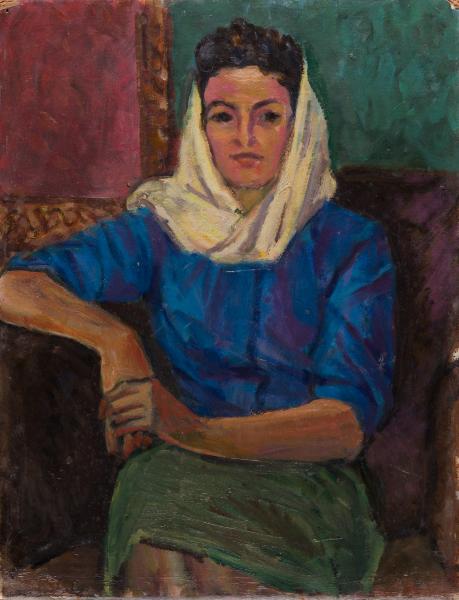
Portrait of Zh. Maksymovych

Roman Turyn

  • Portrait of Zh. Maksymovych 2
  • Portrait of Zh. Maksymovych 3
Basic information
ID
Ж-5707
Author
Roman Turyn
Name
Portrait of Zh. Maksymovych
Date of creation
1964
Country
the Ukrainian SSR
Culture
Contemporary times
Technique
oil painting
Material
cardboard oil
Dimensions (height x width, cm)
63 x 48.5
Additionally
Information about author
Author
Roman Turyn
Artist's lifetime
1900–1979
Country
Austro-Hungarian Empire, Poland, the Ukrainian SSR
Biography
Roman Turyn (2 September 1900, Sniatyn – 29 August 1979, Lviv) was a Ukrainian painter, portraitist, and public figure. He was born in Sniatyn, in the Ivano-Frankivsk region. The artist's family is known in Galicia for its social and cultural support. His father, Mykola Turyn, was a merchant, an active member of the Union of Ukrainian Merchants and Industrialists, and a patron of craft and trade training for Ukrainians. The family often visited Vasyl Stefanyk, who was on friendly terms with Roman's father. After returning to Ternopil, R. Turyn studied in the private art studio of V. Perebyinis, with whom he went to Krakow in 1921. His passion for painting led R. Turyn to the Krakow Academy of Fine Arts, where he studied under J. Pankiewicz, I. Penkovskyi, and W. Jarocki. In the mid-1920s, he went to Paris to continue his studies with the Kapists (the KP group or Paris Committee, organised by J. Pankiewicz). In the artistic capital of Europe, he became interested in the work of the Post-Impressionists. He exhibited his paintings in the galleries of famous Parisian marshals. At the same time, he became interested in photography and cinematography, photographic advertising and photo editing. He gained his first professional experience in the field of cinema at the Tobis-Klangfilm studio, where he later assisted famous directors. He worked independently in small studios, specialising in short films. He liked the avant-garde films of René Clair, Georg Wilhelm Pabst, and Victor Trivas. In the winter of 1931, he met the self-taught Lemko artist Epifanii Drovniak, known as Nykyfor. In 1932, he bought and exhibited his drawings in Paris at the Leon Marseille Gallery. He then organised exhibitions of talented artists in Lviv and supported them for many years. At the beginning of the 1930s, Turyn moved to Lviv, where he actively promoted cinema and realised a number of his creative projects (the films "On a High Meadow", "With Styr and Foam", "Hutsul Fragments", "Over the Prut in the Meadow", and "A Boy Goes to Town"). Some of them were made together with the young film enthusiast Stanislaw Lipinski, who later became a famous Polish cinematographer. After 1939, Turyn was unemployed for some time and earned money by copying portraits. In 1949, he co-founded and became director of the Lviv School of Art, which he directed for 25 years. The integration of the influences of various trends of European modernism characterises the artist's work of the 1920s and 1930s. In the 1940s and 1950s, R. Turyn was forced to adapt his works to the requirements of realism. In the 1960s and 1970s, he created an original, individual style characterised by a synthetic generalisation of natural materials and a post-Impressionist interpretation of form. He showed his works at exhibitions, particularly as a member of the Union of Ukrainian Fine Artists and the Union of Artists of Ukraine. He died in Lviv, buried in the family tomb in the Lychakiv cemetery. The first personal exhibition of R. Turyn was held in Lviv in 1982, after his death.
Object description
The decorative, figurative and colourful "Portrait of Zh. Maksymovych" was painted in 1964, when R. Turyn was developing his artistic style based on modernist inspirations. Thus, the painting is related to the experience of Post-Impressionism through "the realisation of not an impression, but a stable visual perception", the self-sufficiency and autonomy of the painting surface, and the combination of structure and intense drama of colours. At the same time, the work resembles Fauvism in the characterisation of the sitter, especially in terms of colour, with the juxtaposition of deep purple, carmine, blue, green, peach, and gold tones. The white headscarf, the lightest tonal accent in the painting, adds to the expressiveness of the face. The peculiarity of the picture lies in the contrast between the almost fresco-like monumentality, the strength and tenderness reflected in the flowing line of the hands, the soft contours and the charm of the features. The portrait's ethno-cultural inspiration is evidenced by the similarity of the headscarf to an ancient Ruthenian woman's headdress and the surface of the canvas to the colourful variety of folk carpets.
Legal regulation
Borys Voznytskyi Lviv National Art Gallery