Portrait of Madame de Le Fevre

Francois de Troy

  • Portrait of Madame de Le Fevre 2
  • Portrait of Madame de Le Fevre 3
  • Portrait of Madame de Le Fevre 4
  • Portrait of Madame de Le Fevre 5
Basic information
ID
Ж-347
Author
Francois de Troy
Name
Portrait of Madame de Le Fevre
Technique
oil painting
Material
canvas oil
Dimensions (height x width, cm)
41.5 x 33.8
Additionally
Information about author
Author
Francois de Troy
Artist's lifetime
1645–1730
Country
France
Biography
Francois de Troy (1645–1730) was a French portraitist and engraver, the father of the artist Jean-Francois de Troy (1679–1752). He was born into the family of Nicolas de Troy, a painter from Toulouse who worked in the Languedoc region. His elder brother, Jean de Troy, was also an artist known for his historical paintings and founded the Academy of Arts in Montpellier. Francois learnt the basic skills of painting from his father and then entered the studio of the local artist Antoine Durand. At twenty-four, the painter went to Paris, where he continued studying with portraitists Claude Lefebvre and Nicolas-Pierre Loir. During his early years in the capital, Francois befriended the painter, engraver, critic, and diplomat Roger de Piles, who introduced him to Dutch and Flemish painting. In 1671, de Troy became a candidate for the Royal Academy of Painting and Sculpture, and in 1674, he was accepted as a historical painter. After the death of his teacher Lefebvre in 1675, de Troy devoted himself to the portrait genre, hoping to work with his late master's former clients. In 1679, the artist received his first prestigious commission for a portrait of the Swedish ambassador, Niels Bilke. A year later, he painted a portrait of Anne-Marie of Bavaria, fiancée of Dauphin Louis, the heir to the French throne. Following the success of these portraits, de Troy consistently worked in court circles. Commissioners appreciated his talent to emphasise their manners, social status, and fashionable attire.
Object description
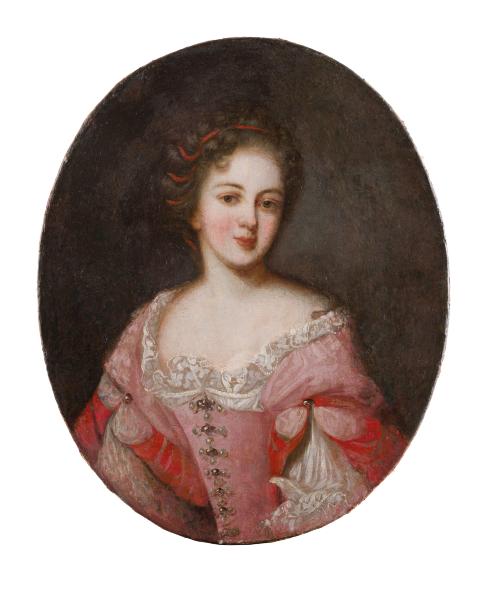
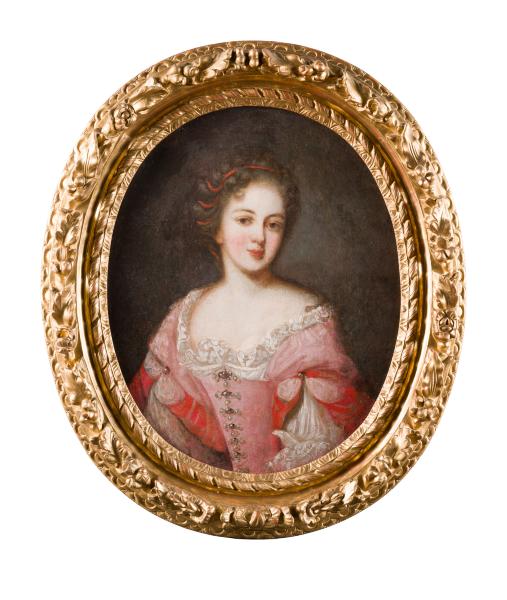
The painting, probably by Francois de Troy, shows a half-length portrait of a young woman with an enchanting face. She is depicted against a dark green background, slightly turned, with her gaze directed toward the viewer. The woman is dressed in a pink gown with a plunging neckline featuring a corset and voluminous sleeves. The ideal of feminine beauty in 17th-century French art is characterised by grandeur, ceremonial, and stiffness. The female figure has a tall stature, a "swan-like" neck, sloping shoulders, a narrow waist, and full hips. Wavy long hair complements the feminine image. In the portrait, we likely see the depiction of the philosopher Tanneguy Le Fevre's daughter, the young Anna Dacier (nee Le Fevre) (1645–1720) – a philosopher, scholar, and translator who introduced the works of Aristophanes and Homer to France.
Legal regulation
Borys Voznytskyi Lviv National Art Gallery