Landing of the Honourable Man from the East
Circle of Adam Elsheimer


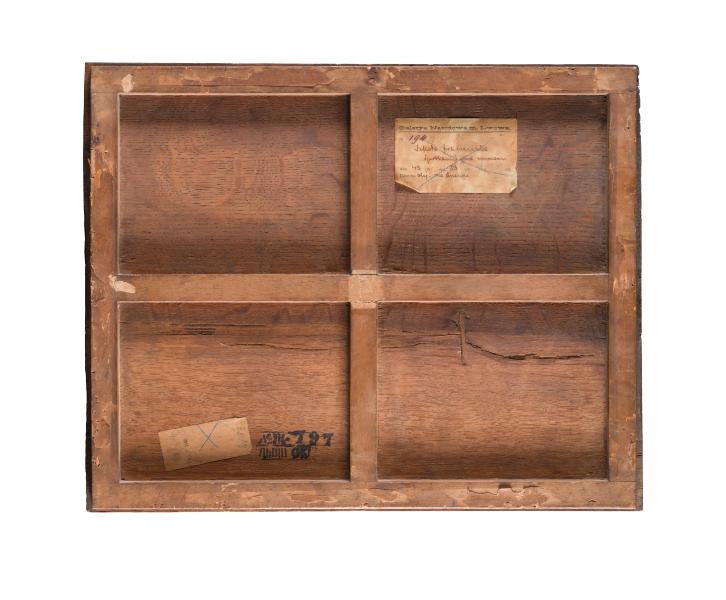
Basic information
- ID
- Ж-797
- Author
- Circle of Adam Elsheimer
- Name
- Landing of the Honourable Man from the East
- Technique
- oil painting
- Material
- wood oil
- Dimensions (height x width, cm)
- 43 x 53
Additionally
- Type
- painting
- Provenance
- Collection of Lviv City Gallery
- Exposition
- Potocki Palace
Information about author
Object description
In the painting, a group of people dressed in Eastern attire is depicted on the shore by the sea, with a ship in the background. On the right is a fragment of an ancient building with a colonnade. In the background is a castle on a hill. The work came from the Lviv City Gallery's collection. It was attributed as "The Landing of the Saracens at Ostia", initially attributed to Domenico Robusti (1560–1635) and later to the Circle of Adam Elsheimer (1578–1610), a German engraver, landscape painter, and master of "night scenes". In Venice, the artist mastered the veduta (cityscape) genre, and in Rome, he absorbed the traditions of Romanticism – foreign artists' fascination with depicting both ancient and contemporary Rome. He painted Roman landscapes on small copper plates. His painting style influenced Carlo Saraceni and Dutch romanticists. In 846, the Emir of the Aghlabid Ifriqiya, Muhammad I ibn al-Aghlab, led a campaign against Rome, capturing Ostia first. In 849, a battle occurred at Ostia between the fleets of Muslim invaders from Southern Italy and the Christian League. Since Rome was located in the depths of the peninsula, Ostia served as its seaport. The Arabs plundered the temples outside the city walls, but soon, the Romans, with the help of their allies, managed to drive the invaders away.
Legal regulation
Borys Voznytskyi Lviv National Art Gallery