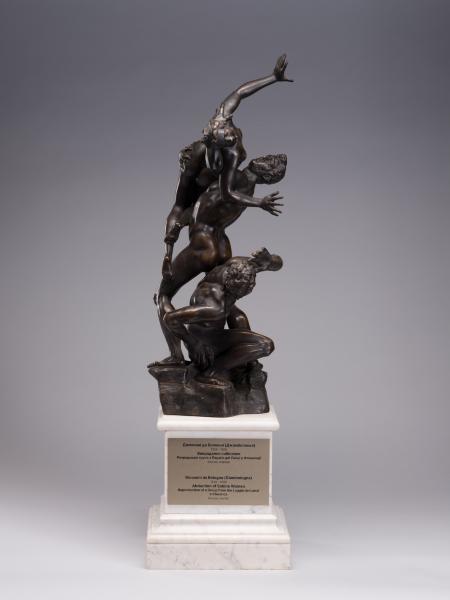
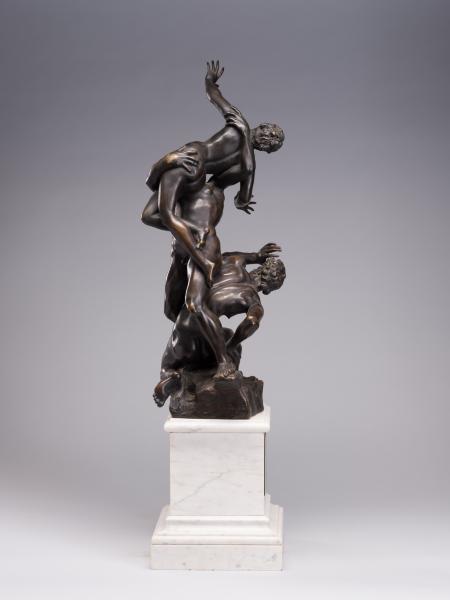
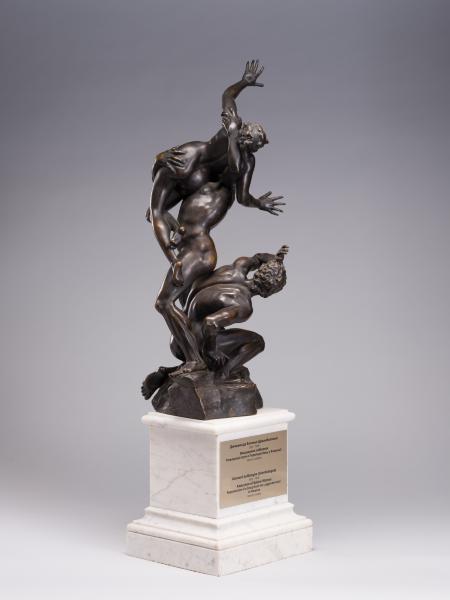
Abduction of a Sabine Woman (work after Giovanni da Bologna)
unknown








Basic information
Additionally
Information about author
Object description
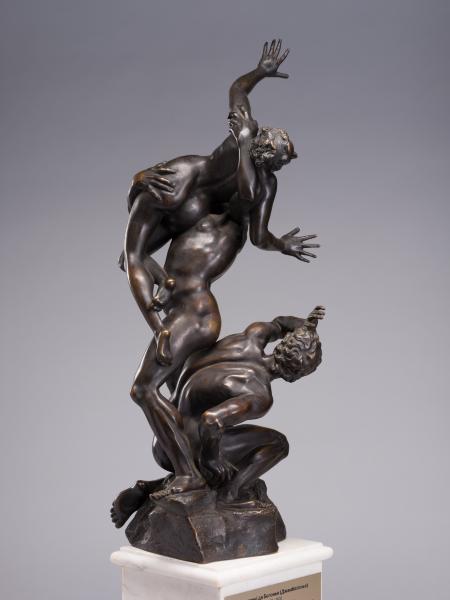
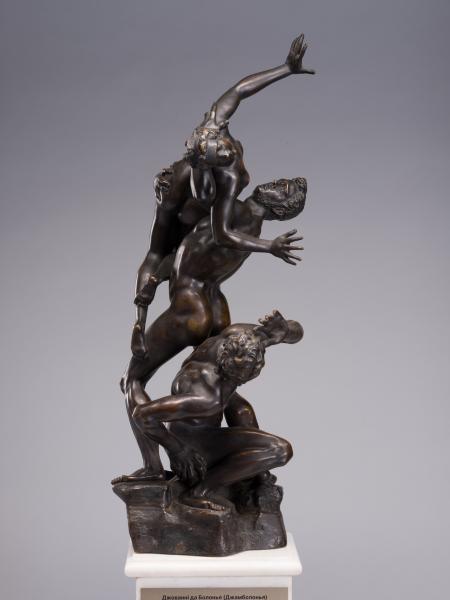
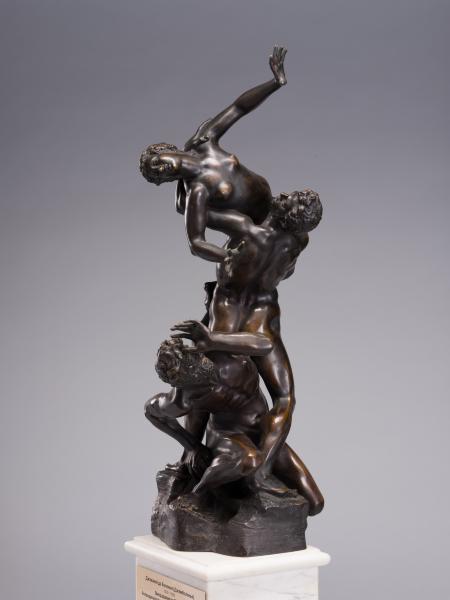
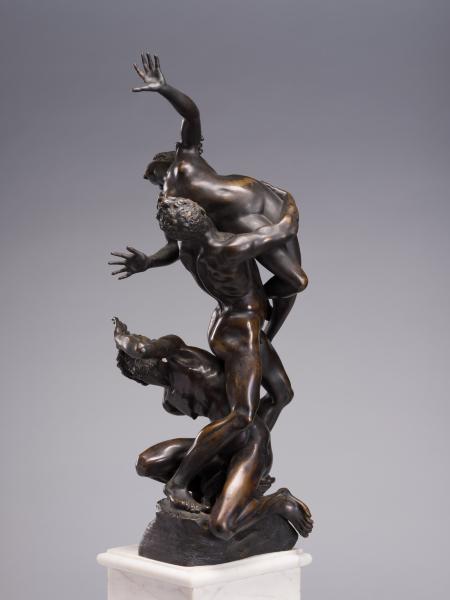
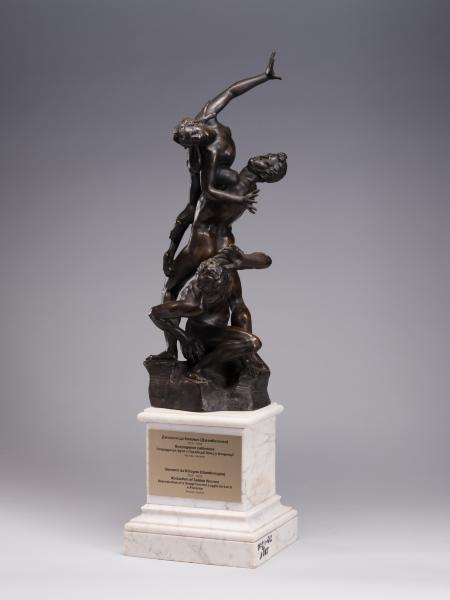
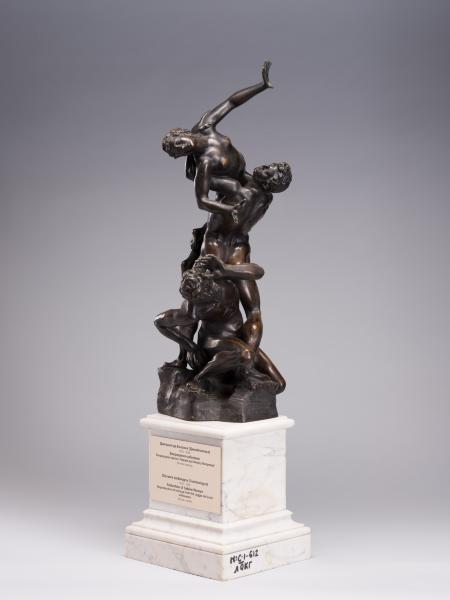
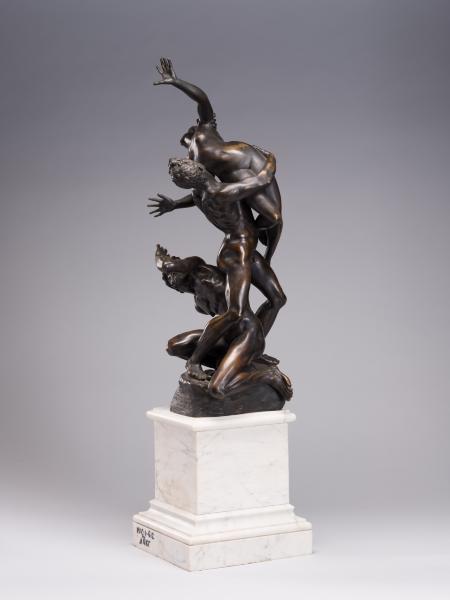
"Abduction of a Sabine Women" is one of Giovanni da Bologna's most famous sculptural groups, installed in 1583 in the Loggia dei Lanzi, Piazza della Signoria, Florence. This three-figure group was carved from a single block of marble. The author created the sculpture to allow for viewing from different angles, thereby enriching the viewer's impression of the work. This sculptural group was repeatedly copied by masters of subsequent centuries, and in the 19th century, sculptors sometimes made minor adjustments compared to the marble original. The work is based on a legendary story from the early period of ancient Roman history (8th century BC). There were few women in Rome, so in order to obtain more, the Romans invited a neighbouring tribe, the Sabines, to a banquet, and in the heat of the festivities, they attacked the unarmed guests and kidnapped their women. This 19th-century version, which replicates in bronze the composition by Giambologna from the Loggia dei Lanzi in Florence, is not an exact copy of the famous original. Certain differences suggest that the 19th-century sculptor attempted to make the composition more expressive and dynamic. The author of this work (dated to the "fourth Neo-rococo" period (late 19th century)) showcased the desire for dynamism, distinguishing this work from the original in the Mannerist style with its emphasized theatricality. As in Giambologna's sculpture, the work is based on a plastic combination of spiral lines – the so-called figura serpentinata – a technique pioneered by the outstanding Flemish artist. Three naked figures are depicted in motion: an athletic young Roman holding a young woman above him, a Sabine woman trying to free herself from his clutches; a defeated Sabine, a bearded man crouching at the Roman's feet, covering his face with his hand. Unlike the marble original, the figure of the rebellious woman in bronze is much more active – she has almost broken free from the kidnapper's hands. In the sculpture, this is manifested by the greater elevation of the body, the longer neck, and the arms spread out to the sides with spread fingers: the captive seems to be trying to fly away, freeing herself from the enemy's embrace. In contrast, the figure of the Sabine man is in distress – his hand covers his face even more than in the original work. The figures are placed on a bronze podium in the form of stone steps. The entire composition is set on a tall square marble pedestal with a profiled base.
Inscriptions
On the right side of the pedestal base, there is an inscription in black: "С-І-612/ Л.ОКГ". On the front edge of the pedestal, there is a cardboard plaque with inscriptions. At the top (in ukrainian): "Giovanni da Bologna (Giambologna)/ 1529–1608/ Abduction of the Sabine Women/ Reproduction of a Group from the Loggia dei Lanzi in Florence/ Bronze, marble"; at the bottom (in english): "Giovanni da Bologna (Giambologna)/ 1529–1608/ Abduction of Sabine Women/ Reproduction of a Group from the Loggia dei Lanzi/ in Florence/ Bronze, marble".
Legal regulation
Borys Voznytskyi Lviv National Art Gallery