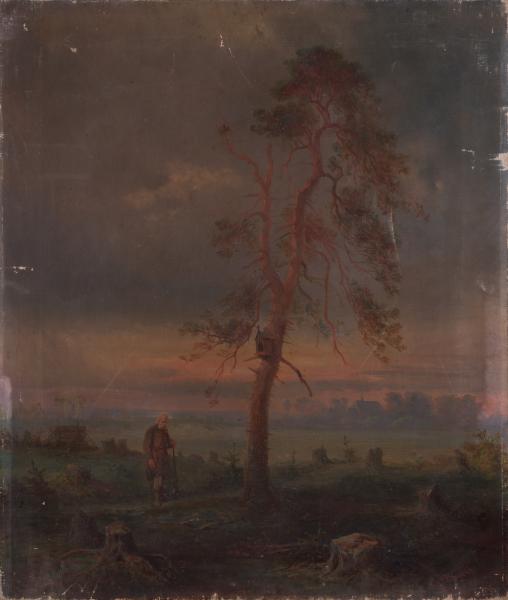
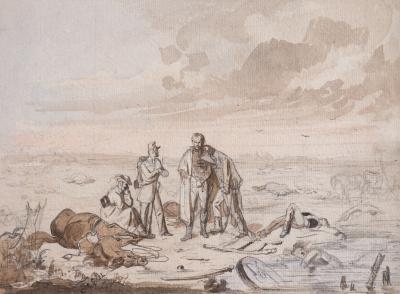
Hunter

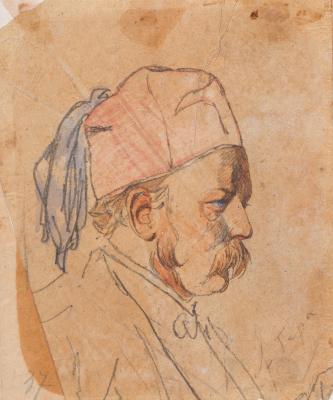
Franciszek Kostrzewski

  • Hunter 2
  • Hunter 3
Basic information
ID
Ж-1103
Author
Franciszek Kostrzewski
Name
Hunter
Date of creation
1875
Country
Kingdom of Poland
Culture
Modern times
Technique
oil painting
Material
canvas oil
Dimensions (height x width, cm)
67.3 x 57.5
Additionally
Information about author
Author
Franciszek Kostrzewski
Artist's lifetime
1826–1911
Country
Kingdom of Poland
Biography
Franciszek Kostrzewski (19 April 1826 – 30 September 1911) was a Polish realist painter, illustrator, and author of satirical drawings and caricatures. He was born in Warsaw to Franciszek, a poor official and administrator of one of the noble palaces, and Dorota, née Żbikowska. In 1831, during the November Uprising, the family moved to an estate in the Sandomierz Voivodeship, where the artist spent his childhood. After graduating from secondary school in Warsaw, F. Kostrzewski decided to devote himself to artistic creation, but his father arranged for him to work in one of Warsaw's offices. Soon, the young man was dismissed after his boss noticed drawings on the documents. After that, his father allowed his son to pursue an artistic career. From 1844 to 1849, F. Kostrzewski studied at the Warsaw School of Fine Arts under the guidance of Chrystian Breslauer, Aleksander Kokular, Rafał Hadziewicz, Marcin Zaleski, and Jan Feliks Piwarski. The latter had the most significant influence on the young man's work. From 1849 to 1851, F. Kostrzewski spent time in Kielce at the invitation of the famous collector Tomasz Zieliński. Copying paintings allowed the artist to master the stylistic features of 17th-century Dutch painting. After returning to Warsaw, F. Kostrzewski worked as an art teacher, mainly in aristocratic families. Between 1850 and 1860, he created over 200 watercolours, drawings for 7 albums, portraits, and caricatures. He depicted scenes from urban and rural life. He earned his living by giving art lessons and making shop signs. In 1852–1853, he was commissioned by the Steamship Company to paint several compositions on sheet metal to decorate passenger ships sailing on the Vistula River. In 1854, he married Lucyna, née Żukowska. He had three children: two daughters and a son, Stanisław, who became an artist. In 1856, F. Kostrzewski took a several-month trip to Dresden, Berlin, Vienna, Brussels, and Paris, which had a decisive influence on his creative development. During this time, he deepened his knowledge of the work of the "Little Dutchmen" and became acquainted with the landscapes of the representatives of the "Barbizon School". After returning to Poland, he worked as an illustrator. In 1858, his works were published in a number of periodicals. In 1858–1859, he became co-editor of the satirical magazine "Wolne Żarty", and from 1859 to 1911, he worked as a cartoonist for "Tygodnik Ilustrowany". F. Kostrzewski's drawings were published in literary and satirical magazines, including "Biesiada Literacka" (1894–1905), "Kłosy" (1865–1890), "Kolce" (1874–1910), "Kurier Świąteczny" (1883–1911), and "Wędrowiec" (1869–1905). On 3 October 1859, the first part of the story "The History of Unicorns with 32 Images", one of the oldest Polish comics, was published. From 1868, the artist taught at Maria Lubenska's School of Drawing and Painting. From the 1870s, he devoted himself mainly to illustration and gradually gave up painting almost entirely. He often combined drawings into thematic series, such as 2The Story of an Only Child". In 1891, "The Monument" was published in Warsaw, in which the artist described his life. He died in Warsaw and was buried in the Powązki Cemetery.
Legal regulation
Borys Voznytskyi Lviv National Art Gallery