Collection of Ethnographic Drawings
Kajetan Kielisinski

Basic information
- ID
- Г-V-424_130
- Author
- Kajetan Kielisinski
- Name
- Collection of Ethnographic Drawings
- Country
- Kingdom of Poland
- Culture
- Modern times
- Technique
- drawing
- Material
- pencil
Additionally
- Type
- graphic art
- Genre
- genre art
- Provenance
- the Dzieduszycki collection
Information about author
Object description
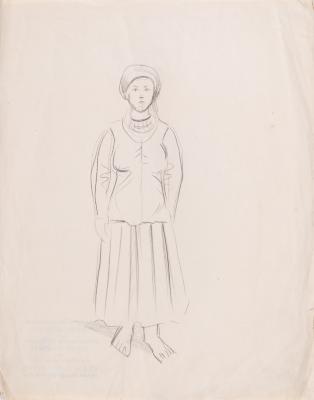
Kajetan Wincenty Kielisiński created numerous etchings and drawings devoted to folklore, life in Polish villages and towns, historical monuments, and landscapes. He was one of the first to develop bookplates in Poland. During his travels to various locations, he collected graphic materials for the publications "Polish Antiquities" and "Folk Costumes". In 1855, Poznań publisher Jan Konstanty Żupanski published "Kielisiński's Album", which collected the artist's scattered works. Kielisiński's graphic works, drawings, sketchbooks, and correspondence were kept in the Kórnik Library of the Polish Academy of Sciences, as well as in national museums (Kraków, Poznań, Warsaw) and renowned libraries (Jagiellonian University, Ossolineum, Warsaw University). The picture depicts four people. In the centre foreground, there is apparently a family of three – a man, a woman, and their son. We can assume that they are wealthy peasants or townspeople, as their clothes look dignified and elegant. The man and boy are wearing tall hats with tassels and long cloaks with embroidery on the lapels. The man's cloak is also tied with a belt. In his left hand, the man holds a stick or cane, while his right hand is tucked behind his belt. He and his son are wearing boots, while the woman is wearing lighter shoes. The figure of the girl peeking out from behind the man's back contrasts with the presented group. Her status is obviously subordinate to the family, which is emphasised by both her clothing and her posture. She is not wearing any outer clothing – only a shirt and a long skirt. Her head is covered with a tied scarf, and, most strikingly, she is barefoot, demonstrating her property and social status. In addition to standing behind and partially hidden by the man's figure, the girl is shown with her head bowed forward and to the side, her gaze somewhat timid and gloomy. The man with his wife and son is depicted in a static pose. He is looking forward with his head slightly bowed, and his facial expression and gaze appear a little tired. His wife is looking at him, her gaze direct and wholly focused; her emotional state is gentle and calm. The boy's figure is vividly portrayed, with a confident expression, his head held straight and his gaze direct. The graphic drawing has undeniable historical and cultural value, as it clearly and carefully reproduces folk clothing. Since the drawing accurately reflects and conveys the details and features of the folk clothing of a particular region, it has a pronounced ethnographic, historical, and cultural value. Its artistic significance lies in the accurate and detailed reproduction of folk costumes, making it a valuable source for research and study of traditional culture. From an aesthetic point of view, we are dealing with a realistic drawing, with a special emphasis on its documentary nature.
Legal regulation
Borys Voznytskyi Lviv National Art Gallery