Back

Old Alley in Salzburg

Jakub Glasner
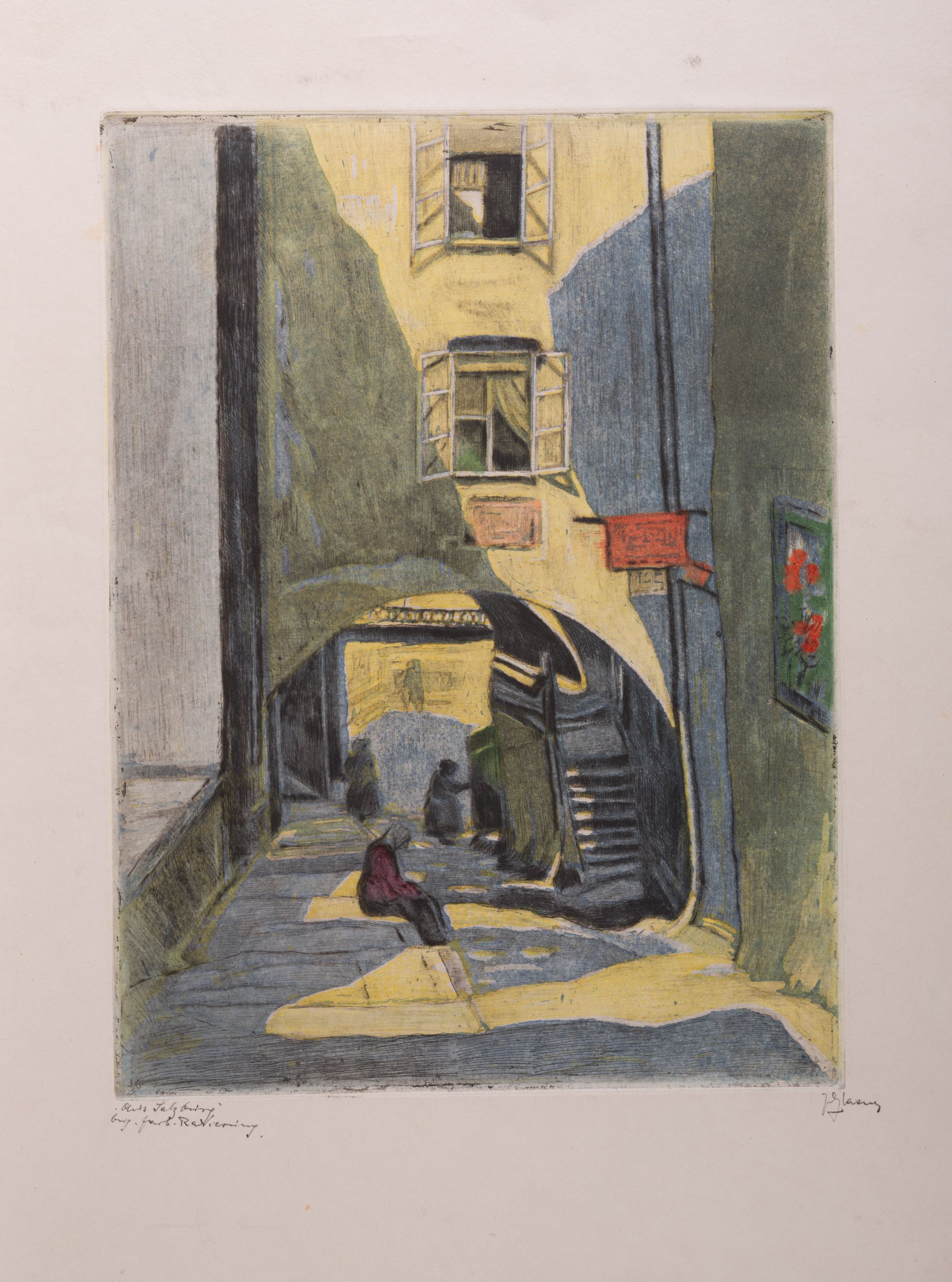
  • Old Alley in Salzburg
Basic information
ID
Г-IV-30
Author
Jakub Glasner
Name
Old Alley in Salzburg
Date of creation
1920s–1930s
Country
Austria
Technique
colour linocut
Material
paper
Dimensions
33 x 24.7 cm (height x width)
Information about author
Author
Jakub Glasner
Artist's lifetime
1879–1942
Country
Austro-Hungarian Empire, Poland, the Ukrainian SSR
Biography
Jakub Glasner (Polish: Jakub Glasner; 1879, Rdzawka near Nowy Targ – 1942, Lviv) was a painter and graphic artist of Jewish origin. He was born into a family of innkeepers near Nowy Targ. In the mid-1890s, he moved with his parents to Bielsko (now Bielsko-Biała), where he grew up, received his primary education and developed an interest in painting. He worked as a house painter and graphic artist, but abandoned this occupation and began his art studies in Vienna in 1901–1902.
After two semesters of study, the artist moved to Krakow, where he continued his education at the Academy of Fine Arts. His teachers there included Julian Falat, Teodor Aksentowicz and Jan Stanislawski. In 1905, he travelled to Venice, where he studied under Lucien Simon, and later to Paris, where he attended the studio of Théophile-Alexandre Steinlen. After completing his studies in Vienna, Krakow, Venice and Paris, Glasner returned to Bielsko.
His studio on Piastowska Street became a centre of the city's bohemian life at that time. The artist frequently travelled to Italy and Germany, where he exhibited his works on numerous occasions. He served in the First World War as a soldier in the Austrian army. During this period, he created around 200 drawings, mostly portraits. After the end of the war, he returned to Bielsko. During the interwar period, he also stayed in Lviv, where his studio was located at 11 St Anthony Street (now M. Zankovetska Street).
Following the outbreak of the Second World War and the Nazi occupation in 1939, he fled to Soviet-controlled Lviv. In 1940, using the surname Libidovskyi, he participated in graphic art exhibitions in Kyiv, Kharkiv and Moscow. Glasner died in the Lviv ghetto in 1942.
Object description
A multicoloured linocut executed in a warm colour palette. The artist depicts a narrow arched passageway, presumably located in the Jewish Quarter of Salzburg's Old Town. The walls are pierced by narrow windows only in the central section above the arch. Several dark female figures are shown on the cobbled street, emphasising the hardship of the quarter's inhabitants.
Inscriptions
Below the print are the artist's inscriptions: on the right, "J. Glasner"; on the left, "Aus Salzburg/Orig. farb. Radierung".
Legal regulation
Borys Voznytskyi Lviv National Art Gallery
Link copied