Back

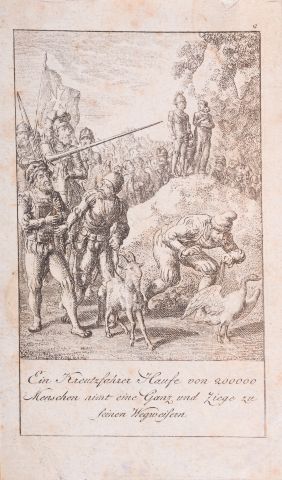
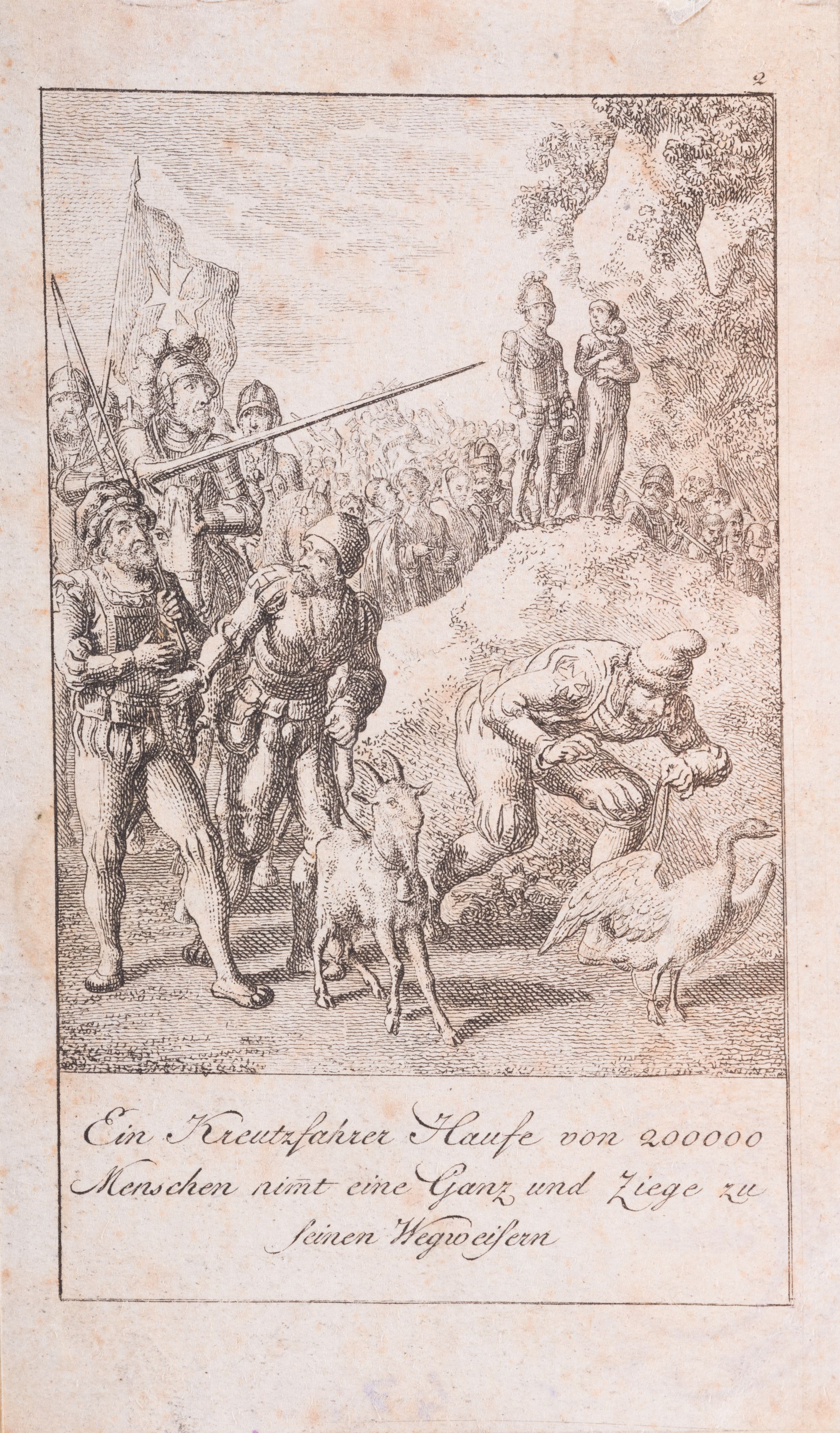
Scene Depicting the Crusades (Crusader, Accompanied by a Crowd of Two Hundred Thousand, Takes a Goose and a Goat as His Guides)

Daniel Chodowiecki
  • Scene Depicting the Crusades (Crusader, Accompanied by a Crowd of Two Hundred Thousand, Takes a Goose and a Goat as His Guides) 1
  • Scene Depicting the Crusades (Crusader, Accompanied by a Crowd of Two Hundred Thousand, Takes a Goose and a Goat as His Guides) 2
  • Scene Depicting the Crusades (Crusader, Accompanied by a Crowd of Two Hundred Thousand, Takes a Goose and a Goat as His Guides) 1
  • Scene Depicting the Crusades (Crusader, Accompanied by a Crowd of Two Hundred Thousand, Takes a Goose and a Goat as His Guides) 2
Basic information
ID
Г-IV-1206
Author
Daniel Chodowiecki
Name
Scene Depicting the Crusades (Crusader, Accompanied by a Crowd of Two Hundred Thousand, Takes a Goose and a Goat as His Guides)
Date of creation
late 18th c.
Country
Germany
Technique
сopper engraving
Material
paper
Dimensions
9.5 x 5.7 cm (height x width)
Information about author
Author
Daniel Chodowiecki
Artist's lifetime
1726–1801
Country
Poland, Germany
Biography
Daniel Nikolaus Chodowiecki (1726, Gdańsk – 1801, Berlin) – a Polish-German artist, printmaker and painter, a master of etching and book illustration, a representative of the academic movement, and one of the leading exponents of sentimentalism in 18th-century German art.
The artist's father was a merchant, a descendant of a noble family. His mother came from a family of Swiss Huguenots. The young Daniel, continuing the family tradition, began working as a merchant. At the age of 17, he went to Berlin for a commercial apprenticeship, where he spent most of his life. Towards the end of his career, he became the director of the Prussian Academy of Arts (Preußische Akademie der Künste).
In the 1750s, the artist developed an interest in painting, and later in printmaking, becoming one of the leading book illustrators. Between 1770 and 1774, together with Johann Bernhard Basedow, the founder of the philanthropic movement in education, he worked on the four-volume publication "Elementary Textbook for Young People" ("Elementarwerk für die Jugend"). Chodowiecki created over 100 illustrations for it using the copper engraving technique, including some dedicated to the Crusades.
In 1781, the artist produced 12 illustrations for a play by Gustav Friedrich Wilhelm Großmann entitled "No More Than Six Dishes" ("Nicht mehr als sechs Schüsseln"). This comedy, with its strongly social-critical undertones, is considered one of the earliest outstanding dramatic works in German bourgeois literature.
Around 2,000 engravings by Chodowiecki on various subjects, executed in the techniques of etching and copper engraving, have survived to this day. One of his contemporaries wrote that, were it not for Chodowiecki's illustrations, countless books would never have found their readers. The artist created a large number of painted and graphic portraits, as well as genre scenes of burgher life, mostly executed in pen and ink. The total number of the artist's surviving drawings amounts to around 4,000.
Daniel Chodowiecki's works are held in Germany – at the Kupferstichkabinett (Museum of Prints and Drawings) in Berlin, the Museum of Fine Arts in Leipzig, and the Städel Museum in Frankfurt; in Poland – at the National Museum in Gdańsk; in Ukraine – at Borys Voznytskyi Lviv National Art Gallery, Vasyl Stefanyk Lviv National Scientific Library of Ukraine and the Kharkiv Art Museum, as well as in museums in Washington, Madrid and London.
Object description
An episode from the Peasants' Crusade of 1096. It was predominantly the poor who took part. A goose and a goat, which they believed to have received a divine revelation, showed the crowd of fanatics the way. The artist treats these events with a certain degree of irony.
In the foreground on the right is an unarmoured participant in the crusade, attempting to catch a goose. To his left, another pilgrim leads a goat on a lead and pushes aside a well-dressed man.
Behind these figures, several knights on horseback are riding, and beyond them stretches a vast multitude of people from various walks of life, predominantly peasants. In the middle ground on the right, on a hill, stands a crusader knight, next to whom is a woman holding a child in her arms.
Inscriptions
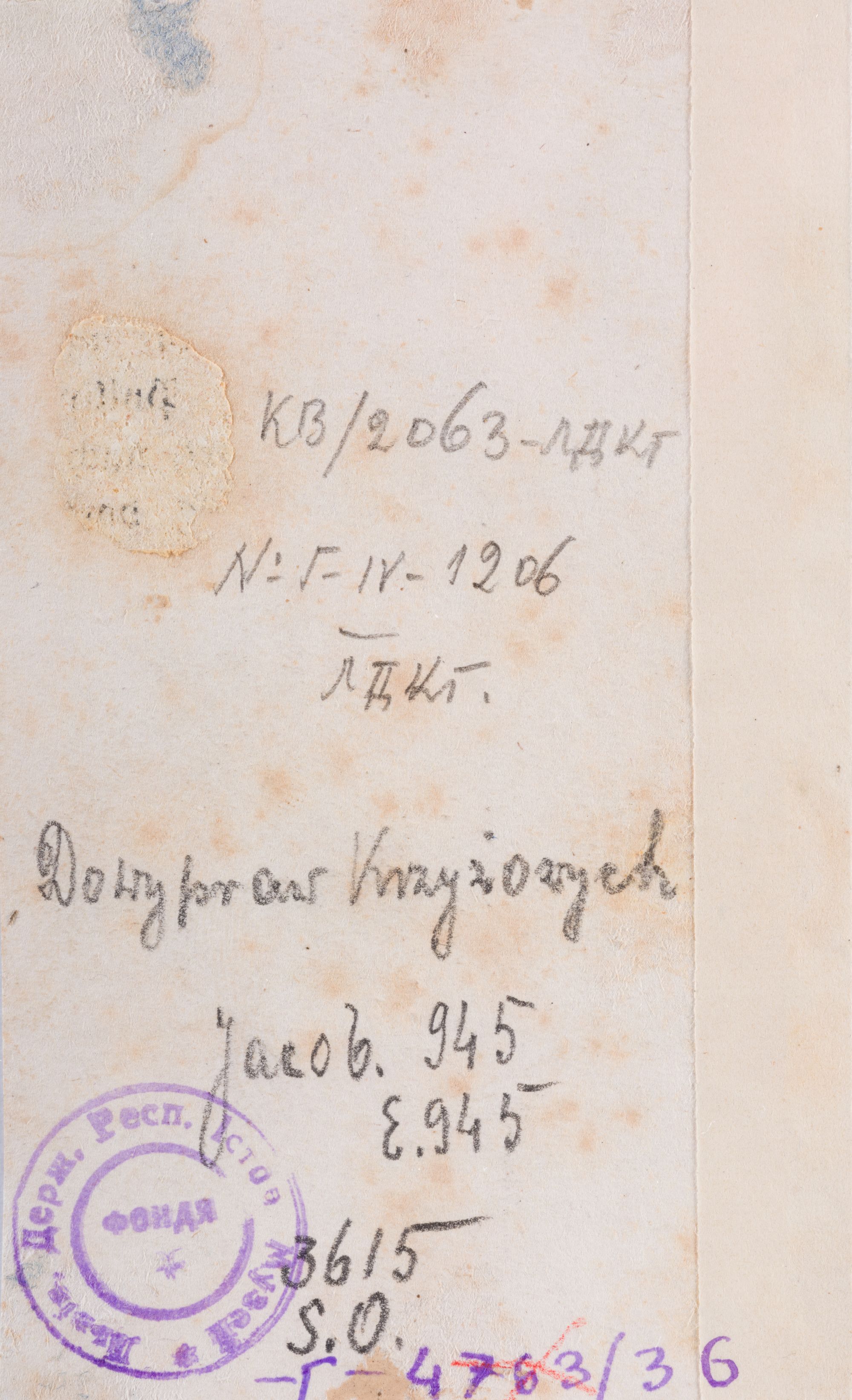
Below the image is the inscription: "Ein Kreutzfahrer Haufe 200000 Menschen nimt eine Ganz und Ziege zu seinen Wegweisern". On the reverse, at the top, are the inventory numbers of the Lviv Picture Gallery; below, in the centre: "Do wypraw Krzyżowych/ Jacob. 945/ E. 945/ 3615/ S.O.". At the bottom left is the round seal of the Lviv State Republican Historical Museum's holdings; on the right – the historical museum's inventory number.
Legal regulation
Borys Voznytskyi Lviv National Art Gallery
Link copied