Back

Thoughtful Woman

Imre Revesz
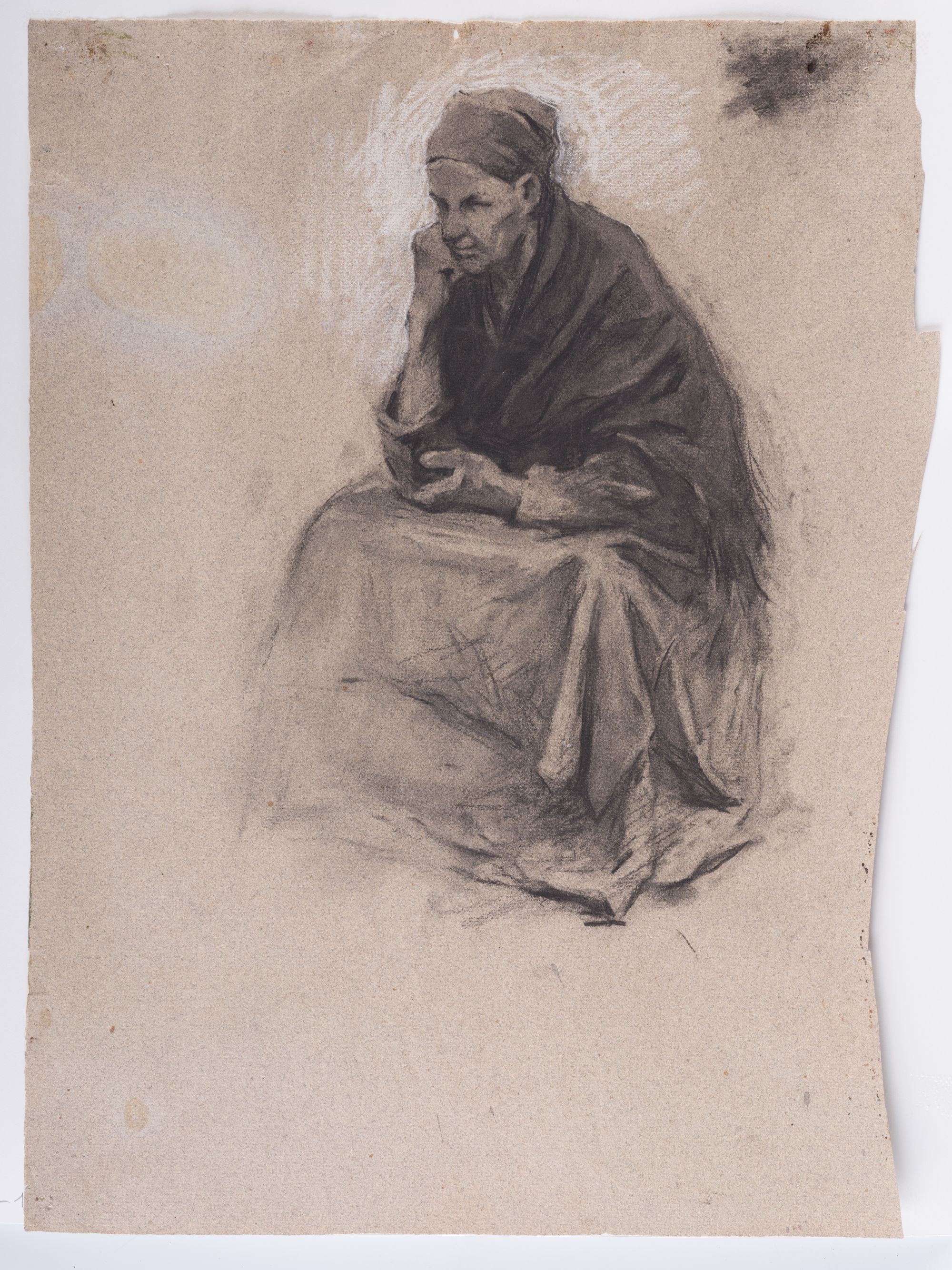
  • Thoughtful Woman
Basic information
ID
Г-V-1177
Author
Imre Revesz
Name
Thoughtful Woman
Previous attributions
Elderly Woman
Date of creation
1930–1940s
Technique
drawing
Material
toned paper charcoal chalk
Dimensions
48.2 x 35 cm (height x width)
Information about author
Author
Imre Revesz
Author in the original
Révész Imre
Artist's lifetime
1859–1945
Country
Hungary
Biography
Imre Revesz (Révész Imre; 1859, Sátoraljaújhely, Austria-Hungary – 1945, Sevliush (now Vynohradiv, Hungarian: Nagyszőlős), Transcarpathian Ukraine). His real surname was Csebrai.
A Hungarian painter and graphic artist. He was born into a Reformed family in a Hungarian-Slovak town whose name translates as "New Place under the Tent". Soon afterwards, the whole family moved to what is now Vynohradiv – then known as Nagyszőlős. Imre began his artistic training in Budapest, later continuing it in Szatmár (now Satu Mare, Romania). Between 1875 and 1877, he studied at the Vienna Academy of Fine Arts under Leopold Müller, and from 1878 to 1879 at the Institute of Fine Arts in Budapest. Between 1879 and 1882, he completed his studies in Vienna. He was awarded a scholarship to further his skills in Paris (1882–1884), where he studied under Mihály Munkácsy. The paintings and drawings he created during this period were selected as illustrations for the two-volume complete collection of poems by Sándor Petőfi, published in Budapest in 1900. Adopting Munkácsy's artistic style, Revesz created genre scenes from folk life, landscapes and historical works in a realistic style. His work "Petőfi Among the People" was acquired by the London Museum of Art.
In 1903, Revesz began teaching at the Hungarian University of Fine Arts in Budapest. In 1921, he established an artists' residence in Kecskemét. Among his students were the future founders of the Transcarpathian School of Painting – József Boksay and Béla Erdélyi. After retiring in 1932, he lived in Sevliush (then Czechoslovakia, and from 1939 – Hungary). He frequently went on plein air trips. Each of his sketches and compositions bears witness to his exceptional mastery of drawing and his confident graphic line. The artist enjoyed working in mixed media, combining charcoal, chalk, watercolour and pastel. Imre Revesz died in September (according to other sources, in February) 1945 in Sevliush. He was buried in the Reformed cemetery.
The artist's works are held in Hungary's largest state collections, notably the Hungarian National Gallery, the Petőfi Museum of Literature, and several provincial museums in Kecskemét, Szeged and Debrecen. In Ukraine, the artist's works are represented in museums in Lviv, Kyiv and Uzhhorod. For his work "We Demand Bread!" ("Panem!"), the artist was awarded a gold medal at the international exhibition in Munich in 1901.
Object description
The middle-aged woman, depicted by the artist deep in thought, appears to be an elderly person. She sits, propping her head up with an arm bent at the elbow. She wears a modest long dress that drapes down at her knees, and a woollen shawl over her shoulders. Her hair is gathered under a headscarf. Her hardworking hands and the wrinkled skin of her face bear witness to her difficult life. Detailing the figure and using contrasts of light chalk and black charcoal, the artist creates a characteristic image of a hardworking woman who has paused briefly to rest and reflect on her fate.
Legal regulation
Borys Voznytskyi Lviv National Art Gallery
Link copied