Sketches of Figures at a Banquet
Imre Revesz
Basic information
- ID
- Г-V-1185
- Author
- Imre Revesz
- Name
- Sketches of Figures at a Banquet
- Previous attributions
- Sketch
- Date of creation
- 1930–1940s
- Technique
- drawing
- Material
- toned paper charcoal chalk
- Dimensions
- 63 x 48 cm (height x width)
Additionally
Information about author
Object description
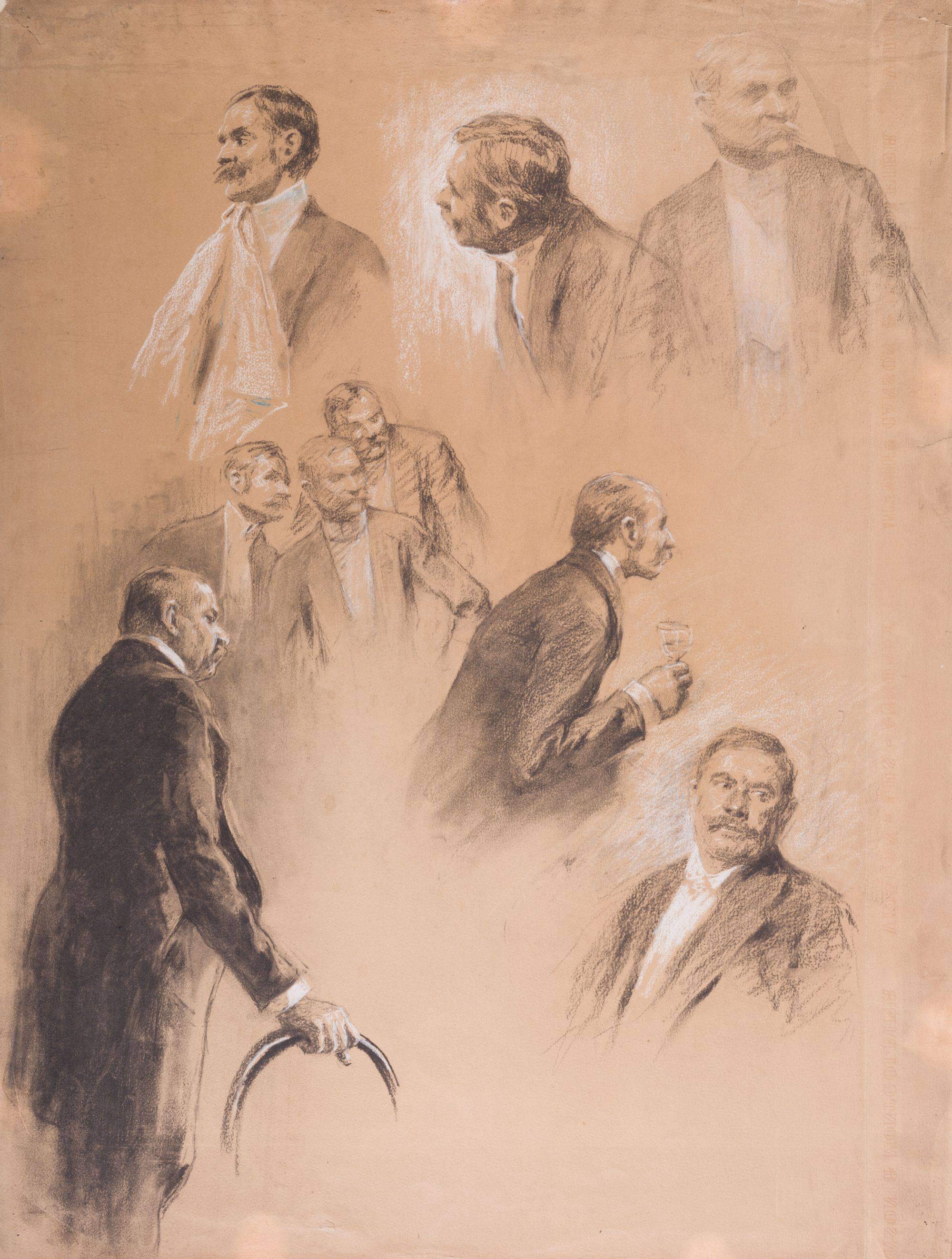
Various parts of the sheet depict fragments of male portraits executed by the artist during the banquet. In the lower left part, a distinguished wealthy man in a black suit is shown in profile facing right, holding his hand on the back of a chair. His posture emphasises his high social status. To the right stands a bust-length portrait of a man full-face, turned a quarter to the left. The expression on his face suggests a critical attitude towards what is happening. Above is a half-length portrait of a man in profile, in a fawning posture and holding a glass. To his left is a group of three men looking critically at someone. In their images, the features of individuals recorded in other parts of the sheet are noticeable.
The upper part of the sheet features three images. On the left is a man with a moustache and a wide white bow at the collar of his shirt. He is likely the central figure of the banquet, striving to maintain his dignity under any circumstances. From the right, another man looks at him, his expression conveying an ironic attitude towards the first. In the top right-hand corner is another, schematically sketched image of an older man. The artist captures psychological portraits of the banquet guests, skilfully employing contrasting combinations of black charcoal and white chalk.
The upper part of the sheet features three images. On the left is a man with a moustache and a wide white bow at the collar of his shirt. He is likely the central figure of the banquet, striving to maintain his dignity under any circumstances. From the right, another man looks at him, his expression conveying an ironic attitude towards the first. In the top right-hand corner is another, schematically sketched image of an older man. The artist captures psychological portraits of the banquet guests, skilfully employing contrasting combinations of black charcoal and white chalk.
Legal regulation
Borys Voznytskyi Lviv National Art Gallery