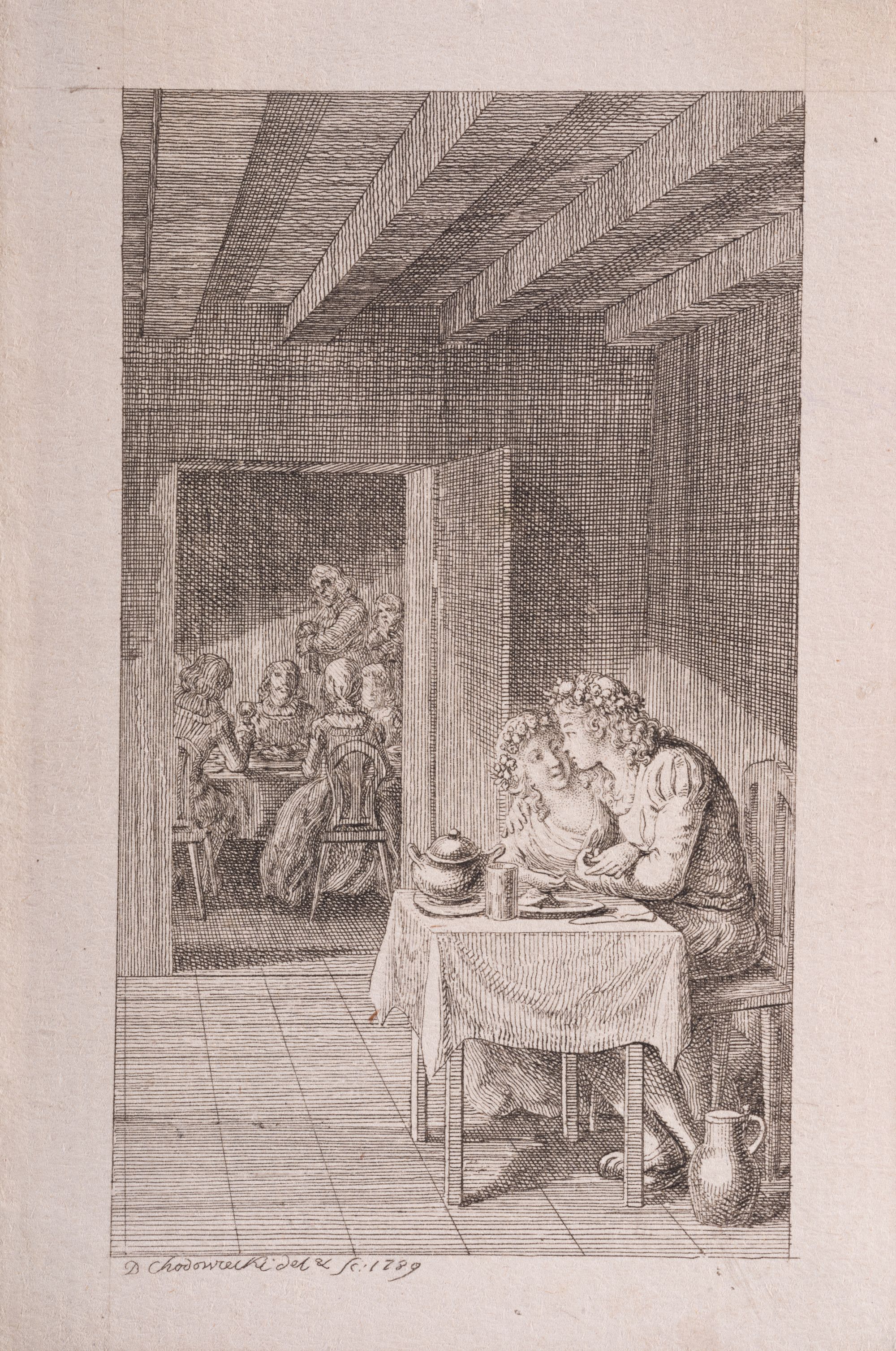
Banquet. From the "History of Brandenburg" Series
Daniel Chodowiecki
Basic information
- ID
- Г-IV-2709
- Author
- Daniel Chodowiecki
- Name
- Banquet. From the "History of Brandenburg" Series
- Previous attributions
- In the Tavern
- Country
- Germany
- Technique
- etching
- Material
- paper
- Dimensions
- 8.6 x 5.1 cm (height x width)
Additionally
- Type
- graphic art
- Genre
- genre art
- Provenance
- Purchased from O. Bushel, 1977
Information about author
Object description
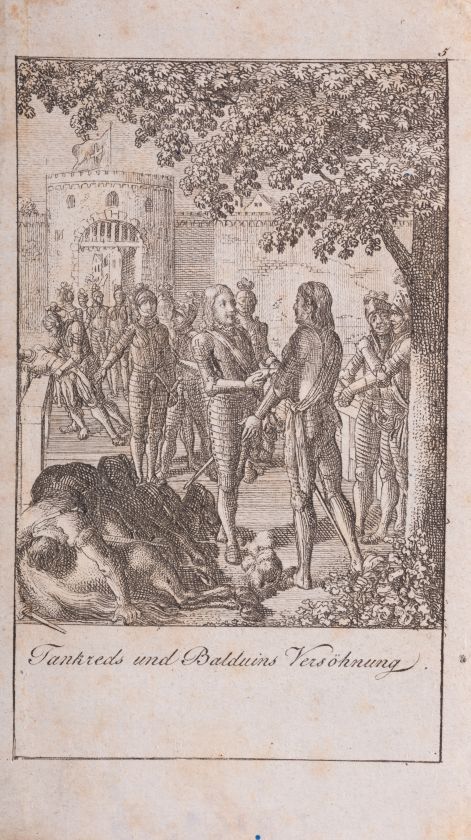
One of the twelve engravings from the "Brandenburgische Geschichte" ("History of Brandenburg") series in the 1790 Berlin "Historisch-Genealogischer Calendar". It depicts both historical and everyday scenes. It was with this series that the artist began his work on pocket calendars.
The composition depicts a banquet scene involving a wealthy family, taking place in the background. However, the artist focuses his attention on the foreground, where a young man and a young woman are seated at a table. The young couple in love wear wreaths on their heads, symbolising youth and prosperity. In this way, the artist emphasises the contrast between formality and informality. The artist renders the interior details, highlighting the solid construction of the house – the ceiling, supported by sturdy wooden beams, and the floor, laid with slabs. Judging by the elegance of their attire, the young man and woman also belong to the aristocracy, although they are seated separately from the older generation.
The composition depicts a banquet scene involving a wealthy family, taking place in the background. However, the artist focuses his attention on the foreground, where a young man and a young woman are seated at a table. The young couple in love wear wreaths on their heads, symbolising youth and prosperity. In this way, the artist emphasises the contrast between formality and informality. The artist renders the interior details, highlighting the solid construction of the house – the ceiling, supported by sturdy wooden beams, and the floor, laid with slabs. Judging by the elegance of their attire, the young man and woman also belong to the aristocracy, although they are seated separately from the older generation.
Inscriptions
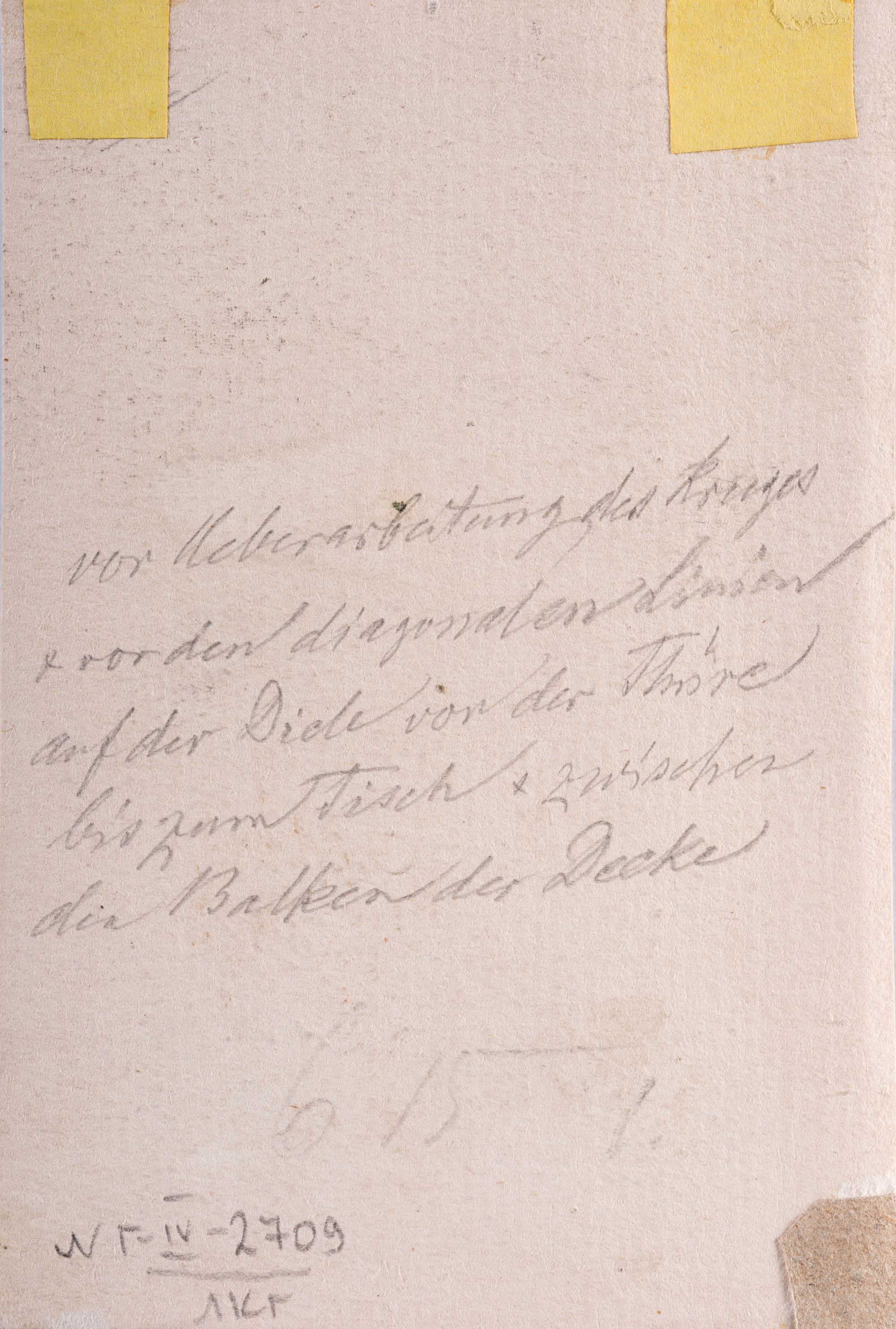
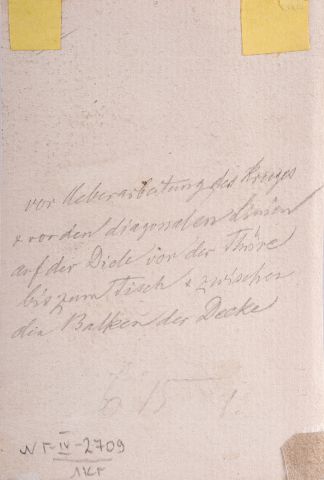
Below the image on the left, the artist's inscription is engraved: "D. Chodowiecki del. & sc. 1789". On the reverse in the centre, there is a text in pencil in German cursive, in Kurrent script: "vor Ueberarbeitung des Kreuzes vor den diagonalen Linien auf der Diele von der Thüre bis zum Tisch zwischen die Balken der Decke", presumably written by a collection keeper in the 19th–20th centuries. Below is the inventory number of the Lviv Picture Gallery.
Legal regulation
Borys Voznytskyi Lviv National Art Gallery