Back

Female Fashion in the Second Half of the 18th Century. From the "Berlin Attire" ("Habilemens Berlinois") Series

Daniel Chodowiecki
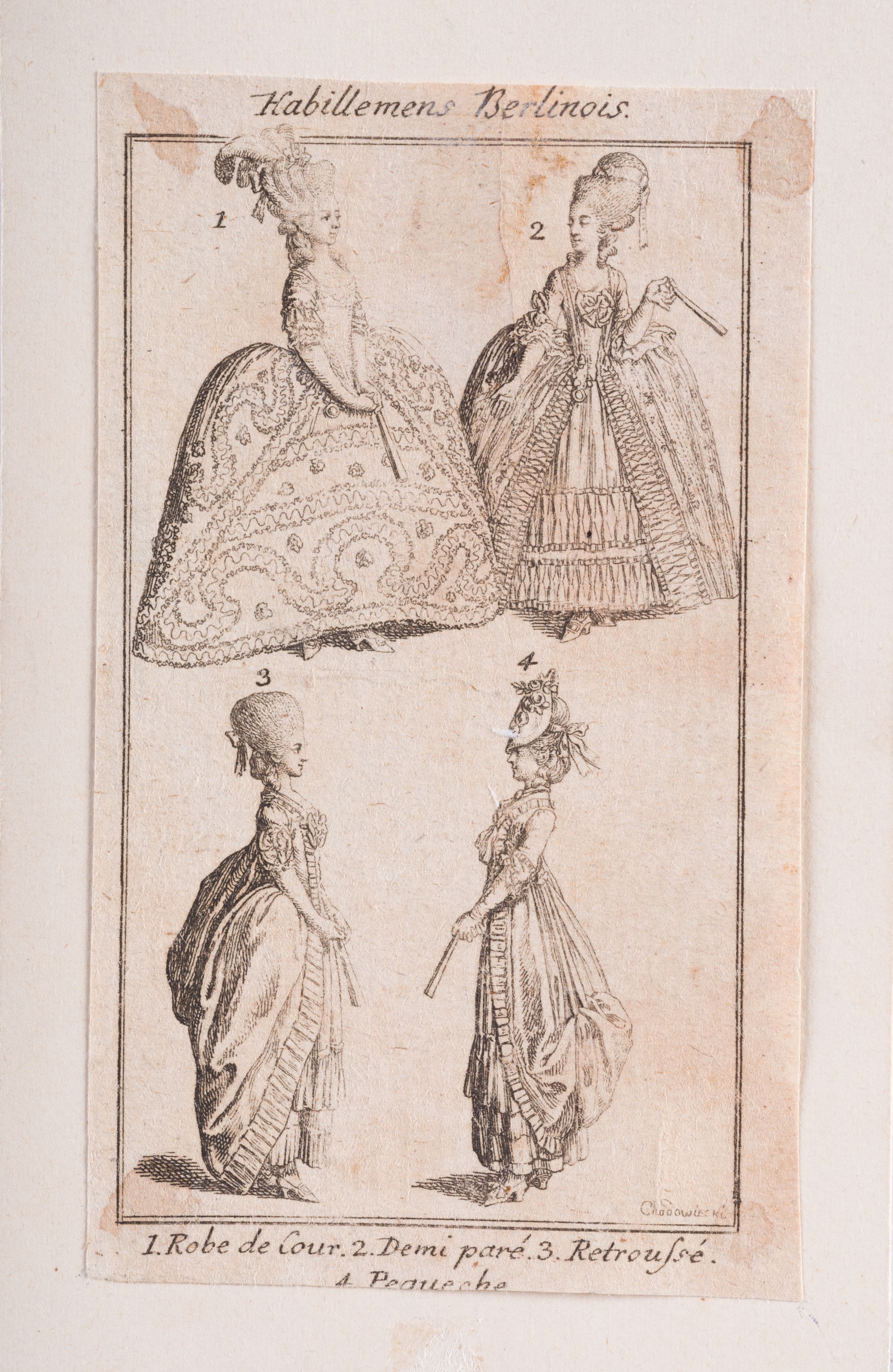
  • Female Fashion in the Second Half of the 18th Century. From the "Berlin Attire" ("Habilemens Berlinois") Series
Basic information
ID
Г-IV-2851
Author
Daniel Chodowiecki
Name
Female Fashion in the Second Half of the 18th Century. From the "Berlin Attire" ("Habilemens Berlinois") Series
Country
Germany
Technique
etching
Material
paper
Dimensions
9.1 x 5.2 cm (height x width)
Additionally
Information about author
Author
Daniel Chodowiecki
Artist's lifetime
1726–1801
Country
Poland, Germany
Biography
Daniel Nikolaus Chodowiecki (1726, Gdańsk – 1801, Berlin) – a Polish-German artist, printmaker and painter, a master of etching and book illustration, a representative of the academic movement, and one of the leading exponents of sentimentalism in 18th-century German art.
The artist's father was a merchant, a descendant of a noble family. His mother came from a family of Swiss Huguenots. The young Daniel, continuing the family tradition, began working as a merchant. At the age of 17, he went to Berlin for a commercial apprenticeship, where he spent most of his life. Towards the end of his career, he became the director of the Prussian Academy of Arts (Preußische Akademie der Künste).
In the 1750s, the artist developed an interest in painting, and later in printmaking, becoming one of the leading book illustrators. Between 1770 and 1774, together with Johann Bernhard Basedow, the founder of the philanthropic movement in education, he worked on the four-volume publication "Elementary Textbook for Young People" ("Elementarwerk für die Jugend"). Chodowiecki created over 100 illustrations for it using the copper engraving technique, including some dedicated to the Crusades.
In 1781, the artist produced 12 illustrations for a play by Gustav Friedrich Wilhelm Großmann entitled "No More Than Six Dishes" ("Nicht mehr als sechs Schüsseln"). This comedy, with its strongly social-critical undertones, is considered one of the earliest outstanding dramatic works in German bourgeois literature.
Around 2,000 engravings by Chodowiecki on various subjects, executed in the techniques of etching and copper engraving, have survived to this day. One of his contemporaries wrote that, were it not for Chodowiecki's illustrations, countless books would never have found their readers. The artist created a large number of painted and graphic portraits, as well as genre scenes of burgher life, mostly executed in pen and ink. The total number of the artist's surviving drawings amounts to around 4,000.
Daniel Chodowiecki's works are held in Germany – at the Kupferstichkabinett (Museum of Prints and Drawings) in Berlin, the Museum of Fine Arts in Leipzig, and the Städel Museum in Frankfurt; in Poland – at the National Museum in Gdańsk; in Ukraine – at Borys Voznytskyi Lviv National Art Gallery, Vasyl Stefanyk Lviv National Scientific Library of Ukraine and the Kharkiv Art Museum, as well as in museums in Washington, Madrid and London.
Object description
A plate from the German periodical "Journal des Luxus und der Moden", published in Weimar in 1781. It was adapted to French styles in the "Habilemens Berlinois" series. The image depicts four ladies in pairs, all dressed in the latest fashion of the era.
Inscriptions
At the bottom right is the artist's signature: "Chodowiecki". Below the border, the names of the garments are inscribed: "1. Robe de Cour" (formal court dress); "2. Demi-paré" (semi-formal dress); "3. Retroussée" (Polish-style dress); "4. Pequeche" (casual dress). Above the border of the print is the inscription: "Habilemens Berlinois".
Legal regulation
Borys Voznytskyi Lviv National Art Gallery
Link copied