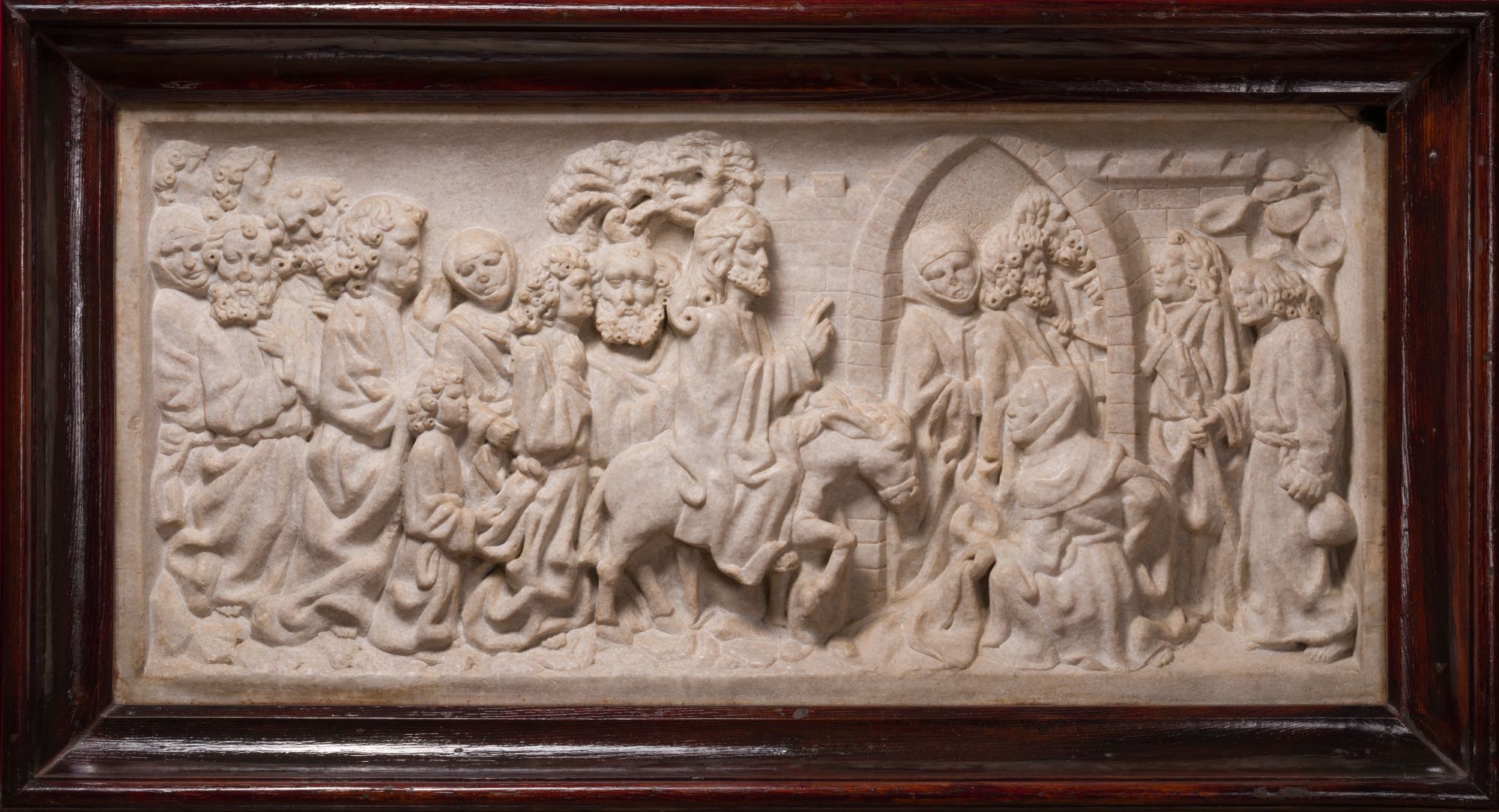
Entry into Jerusalem
unknown
Basic information
Additionally
- Type
- sculpture (high relief)
- Genre
- religious
- Provenance
- Museum of Jan III Sobieski in Lviv
- Exposition
- Olesko Castle
Information about author
Object description
The horizontal relief illustrates the gospel narrative – the Lord's Entry into Jerusalem – and serves as an expressive specimen of medieval sacred sculpture. The artwork is crafted from marble in the high relief technique, where individual characters almost completely detach themselves from the background plane, creating a powerful volumetric effect. The composition of the work reads from left to right, in accordance with the classical religious canon. The focal point of its compositional layout is the depiction of Christ riding a donkey, making a gesture of blessing with His right hand. This figure is distinguished by the elegance of its lines and a gentle forward movement.
The artist masterfully conveys spatial depth by arranging groups of human figures across several planes and bringing to the fore characters bowing in profound reverence. To the right of the Saviour, emerging from beneath a massive Gothic arch that symbolises the city gates, is a crowd of citizens who have come out to meet Him. The artwork retains the austerity of Late Gothic sculpture, which is evident in the modelling of the heavy, monumental folds of drapery that cascade in deep, vertical rhythms.
Nevertheless, the initial stirrings of Renaissance realism are already palpable within the work. There is a noticeable attempt by the artist to endow the characters with individual facial features and to communicate their psychological state through hand gestures, bodily postures, and the tilts of their heads. The monument is striking in its grandeur and internal dynamism. The stone space is occupied by emotionally uplifted people, creating an impression of solemnity and the immense significance of the event. Every line of the master's chisel is imbued with the breath of life, transforming the marble into a visual prayer frozen in the material.
Legal regulation
Borys Voznytskyi Lviv National Art Gallery