From the "Contest of the Seasons" Suite
Stefano della Bella
Basic information
- ID
- Г-IV-881
- Author
- Stefano della Bella
- Name
- From the "Contest of the Seasons" Suite
- Country
- France
- Technique
- etching
- Material
- paper on cardboard
- Dimensions
- 8.3 x 6.7 cm (height x width)
Additionally
- Type
- graphic art
- Provenance
- Received from the Lviv Historical Museum, 1954
Information about author
Object description
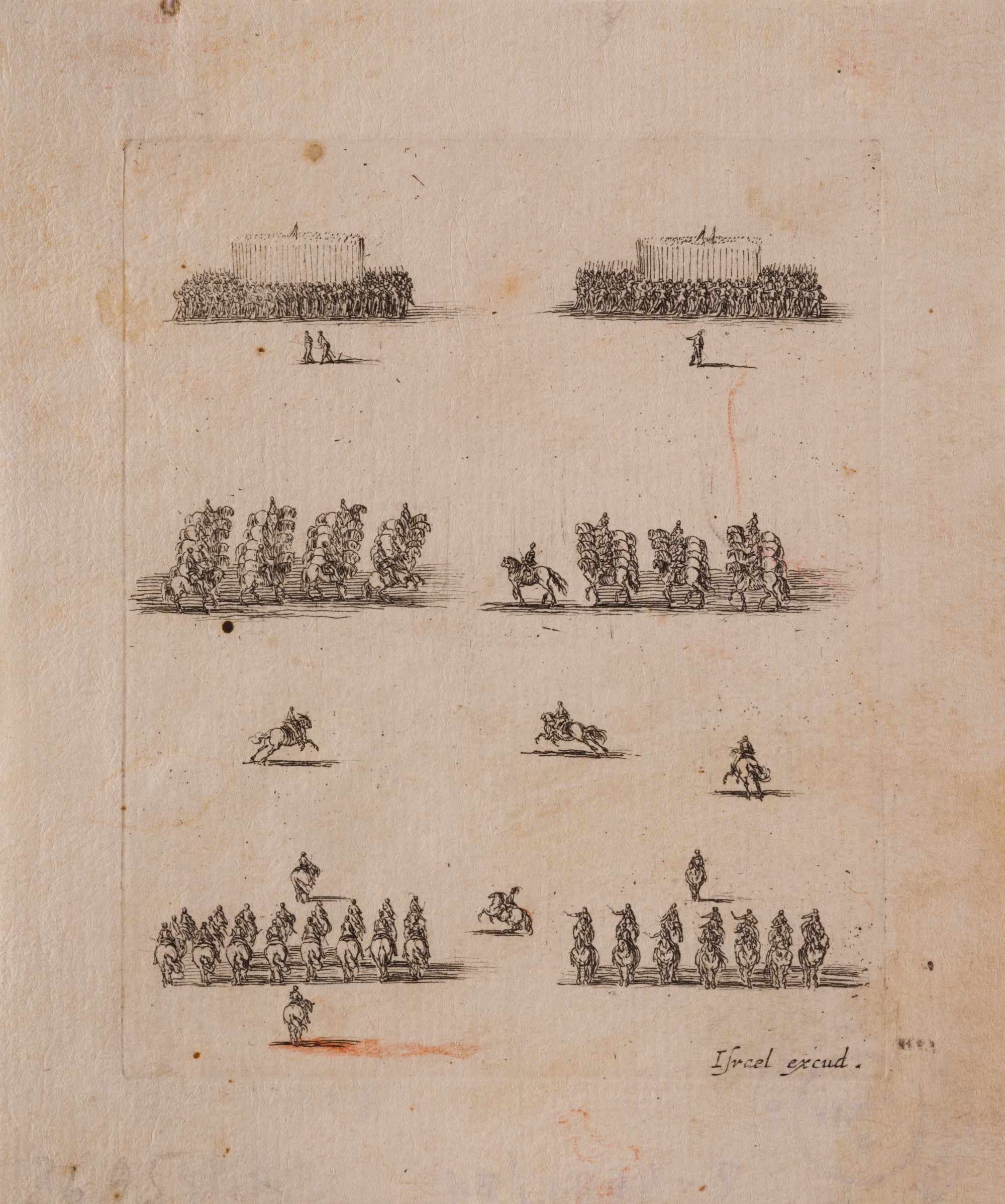
In 1652, a large-scale Baroque spectacle took place in the Italian city of Modena – an equestrian knightly tournament-carousel entitled "La gara delle Stagioni" ("The Contest of the Seasons"). This festival was organised to celebrate the solemn arrival in the city of the Austrian Archdukes Ferdinand Charles and Sigismund Francis, as well as Archduchess Anna of Tuscany.
In that era, a "carousel" (Italian: carosello) referred to complex equestrian ballets, parades, and theatrical knightly competitions that replaced medieval bloody tournaments. The riders demonstrated high mastery in controlling their horses, moving according to clearly defined geometrical patterns.
This event entered art history thanks to a series of detailed etchings by Stefano della Bella, who documented the celebration on commission from the Duke of Modena.
The work is executed in the master's characteristic miniature and dynamic style. On the sheet, several tactical stages or figures of the equestrian carousel are depicted vertically. In the top row, there are two large, tightly packed groups of horsemen lined up opposite each other. In the middle rows, the riders break into smaller detachments and perform various manoeuvres, while individual figures are presented in dynamic motion – during a gallop and duel clashes.
In the bottom row, the cavalry regroup, forming clear ceremonial columns under the leadership of commanders.
The work demonstrates Stefano della Bella's exceptional talent for depicting horses, battle scenes, and mass military manoeuvres with extraordinary detail on a small format.
The print was published in Paris by the artist's close friend and regular publisher, Israël Henriet. This is evidenced by a characteristic engraved inscription in the bottom right corner of the impression below the image: "Israеl excud.", which is an abbreviation for "Israel excudit" – [Israel published it].
Similar prints are held in the collection of the Metropolitan Museum of Art (New York) and other major graphic collections.
Inscriptions
Engraved bottom right below the image is the name of the suite's publisher: "Israеl excud.". Inscribed in pencil on the mounting board on the left, underneath the sheet, is the gallery's inventory number: "№ Г-IV-881/ ЛДКГ".
Legal regulation
Borys Voznytskyi Lviv National Art Gallery