Back

Portrait of the Son

Yulian Zaiats
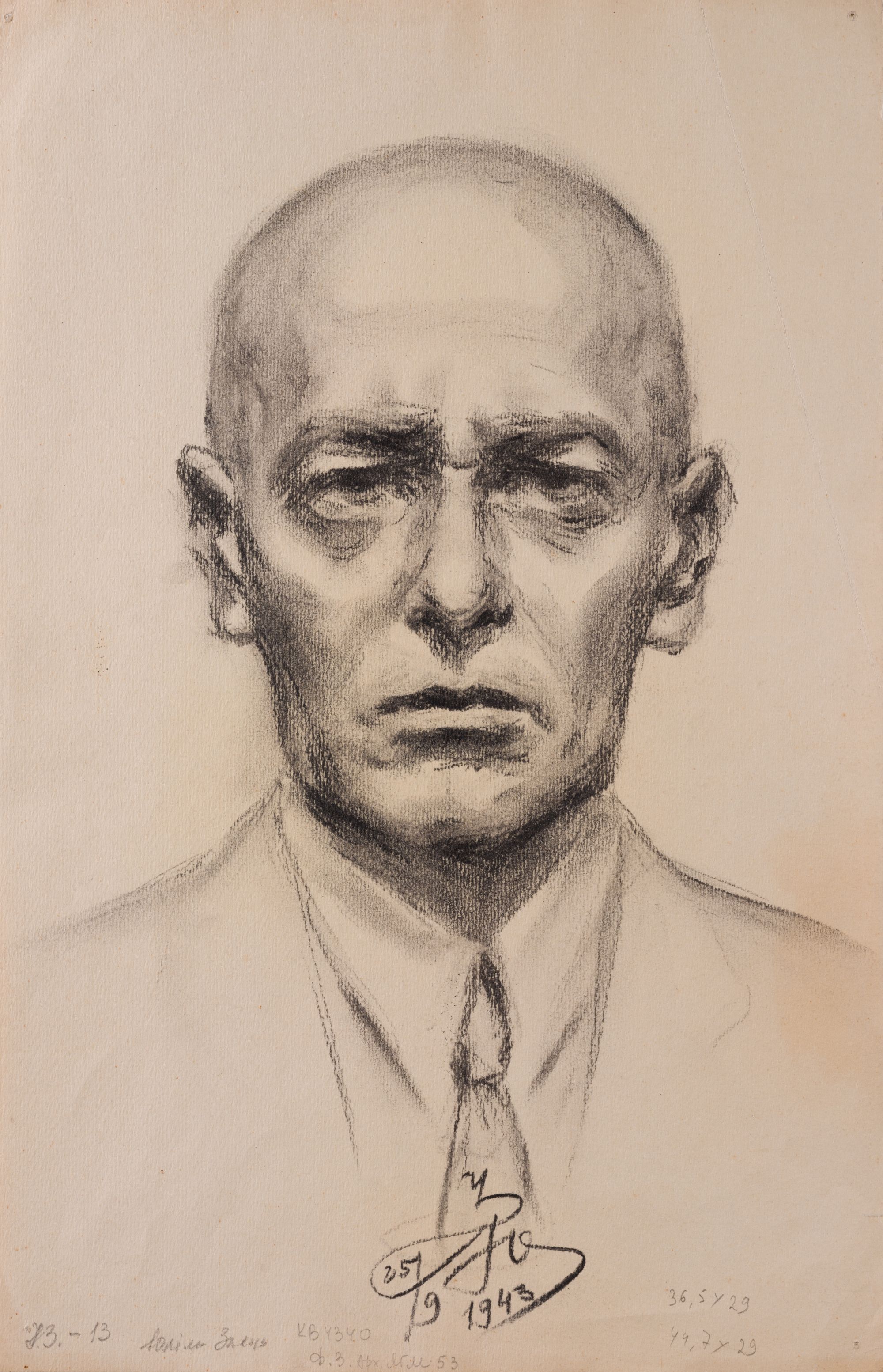
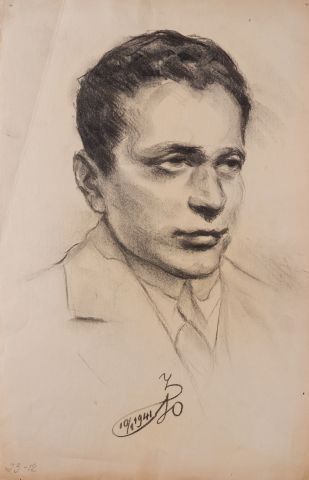
  • Portrait of the Son 1
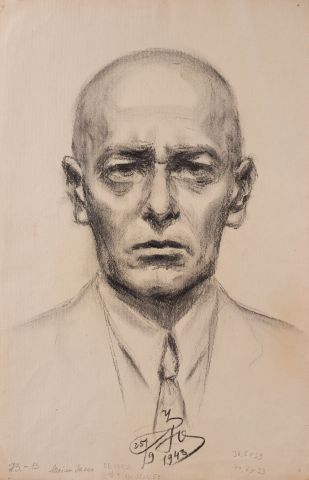
  • Portrait of the Son 2
  • Portrait of the Son 1
  • Portrait of the Son 2
Basic information
ID
Ф-З-Арх-ЛГМ-53
Author
Yulian Zaiats
Name
Portrait of the Son
Technique
drawing
Material
paper charcoal
Dimensions
44.7 x 29 cm (height x width)
Additionally
Type
graphic art
Genre
portraiture
Plot
Portrait
Information about author
Author
Yulian Zaiats
Artist's lifetime
1880–1971
Country
Austro-Hungarian Empire, the Second Polish Republic, the USSR
Biography
Yulian Zaiats (May 30, 1880, Bohutyn, Austro-Hungarian Empire, now Pomoriany district, Lviv region – September 2, 1971, Lviv, Ukrainian SSR) was a Ukrainian artist, lawyer, scholar, bibliographer, and cultural figure. According to some sources, he was the son of a Greek Catholic priest.

He initially studied at a gymnasium in Lviv (graduating with honours in 1899). The artist then enrolled in the law faculty of Lviv University, but for political reasons transferred to the Jagiellonian University in Krakow (1901). At the same time, he enrolled in the Kraków Academy of Fine Arts, where he studied under Leon Jan Wyczółkowski (11 April 1852 – 27 December 1936). According to researcher Oleh Kupchynskyi, he was actively involved in research work. In 1902, he submitted his scientific work, "Usus fructus nominis", to the historical and philosophical section of the Shevchenko Scientific Society, which was published in the "Journal of Law and Economics." It should be noted that, based on the results of this work, Julian Zayats defended his doctoral dissertation in 1907. He then worked as a lawyer in the State Treasury Prosecutor's Office (Lviv). In addition, in 1909 and 1912, he improved his legal qualifications in Berlin, where he prepared a scientific work entitled "Jus iurandum in litem." According to researcher Oleh Kupchynskyi, he attended lectures at the Berlin Academy of Arts by the renowned German painter and graphic artist of Jewish origin, Max Liebermann (July 20, 1847–February 8, 1935). However, during this period, the artist did not teach regularly at this institution and was only appointed to the Senate of the Berlin Academy of Arts in 1912.

It should be noted that after World War I, Yulian Zaiats worked as an employee of a private law firm in Komarne (now the centre of the Komarne municipal community in the Lviv region), and later as a lawyer in Lviv. Yulian Zaiats also taught Roman law at the Ukrainian Secret University and was a permanent legal advisor to Metropolitan Andrei Sheptytskyi. He joined the Legal Commission of the Shevchenko Scientific Society and became a member of one of the key parties in the region at that time, the Ukrainian National Democratic Union. During the Second Polish Republic (1918–1939), Yulian Zaiats authored appeals to the League of Nations and the Vatican regarding the violent measures against Ukrainians within the framework of military-police terror, the so-called “Polish pacification”, initiated by the leader of this state entity, Jozef Pilsudski. At the same time, in the 1920s, he was invited to work at the Lviv branch of the Financial Prosecutor's Office of the Polish State Treasury. Later, before the annexation of the western Ukrainian lands to the Ukrainian SSR, he was a judge of the Supreme Administrative Tribunal of Poland in Warsaw (1939). From 1941, he was president of the Court of Appeal (Lviv).

After the end of the Nazi occupation, he was arrested as a person who could have been involved in the crimes of the occupiers. At the request of the intelligentsia (according to documents from the archives of the Security Service of Ukraine, first published in the works of scholars Mykola Kobyletskyi and Lesia Trepak), in particular, Metropolitan Andrei Sheptytskyi, and the head of the National Museum, Ilarion Svientsitskyi, the criminal case against Yulian Zaiats was closed. In 1945, he began teaching at Lviv State University, and from 1946, he worked as a bibliographer at the Scientific Library of the V. Stefanyk Academy of Sciences of the Ukrainian SSR. In 1951, the artist failed to pass the certification due to a lack of professional qualifications, but with the permission of the Certification Commission, he held the position of librarian from 1953 until his retirement.

During his time as a bibliographer, Yulian Zaiats produced a number of bibliographic works: “Materials for the Bibliography of M. Voznyak” (1946), “Bibliography of the works of M. P. Drahomanov” (1947, co-authored), “Bibliography of the history of the city of Lviv” (parts 1–2, 1948) – however, none of them were ever published. He was into collecting art and old books, and did some painting and drawing. Participated in art exhibitions in Lviv (1929–1932, 1934, 1935, 1937, 1943; National Museum and Ukrainian Society of Art Lovers), in Warsaw (Polish Society of Art Lovers in the “Zachęta” Salon), and other cities. Among his well-known works are “Lady in Blue”, “Daughter”, “Self-Portrait”, “Boy”, “Church in Krasne”, “Church in Kryvchytsi”, Flowers”, and “The Kaminka River”, which were highly praised in the press and exhibition catalogues of the time.

Additionally, he possessed a distinctive vocal talent and a powerful tenor voice. According to researcher Oleh Kupchynskyi, he graduated from the Lviv Conservatory (class of Nestor Nyzhankivsky). However, from 1928, Nestor Nyzhankivsky (August 31, 1893–April 10, 1940) taught at the Mykola Lysenko Higher Music Institute in Lviv. Also, according to Oleh Kupchynskyi, Yulian Zaiats performed solo concerts in Lviv, Warsaw, and other cities and participated in annual holiday programs for Shevchenko Days in Galicia. Between 1920 and 1926, he served as the leader of the “Muse” singing society. As for the artist's legacy, thanks to the efforts of Ilarion Svientsitskyi, a significant collection of his works is housed in the Andrei Sheptytskyi National Museum in Lviv, and some works are in the art department of the Lviv Library of the Vasyl Stefanyk National Academy of Sciences. According to researchers Mykola Kobyletskyi and Lesia Trepak, twenty works by Yulian Zaiats were purchased by the State Tretyakov Gallery in Moscow.

An important part of Yulian Zaiats' creative legacy is a series of graphic works currently stored in the Archive of Artists and Cultural Figures of the Borys Voznytskyi Lviv National Art Gallery, which provide valuable insights into the specifics of the educational process as well as the priorities in more conservative artistic circles focused on developing a realistic visual language through careful study of nature and the creative work of artists of past eras, especially those who practised the faithful reproduction of people and the world around them.
Object description
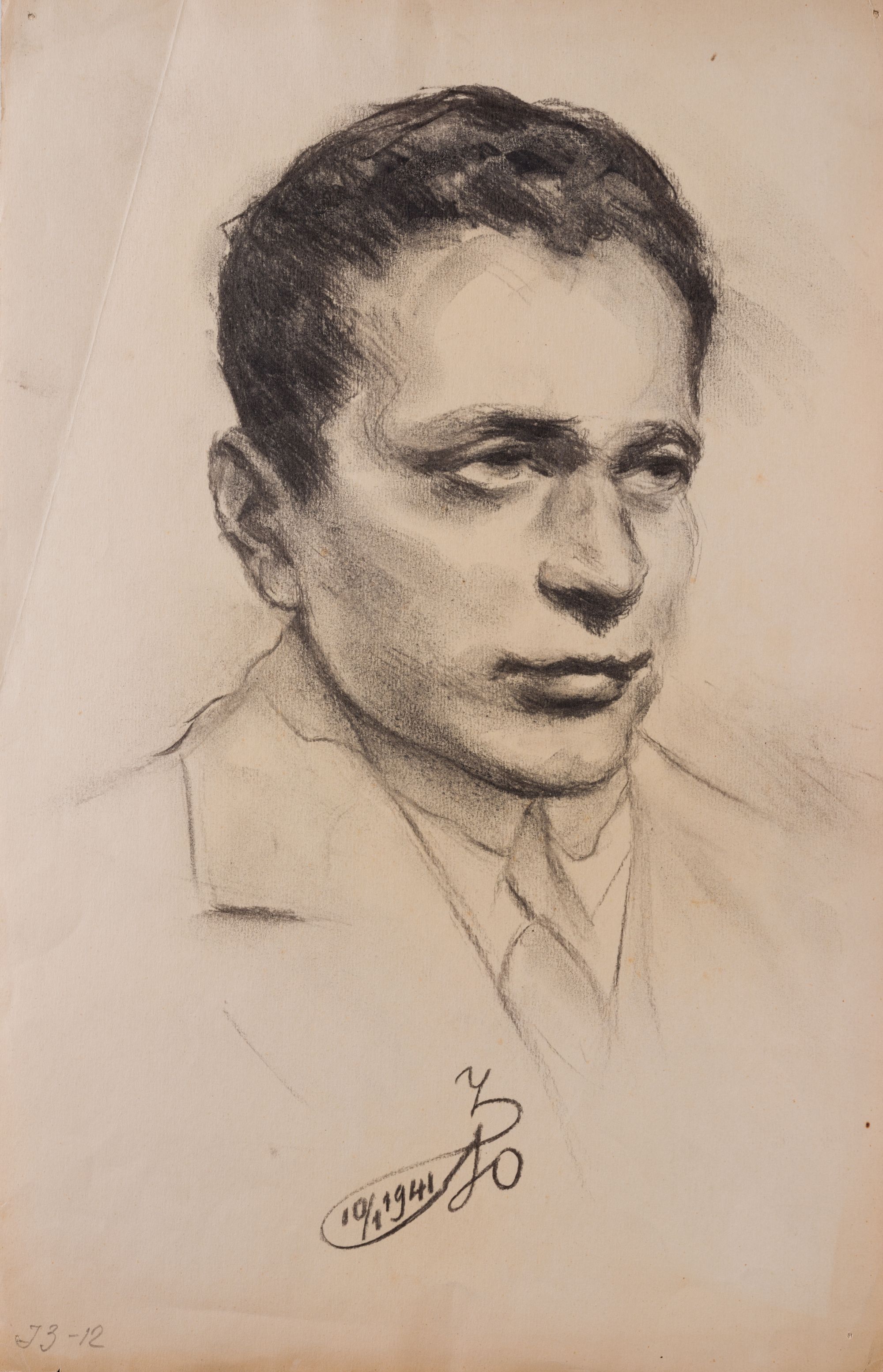
This sheet contains two independent graphic works: a half-length portrait of the artist's son on the obverse and a self-portrait on the reverse (each image size: 36.5 × 29 cm). They are executed in charcoal on cream-ochre paper, the tint of which is caused by natural oxidation.
The obverse depicts a half-length portrait of a young man, the artist's son, with his head turned to the left. He is dressed in a jacket and a tie. The model's hair is thick and combed back. The facial features are elongated, and the gaze is directed downwards and to the side, giving the image a thoughtful, introspective character. The technique used is a charcoal drawing with subtle tonal shading of the hair and facial shadows. The contours of the clothing are rendered with a quick, sketchy line.
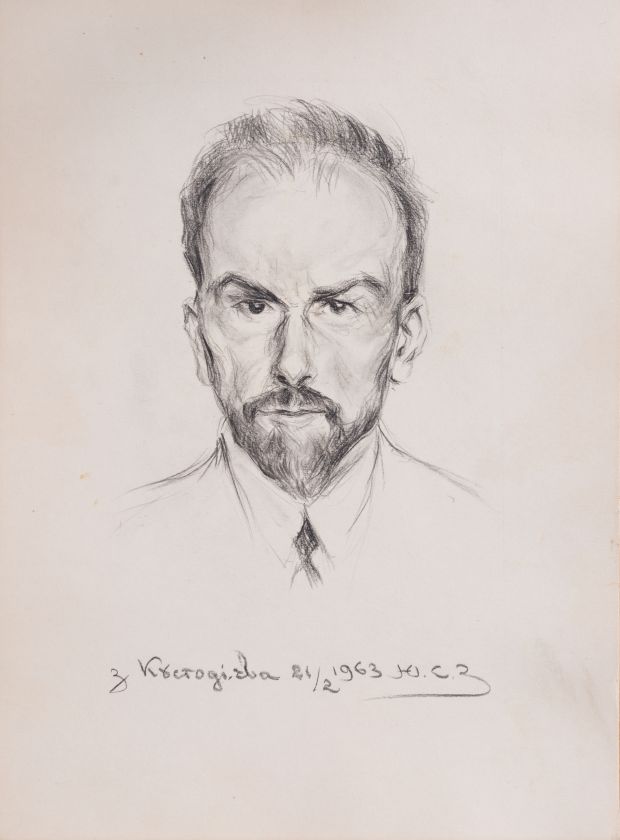
On the reverse, another independent work is presented – a half-length self-portrait of the artist in his senior years. The model features a high forehead, distinct age-related alopecia, and deep-set eyes beneath heavy brows. Vertical wrinkles are noticeable on the bridge of the nose. The man's gaze is directed straight at the viewer, and his facial expression is focused, somewhat sombre. He is dressed in a jacket and a tie, which are outlined with free, slightly unfinished strokes. This contrasts with the meticulously modelled face, where the chiaroscuro accentuation of the cheeks, cheekbones, and lips is highlighted by delicate hatching and shading. The manner of execution reflects the traditions of the Academic school of portraiture, with particular attention to anatomical precision and facial expression.
Both works share the artist's monogram, the form of which is identical on both sides of the sheet. This indicates that they were created by the same hand and, possibly, belong to the same series of preparatory portraits from 1941–1943. The condition is satisfactory; no significant damage to the paper support has been detected, and slight yellowing along the edges of the sheet is natural.
Inscriptions
In the centre below on the sheet: the artist's monogram and the date "10/1 1941". On the reverse in the centre below: the artist's monogram and the date: "25/9 1943".
Portrayed person
The name of the person portrayed
Ivan Zaiats
Legal regulation
Borys Voznytskyi Lviv National Art Gallery
Link copied