Depiction of Jan III Sobieski as Equestrian
unknown
Basic information
- ID
- Ж-6116
- Author
- unknown
- Name
- Depiction of Jan III Sobieski as Equestrian
- Date of creation
- 19th c.
- Country
- Ukraine
- Technique
- oil painting
- Material
- canvas oil
- Dimensions
- 64.6 x 86.5 cm (height x width)
Additionally
- Type
- painting
- Genre
- battle painting
- Provenance
- Lviv Historical Museum
- Exposition
- Olesko Castle
Information about author
Object description
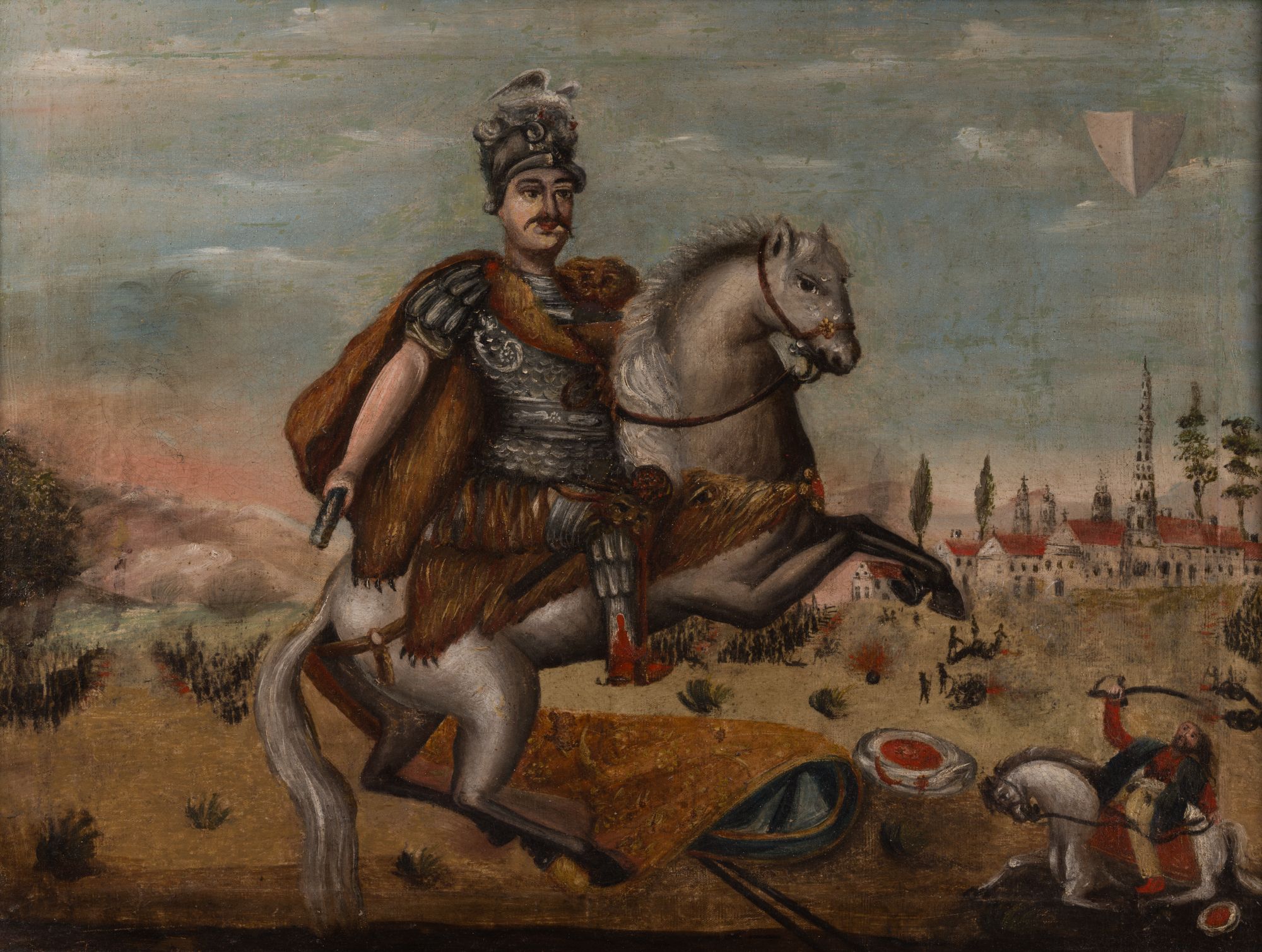
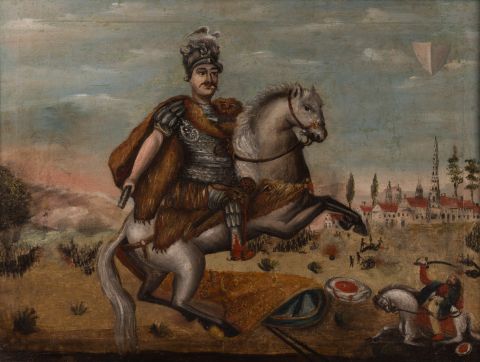
The canvas represents Jan III Sobieski on horseback as the glorious victor over the Turks at the Battle of Vienna in 1683. The compositional solution of the artwork bears a distinctly historical and heroic character, with the central figure being a rider on a white horse caught in a moment of rapid movement. The man is depicted in knightly armour, the texture of which is rendered through alternating light-grey and white patches, creating the illusion of metal without the need to delineate every single detail. The drawing of the rider's figure is distinguished by a generalised, decorative quality. The author of the artwork does not strive for anatomical detail in the academic sense. The King's face bears an expression of resoluteness.
The silhouette of the horse deserves special attention: its forelegs are raised and its body is reared back, creating a sense of active exertion. The horse is not merely a means of transport for the main protagonist, but a unique extension of the action, movement, and unbridled energy of the rider. The depiction of a Turkish rider whose horse has dropped to its forelegs before Jan III is highly symbolic. This moment underscores Sobieski's victory at Vienna.
The horizontal line of the cityscape in the background balances the dynamic composition of the foreground. The architectural staffage does not occupy much space on the canvas, yet it draws attention due to its colouristic treatment. The vertical spires and towers of the city form a rhythmic counterpoint to the horizontal ground plane and the diagonal movement of the rider. Red touches on the clothing and architectural elements function as local colouristic accents. The author of the artwork prioritises the emotional essence of the scene over spatial perspective. The artistic style of the work synthesises elements of military and historical themes with a somewhat naive folk approach, creating the effect of a pictorial narrative filled with drama and patriotic spirit.
Legal regulation
Borys Voznytskyi Lviv National Art Gallery