Virgin and Child
unknown folk craftsman
Basic information
- ID
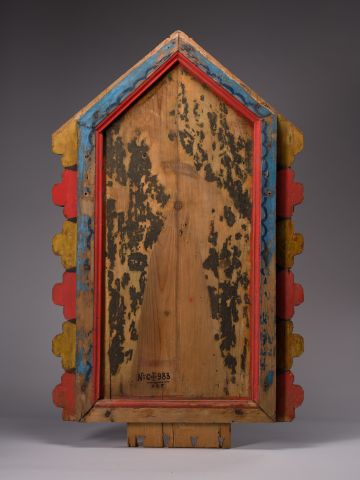
- С-I-983
- Author
- unknown folk craftsman
- Name
- Virgin and Child
- Date of creation
- 18th c.
- Country
- Ukraine
- Culture
- Folk
- Technique
- carving polychromy
- Material
- wood
- Dimensions
- 96 x 57 x 7 cm (height x width x depth)
Additionally
- Type
- sculpture (low relief)
- Genre
- religious
- Plot
- Madonna. The Virgin Mary and Christ Child
- Provenance
- Zhornyska village, Yavoriv district, Lviv region
Information about author
Object description
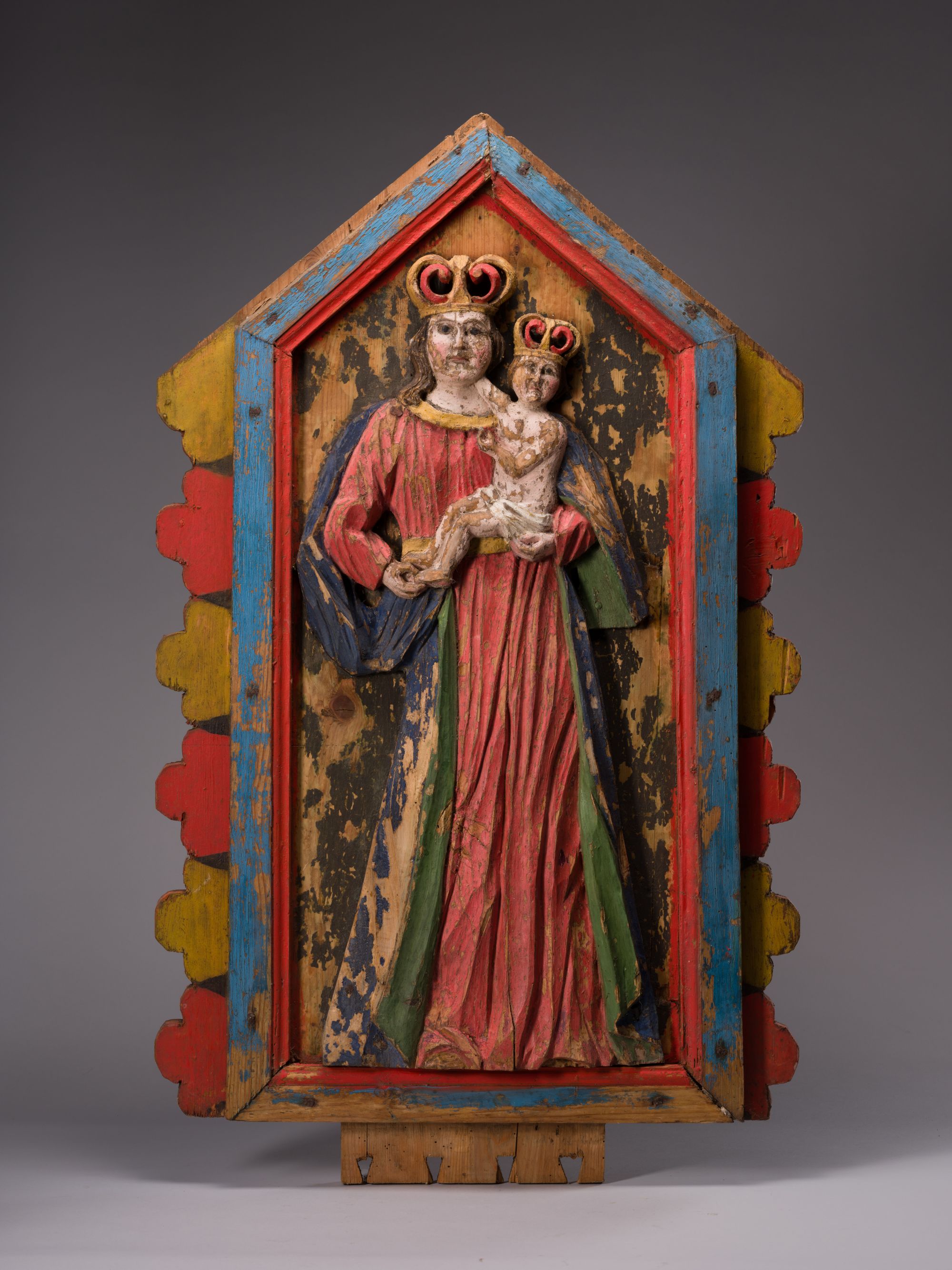
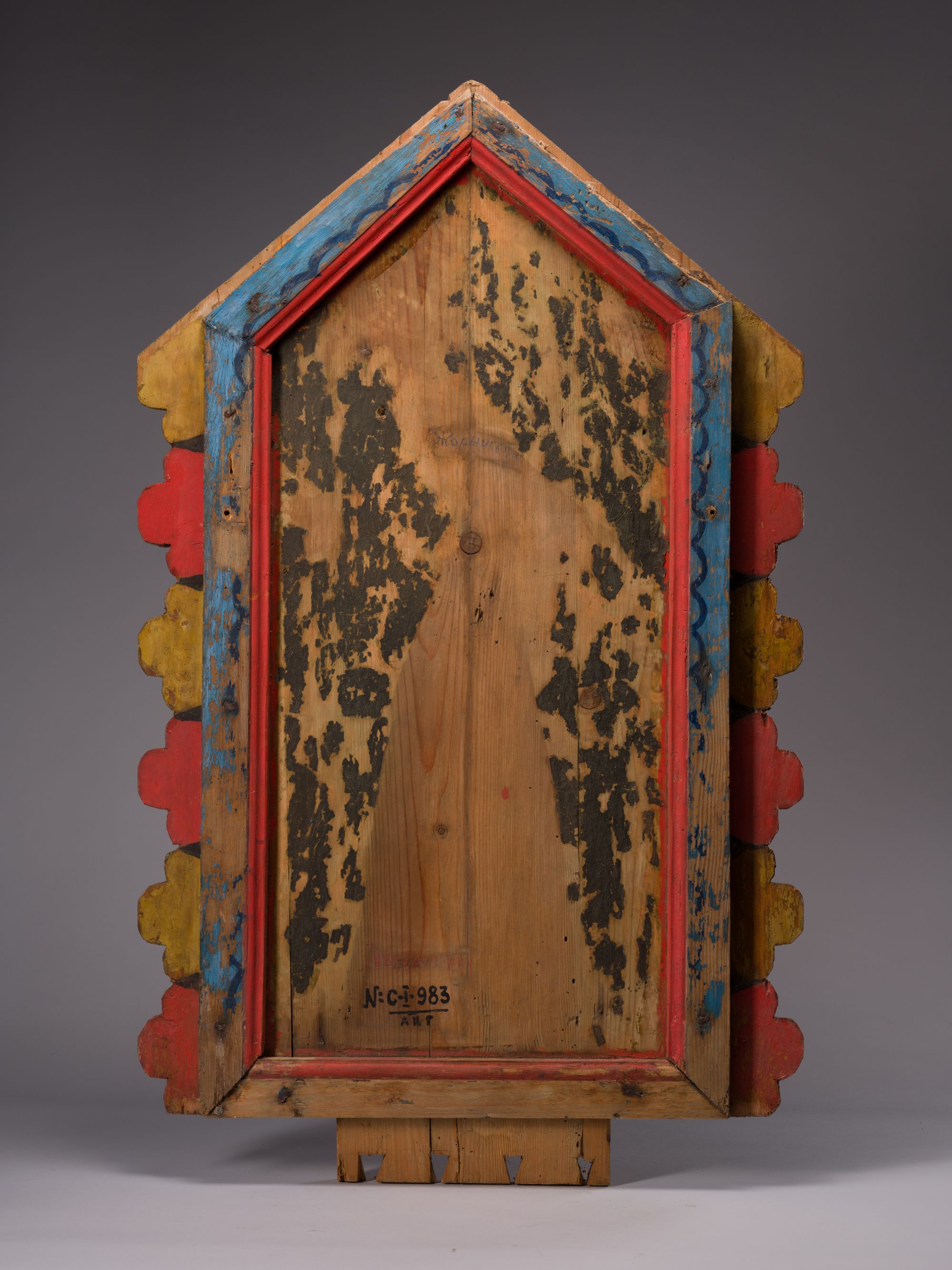
A characteristic example of folk sacred plastic arts is the relief depiction of "Virgin and Child", originating from a provincial workshop where the iconographic prototypes of the Byzantine tradition were reinterpreted by local masters through the prism of the folk worldview. The main image (size – 71×30×3 cm) occupies the central part of a pointed wooden base framed by decorative figurative carving. Such a festooned contour, rhythmically bordering the icon on both sides, is a typical technique of folk carving in the Carpathian region. It functions as a kind of aura that underscores the high sacred status of the depicted image.
At the centre of the composition is a frontal, full-length figure of the Mother of God holding the Infant Christ on her left arm. The Holy Virgin is dressed in a long red tunic, over which is a blue maphorion. The attire is rendered with shallow, rhythmic vertical lines of folds. The head of the saint is crowned with a mitre-like crown – an attribute of the Queen of Heaven. The face is executed in a generalised, flattened manner, characteristic of folk iconography, where psychological portraiture gives way to the canonical, iconic stillness of the image. Wide-open eyes, expressive dark eyebrows, small lips, and plump cheeks characterise the countenance of the saint. The Infant Christ is depicted semi-naked, turned towards the viewer, with his right hand raised in a gesture of blessing. The rhythmic repetition of crowns on both figures creates compositional and semantic symmetry, emphasising the affinity and complementarity of the images of mother and child.
The colour scheme of the work is based on contrasts of rich pigments, dominated by red and blue. Despite the extensive loss of polychromy, the artistic expressiveness of the work is not diminished; on the contrary, it lends the piece additional emotional depth and bears witness to the long liturgical history of the artifact. The work is executed in low relief, flatly, without any striving on the master's part for voluminous sculptural modelling of the figures. The contours of the figures are outlined linearly, and the folds of the clothing are reproduced using conventionally rhythmic vertical grooves. This stylism is a characteristic feature of naive folk carving, where the absence of an academic school is compensated for by the sincerity and spontaneity of the artistic interpretation of the image.
Legal regulation
Borys Voznytskyi Lviv National Art Gallery