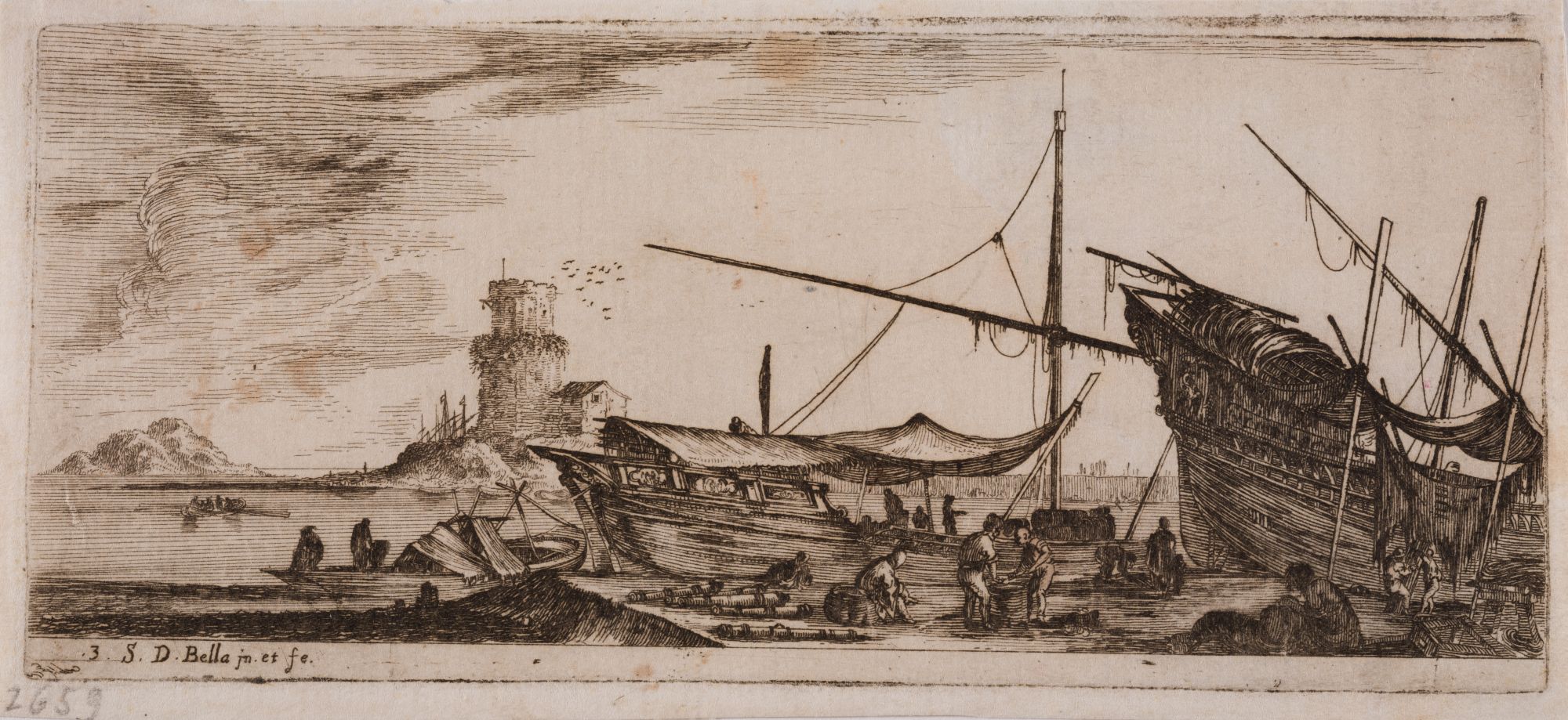
Ships in the Port of Livorno. From the "Set of Eight Nautical Landscapes" (Suite de huit Marines) Series
Stefano della Bella
Basic information
- ID
- Г-IV-900
- Author
- Stefano della Bella
- Name
- Ships in the Port of Livorno. From the "Set of Eight Nautical Landscapes" (Suite de huit Marines) Series
- Country
- France
- Technique
- etching
- Material
- paper
- Dimensions
- 7.3 x 17.2 cm (height x width)
Additionally
- Type
- graphic art
- Genre
- marine painting
- Provenance
- Received from the Lviv Historical Museum, 1954
Information about author
Object description
An impression from the third plate of the aforementioned series. The foreground and middle ground depict a bustling harbour, where large sailing vessels are either undergoing repairs or moored for unloading. On the right, the massive hull of a large ship with bare masts and furled rigging is drawn in detail. In the centre, a vessel covered with a canopy is presented, surrounded by the concentrated labour of dockworkers and sailors.
In the centre of the composition, in the background, rises a defensive round tower. It serves as an analogy to an architectural structure in the Tuscan port city of Livorno, which frequently served as a source of study from life for the artist's prints. Behind the tower on the left, the silhouettes of mountains and a calm sea under a cloudy sky are visible. Thanks to fine lines, the artist flawlessly renders the rigging of the ships, the details of the tower, the calm sea, and the expanse of the sky.
In the centre of the composition, in the background, rises a defensive round tower. It serves as an analogy to an architectural structure in the Tuscan port city of Livorno, which frequently served as a source of study from life for the artist's prints. Behind the tower on the left, the silhouettes of mountains and a calm sea under a cloudy sky are visible. Thanks to fine lines, the artist flawlessly renders the rigging of the ships, the details of the tower, the calm sea, and the expanse of the sky.
Inscriptions
Engraved at the bottom of the sheet on the left: "3 S.D. Bella jn. et fe.". In pencil beneath the impression on the left: "2659". On the left beneath the sheet on the mounting cardboard, there is a sticker with the stamp of the Lviv Historical Museum and the former print number in ink: "Г-4691/45", and above it, the current gallery collection number in pencil: "№ Г-IV-900/ ЛДКГ".
Legal regulation
Borys Voznytskyi Lviv National Art Gallery