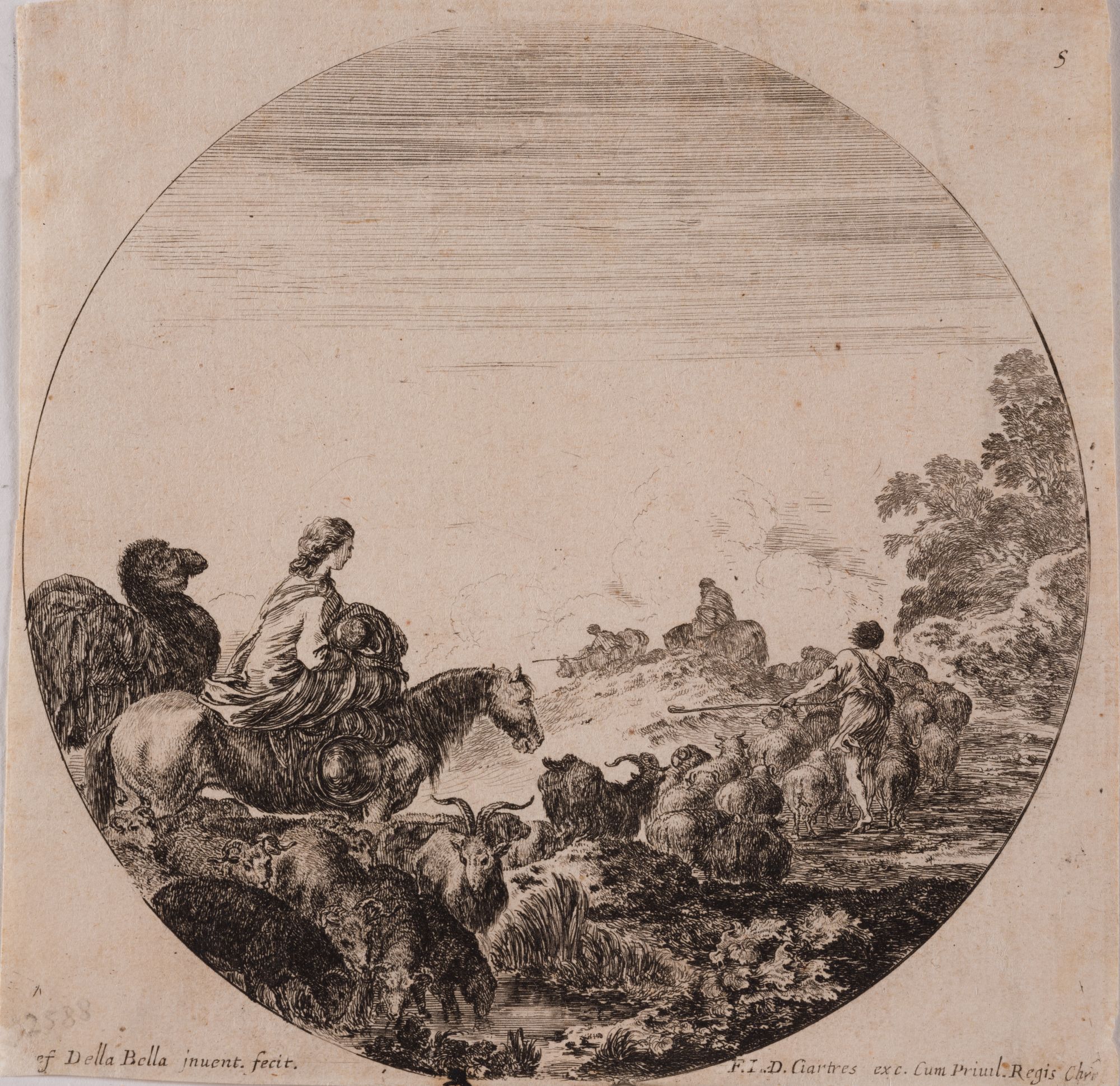
Woman on a Horse with a Camel and a Flock of Sheep and Goats. From the "Round Landscapes" or "Roman Landscapes and Ruins" Series
Stefano della Bella
Basic information
- ID
- Г-IV-917
- Author
- Stefano della Bella
- Name
- Woman on a Horse with a Camel and a Flock of Sheep and Goats. From the "Round Landscapes" or "Roman Landscapes and Ruins" Series
- Country
- France
- Technique
- etching
- Material
- paper
- Dimensions
- 13.5 x 13.5 cm (height x width)
Additionally
- Type
- graphic art
- Genre
- pastoral animal painting
- Provenance
- Received from the Lviv Historical Museum, 1954
Information about author
Object description
The work comes from the "Round Landscapes" series, created by the artist in Paris around 1646. The series consists of 13 prints. In some descriptions, the work is attributed to the "Various Caprices" ("Diversi capricci") series, as an exotic animal – a camel – is depicted among the herd of livestock, as well as to the "Roman Landscapes and Ruins" ("Paysages et ruines de Rome") series. The publisher of this series of prints was François Langlois (1589–1647), known as Ciartres or Chartres. He is considered the first prominent publisher of the French Baroque era.
The print has the shape of a tondo – an experimental format characteristic of della Bella.
In the foreground on the left, a young bareheaded woman is depicted riding a horse and holding a bundle in her arms, possibly her child. Standing beside the horsewoman is a bactrian camel. This adds an oriental, exotic flavour to the classic European pastoral landscape, typical of a Baroque capriccio scene. On the right, a dynamic scene unfolds: a shepherd with a staff is driving a dense flock of goats and sheep. In the distance, two of his companions on horseback can be discerned, their depiction opening up the space of the composition. On the right side, trees rise, serving as a coulisse in this scene. Below, in the foreground, several animals – goats and sheep – are drawn in detail.
The work demonstrates the author's masterful command of the etching technique. The artist uses parallel lines and refined hatching to reproduce volume, chiaroscuro, the texture of the animals' wool, the drapery of the clothing, and the lightness of the clouds in the sky.
Inscriptions
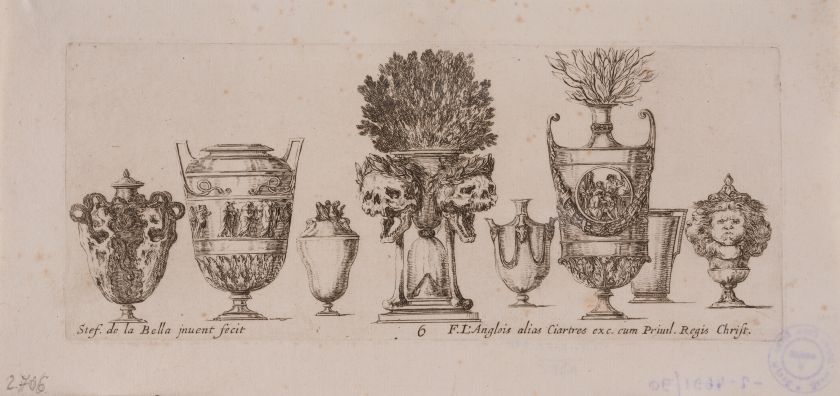
At the bottom of the impression on the left: "Stefano della Bella inuent. fecit.", on the right: "F. L. D. Ciartres exc. Cum Privil. Regis Christ." – [François Langlois, known as Ciartres, published with Royal privilege]. On the mounting cardboard beneath the sheet on the left, there is a sticker with the stamp of the Lviv Historical Museum and the former print inventory number in ink: "Г-4690/62", and above it, in pencil, the current gallery collection number: "№ Г-IV-917/ ЛДКГ". Pencil marks on the mounting cardboard: to the left of the print sheet at the bottom – "56", on the right – "63".
Legal regulation
Borys Voznytskyi Lviv National Art Gallery