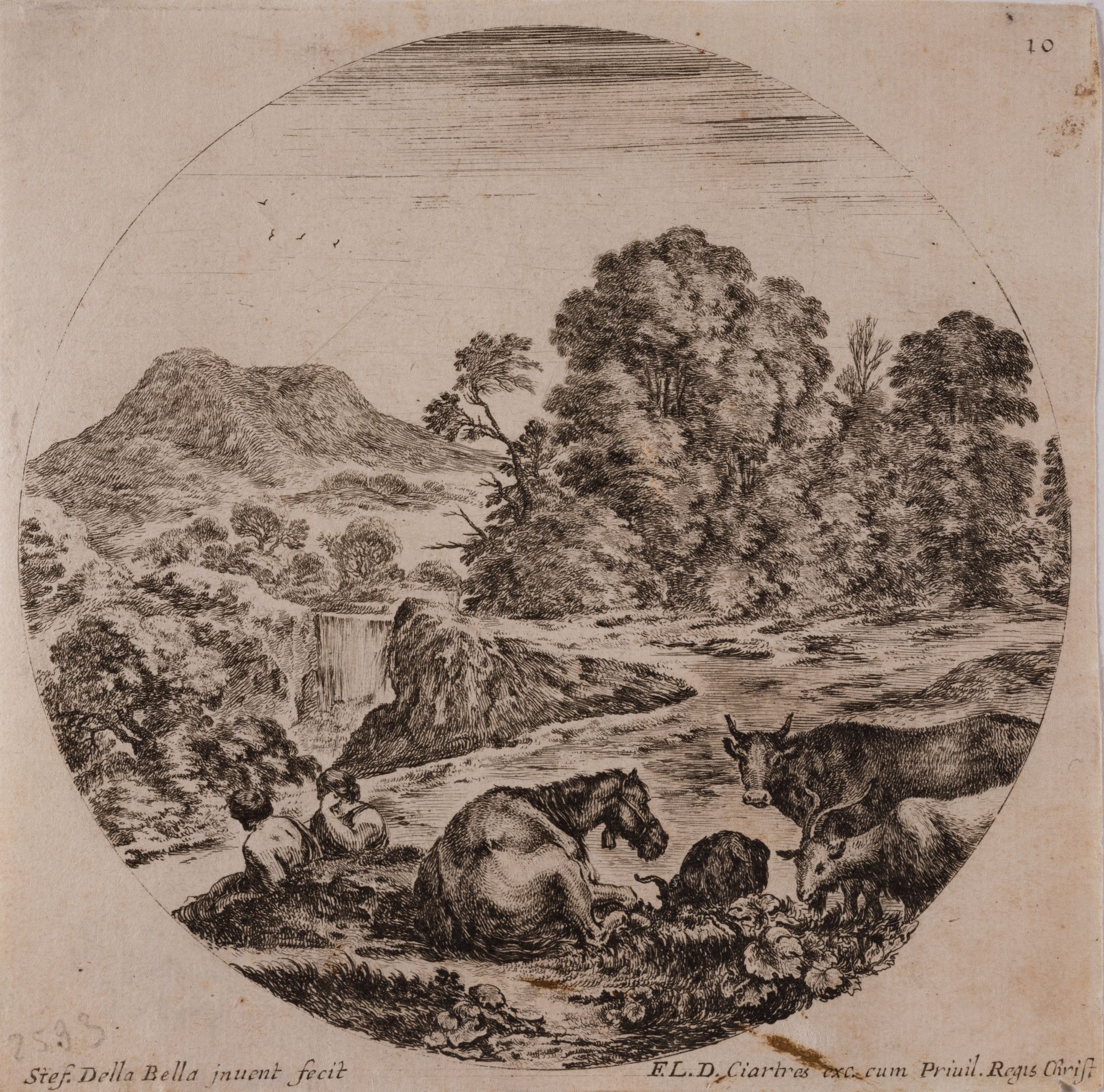
Landscape with Domestic Animals and Two Seated Shepherds. From the "Round Landscapes" or "Roman Landscapes and Ruins" Series, Plate 10
Stefano della Bella
Basic information
- ID
- Г-IV-922
- Author
- Stefano della Bella
- Name
- Landscape with Domestic Animals and Two Seated Shepherds. From the "Round Landscapes" or "Roman Landscapes and Ruins" Series, Plate 10
- Country
- France
- Technique
- etching
- Material
- paper
- Dimensions
- 13.5 x 13.5 cm (height x width)
Additionally
- Type
- graphic art
- Genre
- landscape animal painting
- Provenance
- Received from the Lviv Historical Museum, 1954
Information about author
Object description
The work comes from the "Round Landscapes" series, created by the artist in Paris around 1646. The series consists of 13 prints. In many catalogued descriptions, the work appears as a piece from the "Roman Landscapes and Ruins" ("Paysages et ruines de Rome") series, plate 10. The publisher of this series of prints was François Langlois (1589–1647), known as Ciartres or Chartres. He is considered the first prominent publisher of the French Baroque era.
The print has the shape of a tondo – an experimental format characteristic of della Bella.
The work is a classic example of a pastoral Baroque landscape. In the foreground in the centre, a horse is depicted lying on the ground. To its right is livestock, namely a cow and two goats eating leaves from a bush. On the left, two shepherds are resting. The background of the drawing is filled with detailed elements of wildlife. In the middle ground behind the figures of the shepherds, a steep mountain waterfall is visible, its bed descending from the foot of a tall rocky mountain. The right part of the middle ground is occupied by a dense cluster of trees with meticulously rendered foliage.
Della Bella uses extremely delicate, fine and flexible lines. Through the use of chiaroscuro, the artist alternates dense hatching in shaded areas with clean fields of paper to convey bright light.
Inscriptions
At the bottom of the print on the left: "Stef. Della Bella inuent. fecit", on the right: "F. L. D. Ciartres exc. cum Priuil. Regis Chrіst" – [François Langlois, known as Ciartres, published with Royal privilege]. Top right: "10". On the mounting cardboard on the left under the sheet, there is a sticker with the stamp of Lviv Historical Museum and the former inventory number of the engraving in ink: "Г-4690/65", above it in pencil, the current gallery collection number: "№ Г-IV-922/ ЛДКГ" (due to the positioning of the sticker under the sheet, the gallery number has been moved to the right). Pencil marks on the mounting cardboard: on the left near the bottom corner of the engraving sheet – "97", on the right – "68".
Legal regulation
Borys Voznytskyi Lviv National Art Gallery