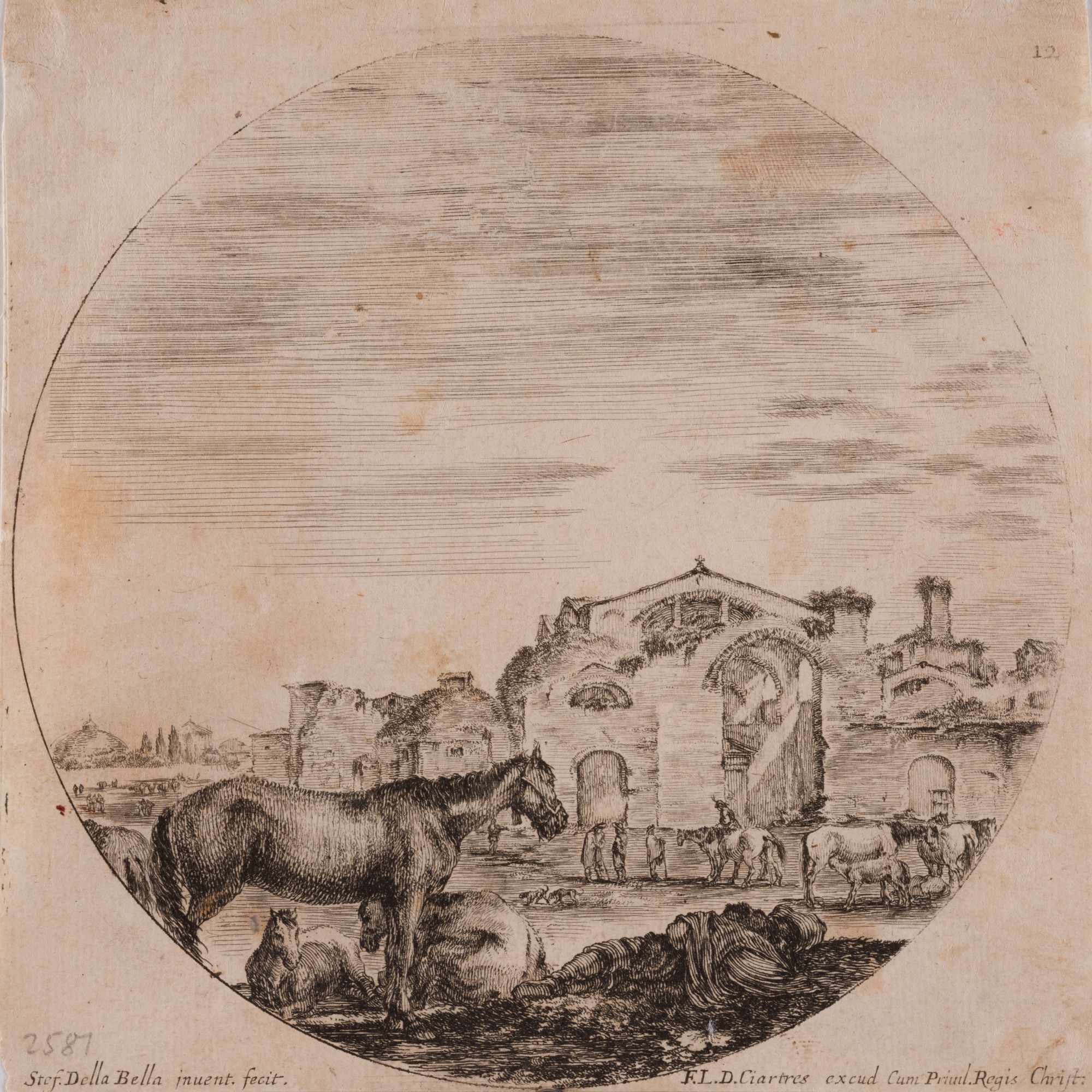
Ruins of the Baths of Diocletian with a Sleeping Shepherd. From the "Round Landscapes" or "Roman Landscapes and Ruins" Series, Plate 12
Stefano della Bella
Basic information
- ID
- Г-IV-924
- Author
- Stefano della Bella
- Name
- Ruins of the Baths of Diocletian with a Sleeping Shepherd. From the "Round Landscapes" or "Roman Landscapes and Ruins" Series, Plate 12
- Country
- France
- Technique
- etching
- Material
- paper
- Dimensions
- 13.5 x 13.5 cm (height x width)
Additionally
- Type
- graphic art
- Genre
- architectural landscape animal painting
- Provenance
- Received from the Lviv Historical Museum, 1954
Information about author
Object description
The work comes from the "Round Landscapes" series, created by the artist in Paris around 1646. The series consists of 13 prints. In many catalogued descriptions, the work appears as a piece from the "Roman Landscapes and Ruins" ("Paysages et ruines de Rome") series, plate 12. The publisher of this series of prints was François Langlois (1589–1647), known as Ciartres or Chartres. He is considered the first prominent publisher of the French Baroque era.
The print has the shape of a tondo – an experimental format characteristic of della Bella.
In the foreground, a horse is depicted in detail, standing and turned in profile to the left. Nearby, other horses are resting. On the right, a shepherd covered with a cloak is sleeping on the ground. In the middle ground, the half-ruined majestic arches of the ancient Baths of the Emperor Diocletian in Rome are depicted. These enormous baths were built at the beginning of the 4th century AD and were completely reduced to ruins at the end of the 16th century. In the print, the space around the ancient walls is inhabited by ordinary people. Small figures of townspeople and drovers are depicted pasturing livestock right among the ruins of the once grand architectural complex. The upper half of the composition is occupied by the sky, executed in fine parallel horizontal hatched lines that convey soft, diffused light.
This work is a classic example of the capriccio genre and pastoral landscape. Stefano della Bella combines two cardinally different aesthetics here: the documentarily accurate reproduction of ancient Roman architecture and the fictional, idyllic everyday life of ordinary Romans.
Inscriptions
At the bottom of the print on the left: "Stef. Della Bella inuent. fecit.", on the right: "F. L. D. Ciartres excud Сum Priuil. Regis Chrіst." – [François Langlois, known as Ciartres, published with Royal privilege]. Top right on the sheet: "12". In pencil at the bottom left: "2587". On the mounting cardboard on the left under the sheet, there is a sticker with the stamp of Lviv Historical Museum funds and the former inventory number of the engraving in ink: "Г-4690/53", above it in pencil, the current gallery collection number: "№ Г-IV-924/ ЛДКГ". Pencil marks on the mounting cardboard: on the left near the bottom corner of the engraving sheet – "99", on the right – "56".
Legal regulation
Borys Voznytskyi Lviv National Art Gallery