Virgin Mary with Symbols of Litany of Loreto
unknown
Basic information
Additionally
- Type
- icon sculpture (high relief)
- Genre
- religious
- Plot
- Virgin Mary
- Provenance
- Museum of Jan III Sobieski in Lviv
Information about author
Object description
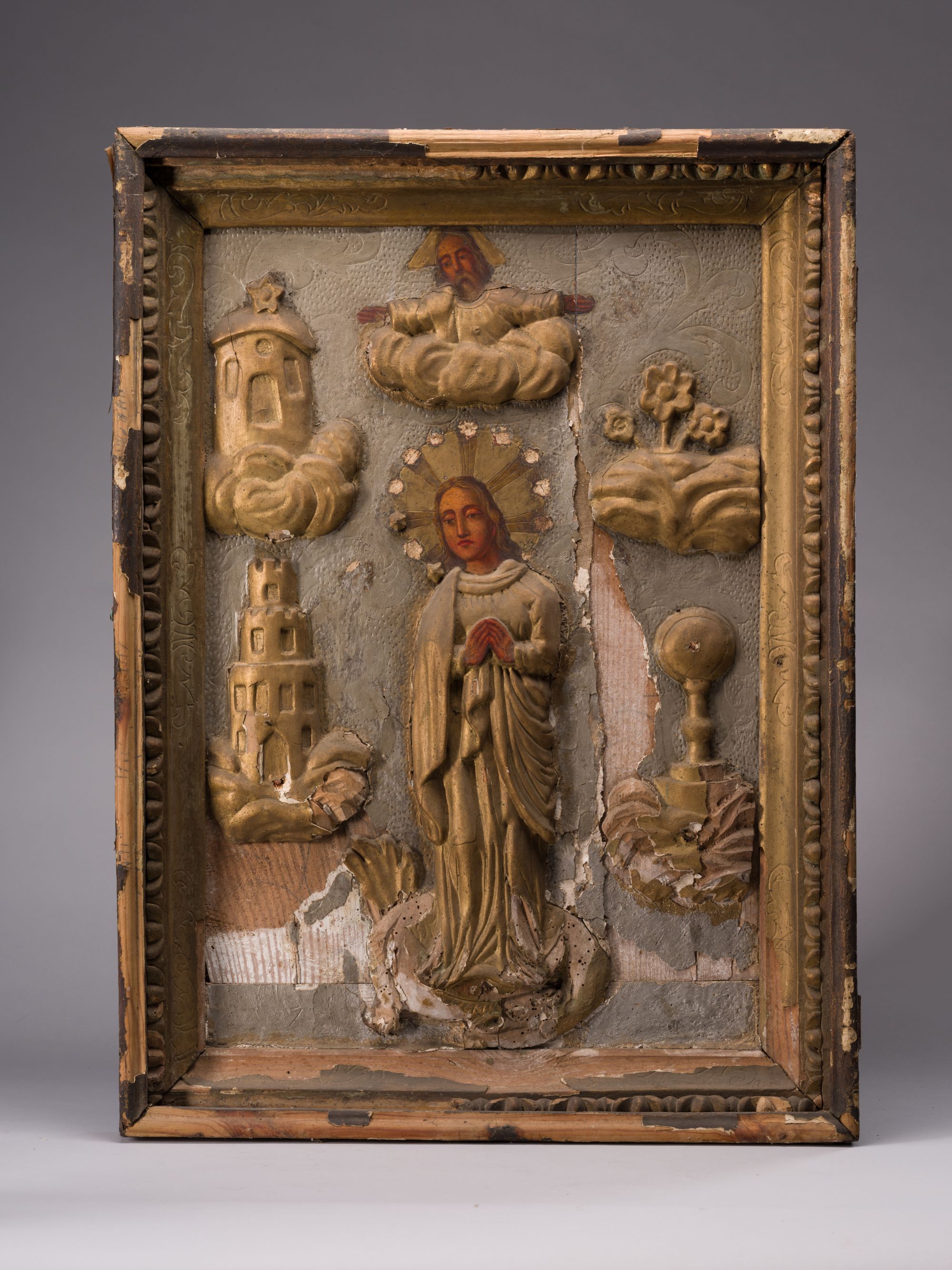
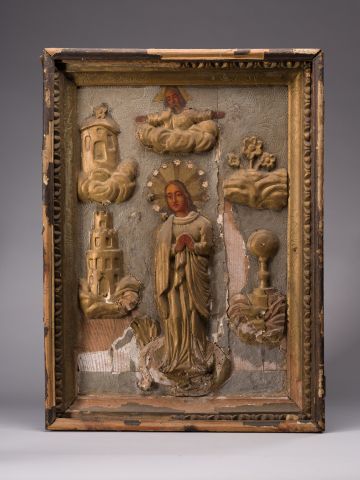
A carved iconographic image of the Mother of God is presented on a rectangular plane. Golden silhouettes seem to emerge from a silvery background. The centre of the compositional solution is a relief image of the Blessed Virgin, around whom four symbols are symmetrically arranged on clouds. At the top, God the Father appears from the clouds. All elements are directed towards the central figure. The Virgin Mary is represented in golden attire, her hands are prayerfully folded on her chest, and her head is surrounded by a halo of rays, framed by twelve stars. This is a direct echo of the apocalyptic image of the "Woman clothed with the sun, with a crown of twelve stars". The figure is elongated, calm, almost incorporeal. The drapery folds are modelled with restraint, using soft diagonal and vertical lines that fall heavily to the bottom. The subtle modelling of the draperies transitions from soft highlights to deep shadows. The complex relief creates a play of light and shadow that changes depending on the viewing angle. The face and hands are highlighted with polychromy. On the warm carnation of the face, the dark arches of the eyebrows, large almond-shaped eyes covered by eyelids with a downcast gaze, and tiny lips clearly stand out. Attention is focused precisely on the face; it is the only living element, expressing detachment and humility within the general golden glow.
The image of the Mother of God is characteristic of the iconographic type of the Immaculate Conception (Immaculata), widespread in Catholic Baroque art, while the carved objects around point to the symbols from the Litany of Loreto. The Blessed Virgin is surrounded by attributes symbolising her virtues and titles: a rose, a tower, a mirror, etc. These symbols, taken from biblical metaphors, emphasise the role of the Virgin Mary as the Mother of God, Intercessor, and Queen. Characterised images are found in the form of stained glass windows, paintings, or icons, where the Mother of God is in the centre, and the aforementioned symbols known from the Litany of Loreto are depicted around her in medallions or separate scenes, which during the Baroque period turned into a visual vocabulary of the purity and chosenness of the Virgin Mary. In the clouds, above the figure of the Mother of God, there is an image of God the Father with a triangular halo, acting as a sign of the Trinity. The presence of God in the image lends a Trinitarian dimension to the scene: the Virgin Mary appears chosen and crowned by heaven.
The viewer's gaze moves from the Blessed Virgin upwards to the Creator, and then along the symbols in a circle. This is not a narrative scene, but a theological schema, an iconographic table of titles from the Litany of the Mother of God. The Litany of Loreto to the Blessed Virgin Mary is a song of praise listing a series of symbolic addresses and titles that describe the virtues of the Mother of God, her role in salvation, and her connection with God. The symbols have deep theological roots, linking Old Testament imagery with New Testament teaching. Four of the key symbols are presented on both sides of the figure of the Mother of God:
- Tower of David – emphasises the closeness of the Mother of God to God and her humility. The Blessed Virgin is not a proud worldly tower, but a "humble tower", which constitutes her strength against the attacks of the evil one;
- Tower of Ivory – this address to the Mother of God emphasises her beauty, uniqueness, and primarily the fact that she carried the most precious treasure – Christ – under her heart;
- Mystical Rose – symbolises the beauty of the soul of the Blessed Virgin, her spiritual life, and her virtues. Faithfulness and deep love make the Virgin Mary a Rose that does not wither under the weight of pain but shines with even greater beauty. A rose without thorns is a beauty that is the result of divine action;
- Mirror of Justice – in the Old Testament, justice is synonymous with holiness. In the Litany, this indicates that the Virgin Mary is a reflection of the justice of God Himself.
The framing of the icon, which forms a deep protrusion, also deserves attention. The carving does not lie on the plane; it seems recessed, possessing its own space and chiaroscuro transitions. The profiled frame with a pearl and egg-shaped ornamental frieze enhances the sense of sacredness. It creates a scenic effect, where the figures rise above the background like a small theatrical decoration. For the folk provincial Baroque of Ukraine, this is a typical practice of combining carving, painting, and gold to achieve a "precious" effect from modest resources. Significant losses of coating, chips, and darkening do not interfere with the perception of the image but lend authenticity and the depth of time. The compact, small-sized image has combined a high theological programme with the skill of a provincial carver. It shows how Western iconographic motifs are interpreted in the Ukrainian artistic environment, acquiring a special warmth and poetic naivety.
Legal regulation
Borys Voznytskyi Lviv National Art Gallery