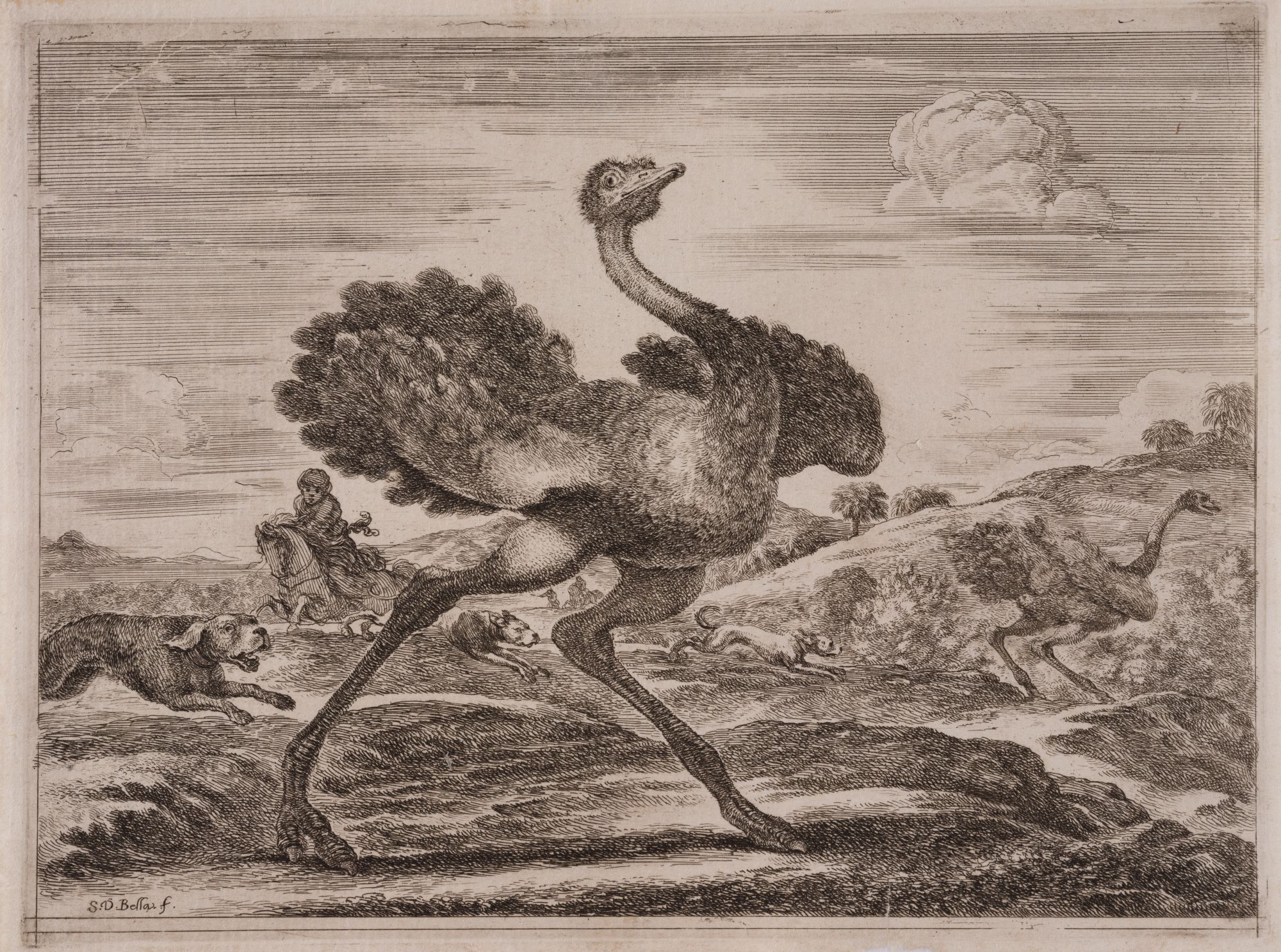
Ostrich Hunt. From the "Animal Hunts" Series
Stefano della Bella
Basic information
- ID
- Г-IV-929
- Author
- Stefano della Bella
- Name
- Ostrich Hunt. From the "Animal Hunts" Series
- Country
- Italy
- Technique
- etching
- Material
- paper
- Dimensions
- 16.5 x 22.8 cm (height x width)
Additionally
- Type
- graphic art
- Genre
- animal painting
- Provenance
- Received from the Lviv Historical Museum, 1954
Information about author
Object description
The work is part of the "Animal Hunts" series (French: "Chasses à différents animaux", Italian: "Cacce di diversi animali"), which consists of nine prints. The author created it shortly after returning to Florence from Paris.
The main space of the composition is occupied by an image of an African ostrich running swiftly to escape its pursuers. The artist details the bird's anatomy – its powerful legs, elongated neck, and the lush, textured plumage of its wings and tail. To the left of the bird, an infuriated hound rushes, catching up with the prey. In the background, a rider on horseback and two hounds are depicted pursuing a second ostrich shown on the right. The space grows in depth thanks to a multi-layered landscape: from the detailed rocky ground in the foreground to the soft hills, trees, and cloudy sky in the distance.
Through the refined mastery of etching the metal plate, the artist imitates various materials: the soft, fluffy feathers of the ostrich, the short coat of the hounds, the folds of the rider's clothing, and the rough surface of the ground.
In the 17th century, there was significant interest in Europe in distant lands and exotic fauna. Artists created series of works demonstrating the hunting of animals and birds unusual for Europeans, satisfying the curiosity of the public of that time. Large flightless birds were considered symbols of overseas countries – Africa and the Middle East. Their feathers were highly valued by the European aristocracy as a luxurious decoration for hats and interiors.
Inscriptions
At the bottom of the print on the left, the author's signature: "S. D. Bella f.".
Legal regulation
Borys Voznytskyi Lviv National Art Gallery