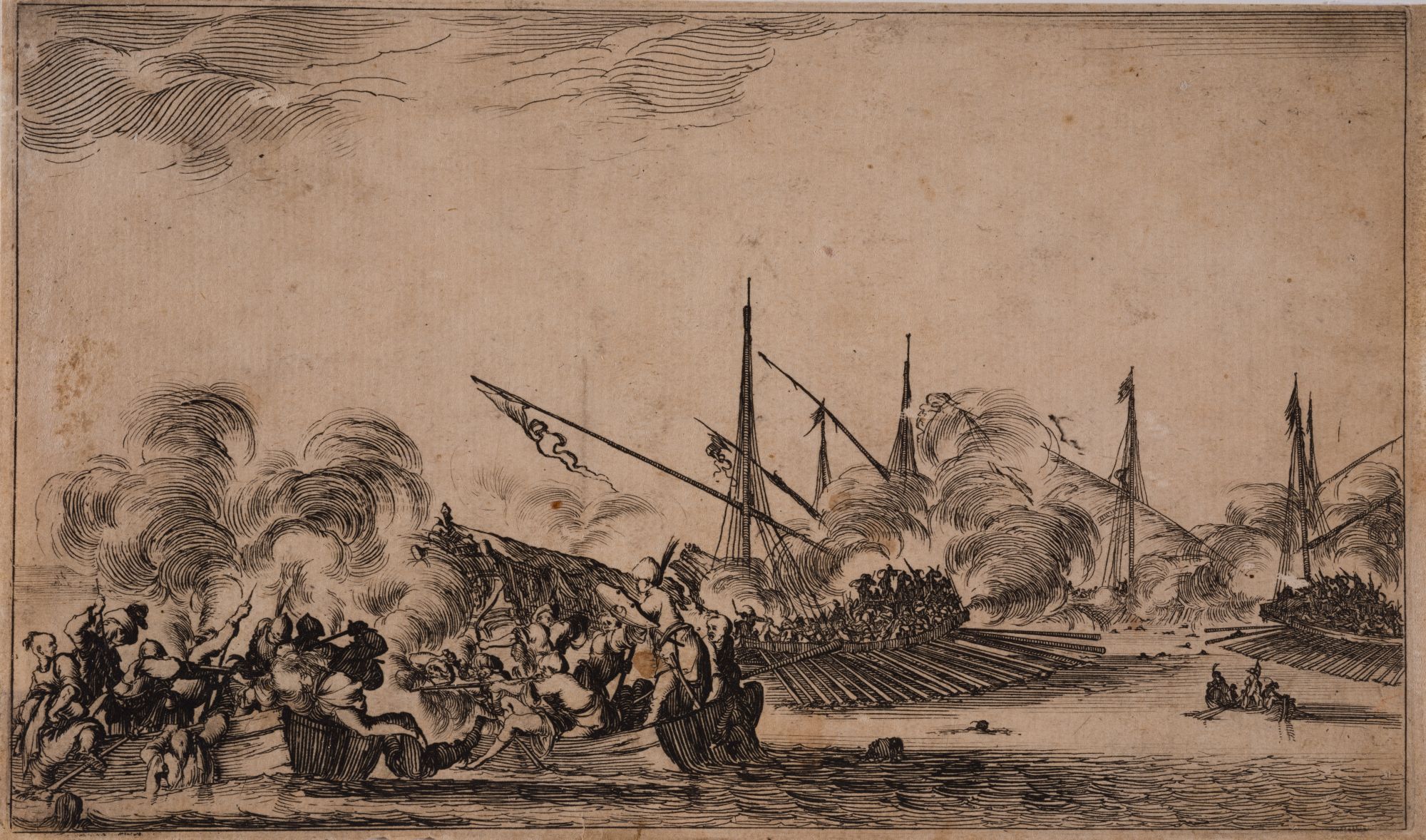
Battle Between Several Boats and Galleys. From the "Various Landscapes" Series or the "Set of Eight Nautical Landscapes" (Suite de huit Marines) Series
Stefano della Bella
Basic information
- ID
- Г-IV-937
- Author
- Stefano della Bella
- Name
- Battle Between Several Boats and Galleys. From the "Various Landscapes" Series or the "Set of Eight Nautical Landscapes" (Suite de huit Marines) Series
- Date of creation
- 1634 (according to other data – c. 1641)
- Technique
- etching
- Material
- paper
- Dimensions
- 12.3 x 20.8 cm (height x width)
Additionally
- Type
- graphic art
- Genre
- battle painting marine painting
- Plot
- Battle
- Provenance
- Received from the Lviv Historical Museum, 1954
Information about author
Object description
In a generalised allegorical form, a naval battle between Europeans and representatives of the Ottoman Empire – either the Turkish fleet or Barbary pirates – is depicted.
The composition presents a dynamic and intense naval battle. In the foreground on the left, several large rowing boats are shown, overflowing with armed warriors. They are engaged in close combat, firing muskets, raising weapons, and actively manoeuvring with oars. The central part of the composition is filled with thick clouds of gunpowder smoke, through which the masts of large military sailing ships can be discerned. In the background on the right, another military galley is visible, participating in manoeuvres or retreating from the site of the main clash. The composition is saturated with movement: the turbulent sea and sky, heavy with clouds and smoke, emphasise the chaos and drama of the battle.
The work demonstrates the expression characteristic of the artist, exquisite linework, and masterly modelling of space through the use of chiaroscuro and smoke effects.
Inscriptions
At the bottom of the backing cardboard from left to right in pencil: "84", "2641", "№ Г-IV-937", and "133".
Legal regulation
Borys Voznytskyi Lviv National Art Gallery