Back

Galley Arriving in Port, or Galley Full of People. From the "Various Landscapes" Series or the "Set of Eight Nautical Landscapes" (Suite de huit Marines) Series

Stefano della Bella
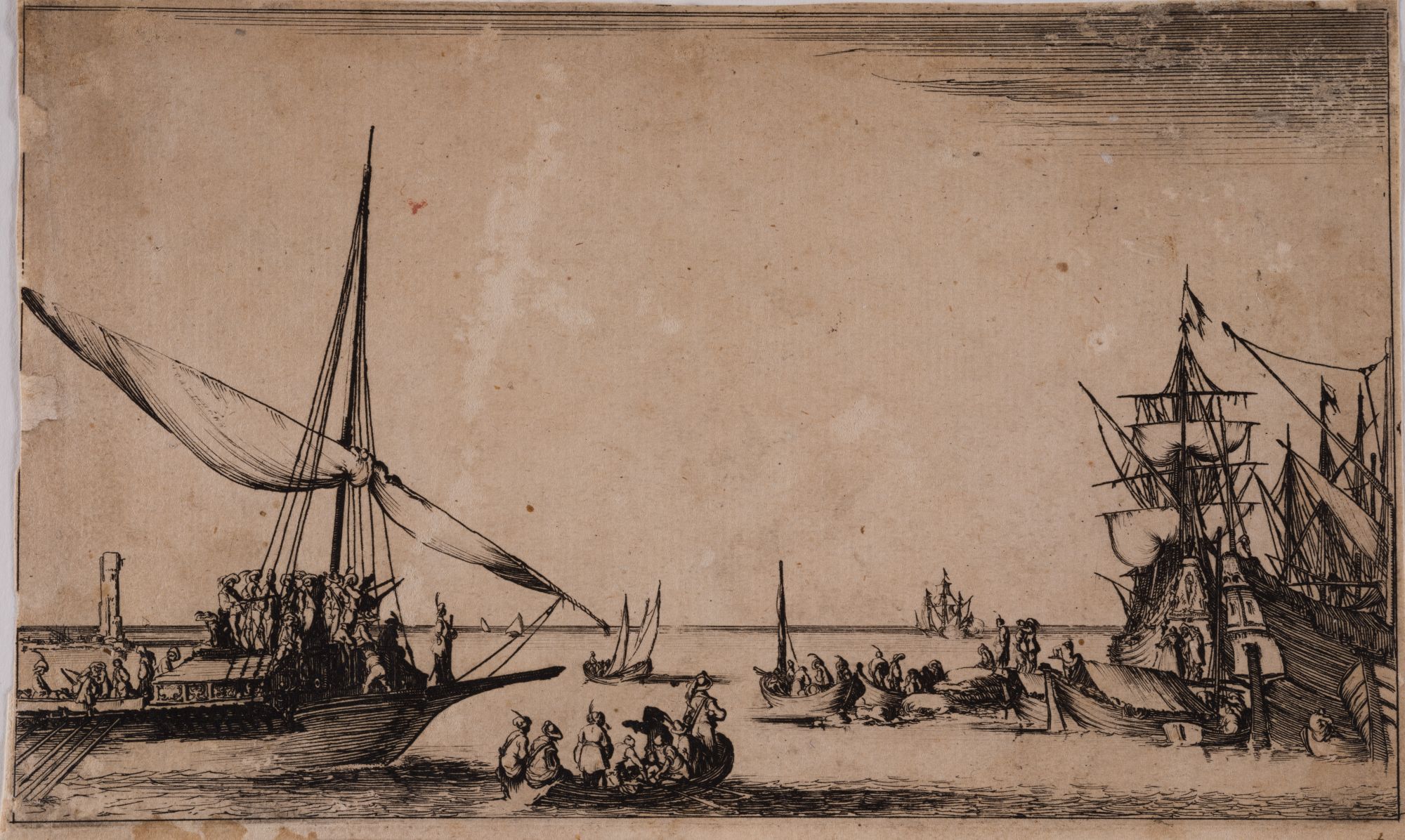
  • Galley Arriving in Port, or Galley Full of People. From the "Various Landscapes" Series or the "Set of Eight Nautical Landscapes" (Suite de huit Marines) Series
Basic information
ID
Г-IV-938
Author
Stefano della Bella
Name
Galley Arriving in Port, or Galley Full of People. From the "Various Landscapes" Series or the "Set of Eight Nautical Landscapes" (Suite de huit Marines) Series
Country
Italy
Technique
etching
Material
paper
Dimensions
12.3 x 20.7 cm (height x width)
Information about author
Author
Stefano della Bella
Author in the original
Stefano della Bella
Artist's lifetime
1610–1644
Country
Italy
Biography
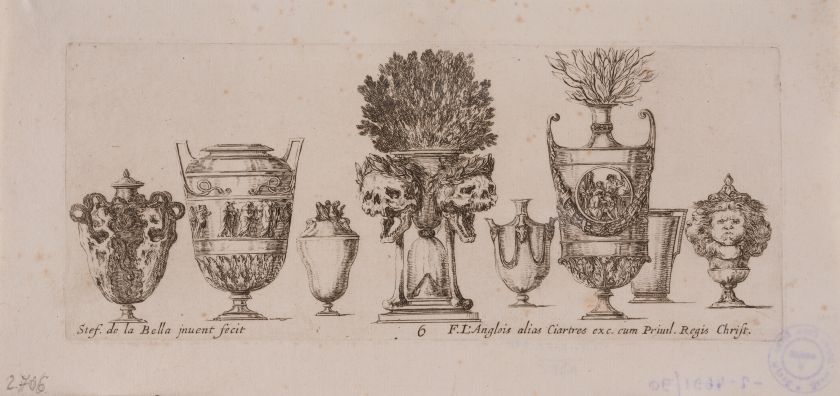
Stefano della Bella (Italian: Stefano della Bella; 1610, Florence – 1664, ibid.). A prominent Italian artist, engraver and etcher of the Early Baroque period, Stefano della Bella was one of the most prolific European printmakers of the 17th century. Following the untimely death of his father, the youth began training in a goldsmith's workshop. Around 1623, he moved to the workshop of the engraver Orazio Vanni, where he mastered the basic techniques of printmaking. Later, he refined his etching technique in the workshop of Remigio Cantagallina – the mentor of the famous French master Jacques Callot. Copying Callot's works significantly influenced the formation of della Bella's own refined artistic style.
During this same period, the artist secured the patronage of the Medici family, who supported him throughout his life. In 1633–1639, funded by his primary patron, Prince Lorenzo de' Medici (uncle of Ferdinand de' Medici, Grand Duke of Tuscany), the artist lived and studied in Rome. There, he immediately received major commissions and made numerous sketches of park ensembles, villas, palaces and ancient ruins, which he later incorporated into his engravings.In Rome, della Bella met the French printmakers Israel Henriet and François Langlois, thanks to whom he moved to Paris in 1639. In France, the artist quickly achieved immense popularity, establishing close and successful collaborations with them, as well as with the leading Parisian publisher Pierre Mariette. His etchings were in high demand among European collectors. In 1650, due to anti-Italian unrest in France (the Fronde), the engraver returned to his native Florence. During this late period, he significantly diversified his favourite themes, creating a series of hunting scenes, landscapes with Roman ruins and detailed depictions of horsemen.
Over his lifetime, Stefano della Bella created more than a thousand unique etchings and thousands of drawings. He worked across battle, landscape, animal, ornamental and genre scenes, capturing the events of his time with documentary precision – from the lavish theatrical pageants of the Florentine nobility to the harsh realities of the Thirty Years' War and the everyday street life of European cities. He became famous for his jewelry-fine, filigree-detailed miniature works.
Object description
The work belongs to a series dedicated to seascapes and inspired by views of the Tuscan port of Livorno. In the foreground on the left, a large galley entering the harbour dominates the scene. A multi-figure group of passengers preparing to disembark is depicted on its deck and bridge. Near the galley, in the centre of the composition, there is a boat into which people have already transferred. On the right, three-masted sailing ships are shown with boats clustered around them. In the distance, on the horizon line, another sailing vessel is visible.
The artist employs laconic strokes, leaving open space for the sky and water. This creates an effect of filling the composition with air and light, which is a characteristic sign of the influence of the prominent French engraver Jacques Callot on the young artist.
Inscriptions
At the bottom of the backing cardboard from left to right in pencil: "83", "2640", "№ Г-IV-938" and "132".
Legal regulation
Borys Voznytskyi Lviv National Art Gallery
Link copied