Before Embarking on Galley. From the "Various Landscapes" Series or the "Set of Eight Nautical Landscapes" (Suite de huit Marines) Series
Stefano della Bella
Basic information
- ID
- Г-IV-939
- Author
- Stefano della Bella
- Name
- Before Embarking on Galley. From the "Various Landscapes" Series or the "Set of Eight Nautical Landscapes" (Suite de huit Marines) Series
- Country
- Italy
- Technique
- etching
- Material
- paper
- Dimensions
- 12 x 20 cm (height x width)
Additionally
- Type
- graphic art
- Genre
- marine painting
- Provenance
- Received from the Lviv Historical Museum, 1954
Information about author
Object description
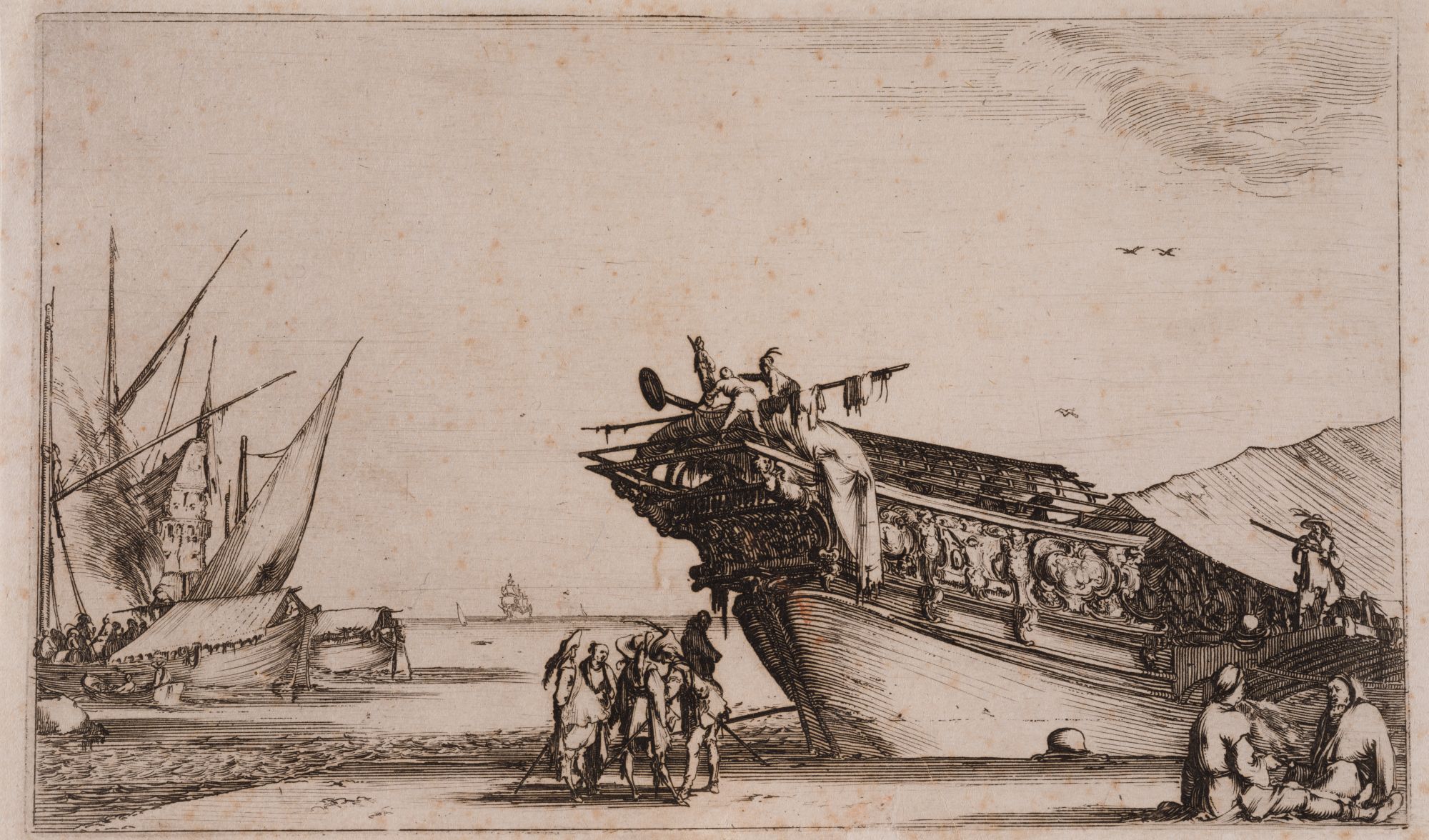
The work belongs to a series dedicated to seascapes and inspired by views of the Tuscan port of Livorno. In the foreground on the left, a large galley, shown from the stern and moored in the harbour, dominates the scene. The stern is exquisitely decorated with relief patterns, where two figures are securing the rigging. On the right, a soldier with a musket is depicted on the quarterdeck. In the centre, a group of figures in contemporary European and Oriental attire are represented on the shore, engaged in a lively conversation. In the lower right corner, two men are resting directly on the ground. Also on the right, boats with people on board are depicted. Behind their sails, the Torre del Marzocco tower in Livorno is visible, which served as an important defensive structure and a signaling beacon at the entrance to the harbour. In the background, a boundless marine expanse unfolds with barely perceptible silhouettes of other ships beneath a low, cloudy sky.
Stefano della Bella demonstrates high mastery in rendering minute details through fine linear and cross-hatching strokes: the texture of the wood, the relief of the carving, the drapery of the garments, and the lightness of the sea air. Through the distribution of light and shade, a deep perspective is created, capturing the genuine atmosphere of seventeenth-century port life.
Stefano della Bella demonstrates high mastery in rendering minute details through fine linear and cross-hatching strokes: the texture of the wood, the relief of the carving, the drapery of the garments, and the lightness of the sea air. Through the distribution of light and shade, a deep perspective is created, capturing the genuine atmosphere of seventeenth-century port life.
Inscriptions
At the bottom of the backing cardboard, the inventory numbers of the work are marked in pencil.
Legal regulation
Borys Voznytskyi Lviv National Art Gallery